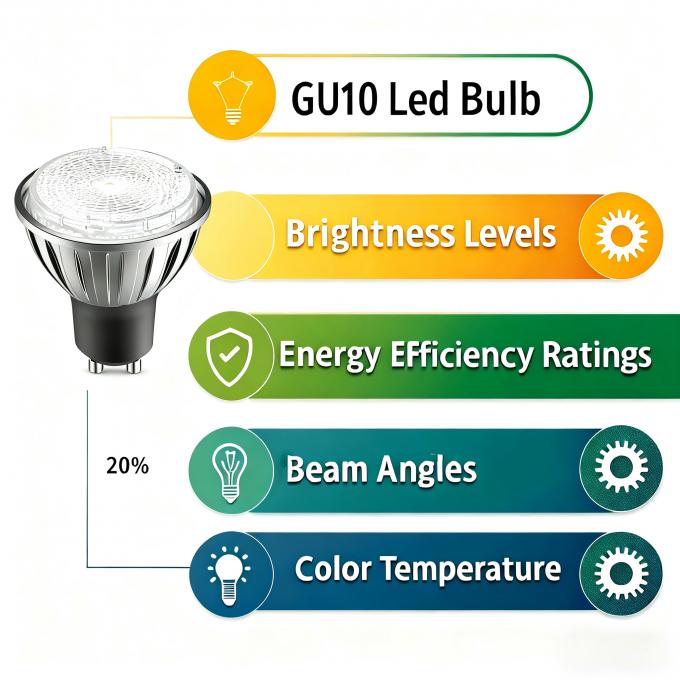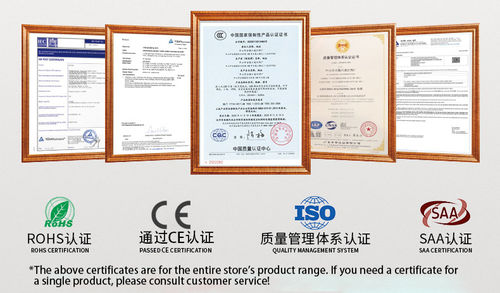
Huizhou Henhui Electronics Technology Co., Ltd.

分类: 未分类

  • Energy Label 2.0: Understanding the New Efficiency Standards for Light

    Energy Label 2.0: Understanding the New Efficiency Standards for Light

    /* Unique root container for style isolation */
    .gtr-container-e7f8g9h0 {
    font-family: Verdana, Helvetica, “Times New Roman”, Arial, sans-serif;
    color: #333;
    line-height: 1.6;
    padding: 20px;
    max-width: 960px;
    margin: 0 auto;
    box-sizing: border-box;
    }

    /* Typography and Text Alignment */
    .gtr-container-e7f8g9h0 p {
        font-size: 14px;
        margin-bottom: 1em;
        text-align: left !important;
    }
    
    .gtr-container-e7f8g9h0 strong {
        font-weight: bold;
    }
    
    .gtr-container-e7f8g9h0 em {
        font-style: italic;
    }
    
    .gtr-container-e7f8g9h0 a {
        color: #007bff;
        text-decoration: none;
    }
    
    .gtr-container-e7f8g9h0 a:hover {
        text-decoration: underline;
    }
    
    /* Headings */
    .gtr-container-e7f8g9h0 .gtr-main-title {
        font-size: 18px;
        font-weight: bold;
        margin-bottom: 1.5em;
        color: #0056b3;
        text-align: left;
    }
    
    .gtr-container-e7f8g9h0 .gtr-section-title {
        font-size: 18px;
        font-weight: bold;
        margin-top: 2em;
        margin-bottom: 1em;
        color: #0056b3;
        text-align: left;
    }
    
    .gtr-container-e7f8g9h0 .gtr-subsection-title {
        font-size: 16px;
        font-weight: bold;
        margin-top: 1.5em;
        margin-bottom: 0.8em;
        color: #0056b3;
        text-align: left;
    }
    
    /* Separator */
    .gtr-container-e7f8g9h0 .gtr-separator {
        border: none;
        border-top: 1px solid #eee;
        margin: 2em 0;
    }
    
    /* Blockquote */
    .gtr-container-e7f8g9h0 blockquote {
        border-left: 4px solid #007bff;
        padding: 10px 20px;
        margin: 1.5em 0;
        background-color: #f8f9fa;
        font-style: italic;
        color: #555;
    }
    
    /* Tables */
    .gtr-container-e7f8g9h0 .gtr-table-wrapper {
        width: 100%;
        overflow-x: auto;
        margin: 1.5em 0;
    }
    
    .gtr-container-e7f8g9h0 table {
        width: 100%;
        border-collapse: collapse !important;
        border-spacing: 0 !important;
        margin: 0 !important;
        font-size: 14px;
        min-width: 600px; /* Ensure horizontal scroll on small screens if content is wide */
    }
    
    .gtr-container-e7f8g9h0 th,
    .gtr-container-e7f8g9h0 td {
        border: 1px solid #ccc !important;
        padding: 10px !important;
        text-align: left !important;
        vertical-align: top !important;
        word-break: normal; /* Prevent breaking words */
        overflow-wrap: normal; /* Prevent breaking words */
    }
    
    .gtr-container-e7f8g9h0 th {
        font-weight: bold !important;
        background-color: #e9ecef;
        color: #333;
    }
    
    .gtr-container-e7f8g9h0 tbody tr:nth-child(even) {
        background-color: #f2f2f2;
    }
    
    /* Lists */
    .gtr-container-e7f8g9h0 ul,
    .gtr-container-e7f8g9h0 ol {
        list-style: none !important;
        padding-left: 0;
        margin-left: 0;
        margin-bottom: 1em;
    }
    
    .gtr-container-e7f8g9h0 li {
    position: relative;
        padding-left: 25px;
        margin-bottom: 0.5em;
        text-align: left;
    list-style: none !important;
    

    }

    .gtr-container-e7f8g9h0 ul li::before {
        content: "•" !important;
        position: absolute !important;
        left: 0 !important;
        color: #007bff;
        font-size: 1.2em;
        line-height: 1;
        top: 0;
    }
    
    .gtr-container-e7f8g9h0 ol li::before {
        content: counter(list-item) "." !important;
        position: absolute !important;
        left: 0 !important;
        width: 20px;
        text-align: right;
        color: #007bff;
        font-weight: bold;
        top: 0;
    }
    
    /* Call to Action */
    .gtr-container-e7f8g9h0 .gtr-call-to-action {
        margin-top: 2em;
        padding: 20px;
        border: 1px solid #007bff;
        text-align: center;
        background-color: #eaf5ff;
    }
    
    .gtr-container-e7f8g9h0 .gtr-call-to-action p {
        margin-bottom: 1em;
    }
    
    .gtr-container-e7f8g9h0 .gtr-call-to-action .gtr-button {
        display: inline-block;
        padding: 10px 20px;
        background-color: #007bff;
        color: #fff;
        text-decoration: none;
        border-radius: 4px;
        font-weight: bold;
        transition: background-color 0.3s ease;
    }
    
    .gtr-container-e7f8g9h0 .gtr-call-to-action .gtr-button:hover {
        background-color: #0056b3;
        text-decoration: none;
    }
    
    /* Responsive adjustments for PC */
    @media (min-width: 768px) {
        .gtr-container-e7f8g9h0 {
            padding: 40px;
        }
    
        .gtr-container-e7f8g9h0 .gtr-main-title {
            font-size: 24px;
        }
    
        .gtr-container-e7f8g9h0 .gtr-section-title {
            font-size: 20px;
        }
    
        .gtr-container-e7f8g9h0 .gtr-subsection-title {
            font-size: 18px;
        }
    
        .gtr-container-e7f8g9h0 table {
            min-width: auto; /* Allow table to shrink if content fits */
        }
    }
    

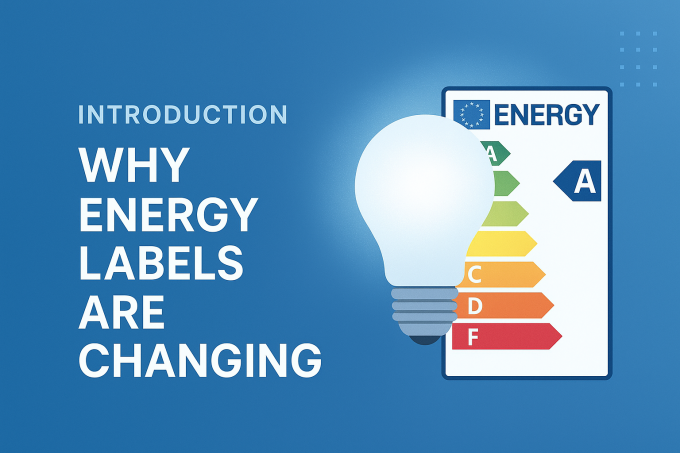
    Introduction: Why Energy Labels Are Changing
    Energy Label 2.0: Understanding the New Efficiency Standards for Light  0

    In 2021, the European Union introduced a major revision to its energy labeling system for lighting products — commonly known as Energy Label 2.0. This update, which officially came into force under Regulation (EU) 2019/2015 and Delegated Regulation (EU) 2019/2015, completely reshaped how energy efficiency is measured and displayed on lighting products sold in Europe.

    For B2B lighting manufacturers, importers, and distributors, understanding Energy Label 2.0 isn’t just a compliance issue — it’s a competitive advantage. The new framework rewards true efficiency, transparency, and innovation.

    If you manufacture or distribute GU10, MR16, or AR111 LED bulbs, these changes directly affect how your products are tested, labeled, and marketed across the EU and U.K.

    What Is Energy Label 2.0?

    Energy Label 2.0 is the new version of the EU energy efficiency label designed to help consumers and professionals compare products more easily. The key change is a return to the simple A–G scale, removing the confusing “A++” and “A+++” grades introduced under the previous directive.

    “The rescaled label will leave the top A class empty at first to encourage further technological progress,” explains the European Commission (source).

    The update applies to all light sources placed on the EU market — including LED bulbs, integrated luminaires, and spotlights.

    Why the Change?

    Between 2010 and 2020, LED technology improved dramatically. Most modern LEDs achieved A+ or A++ ratings under the old system, leaving little room for differentiation. As a result, the label lost its usefulness to both buyers and policymakers.

    Energy Label 2.0 aims to:

    • Rebalance efficiency ratings to reflect current LED performance.

    • Promote innovation by reserving Class A for future products.

    • Simplify consumer understanding of energy efficiency.

    • Enhance transparency with scannable QR codes linking to official product data.

    This reform aligns lighting with the EU’s broader sustainability goals under the European Green Deal and Ecodesign Directive.

    The New A–G Efficiency Scale

    The new label uses a linear energy efficiency index (EEI) to calculate a lamp’s performance based on luminous flux (lumens) and power input (watts).

    Class Efficiency Index (EEI) Description Example (typical LED)
    A EEI < 0.10 Best available tech (future-proof) Very few products (top 1–2 %)
    B 0.10 ≤ EEI < 0.125 Excellent efficiency Premium LED modules
    C 0.125 ≤ EEI < 0.150 Above average Most current high-quality LEDs
    D 0.150 ≤ EEI < 0.200 Average efficiency Mid-range LEDs
    E–G EEI ≥ 0.200 Low efficiency Legacy products, CFLs, halogens

    According to the LightingEurope position paper (2021), “A luminaire that was previously A++ might now fall into Class C under the new scale.” (LightingEurope)

    This doesn’t mean the product became less efficient — the scale was tightened to future-proof the labeling system.

    QR Codes and the EPREL Database

    One of the most visible changes under Energy Label 2.0 is the QR code printed on every packaging label. Scanning this code links directly to the product’s technical file stored in the European Product Registry for Energy Labelling (EPREL).

    The EPREL database provides:

    • Verified energy performance data (luminous flux, lifetime, CRI, power factor, etc.)

    • Regulatory documentation and testing results.

    • Traceability for authorities and B2B buyers.

    Manufacturers are legally required to upload this data before placing the product on the EU market.
    (European Commission EPREL portal)

    This transparency benefits both compliance officers and procurement teams, who can now verify efficiency claims directly from the EU’s official registry.

    Impact on Common LED Bulb Types (GU10, MR16, AR111)

    The most common LED retrofit bulbs — GU10, MR16, and AR111 — are heavily affected by the rescale. Under the new system, even premium bulbs that achieved A++ ratings previously may now appear as Class C or D.

    Bulb Type Typical Power (W) Luminous Flux (lm) Typical New Rating Old Rating Equivalent
    GU10 5 W LED 5 W 350–400 lm Class C–D A++
    MR16 6 W LED 6 W 450–500 lm Class C A+
    AR111 15 W LED 15 W 1,200–1,500 lm Class B–C A++

    (Data compiled from product listings of Signify, Osram, and Tecolite sample tests, 2024.)

    This “downgrading” can surprise buyers if not properly communicated. It’s essential for brands to educate customers that the new label doesn’t mean poorer performance — it reflects the stricter 2021 standards.

    Testing and Compliance: What Manufacturers Need to Do

    To comply with Energy Label 2.0, manufacturers and importers must perform the following steps before launching or re-certifying products:

    • Test the product using harmonized standards such as EN 15193-1 and IEC 62612 for LED lamps.

    Calculate the EEI based on total power and measured light output.

    • Register the product in the EPREL database and upload supporting test data.

    Print the new label with:

    A–G rating

    • QR code

    • Energy consumption per 1,000 hours (kWh/1000 h)

    Remove outdated labels (A+++, A++, A+) from packaging or websites after the transition deadline.

    The European Commission set the transition period to end in March 2023, after which non-compliant labels are prohibited. (European Commission, 2023 guidance)

    Broader Market Implications for B2B Buyers

    For distributors and project specifiers, Energy Label 2.0 brings greater clarity — but also a need to retrain sales teams and update catalogs.

    Key Business Impacts

    • Product portfolio alignment: Some SKUs may need retesting or redesign to reach Class B or C.

    • Marketing updates: Visual labels and datasheets must be refreshed to avoid misleading efficiency claims.

    • Procurement transparency: Buyers can verify claims through EPREL, fostering fair competition.

    • Market differentiation: Brands with higher-class LEDs (Class B or better) will stand out.

    • End-user confidence: Clearer, simpler labels help reduce confusion and improve purchase trust.

    EU Ecodesign Requirements Working Alongside Label 2.0

    Energy Label 2.0 works hand-in-hand with the Ecodesign Regulation (EU 2019/2020), which defines minimum performance thresholds for products to enter the EU market.

    This regulation sets requirements on:

    • Efficacy (lm/W)

    • Power factor

    • Lifetime (L70 ≥ 50,000 h typical)

    • Flicker and stroboscopic effects

    • Standby and network power consumption

    According to the European Commission, these combined measures will “save the equivalent of 150 TWh of electricity annually by 2030 — roughly equal to the annual consumption of Sweden.” (EU Commission energy efficiency statement, 2021)

    This underscores the strategic intent: energy labels are not just marketing tools, but policy instruments driving measurable reductions in energy use and emissions.

    Comparing Old vs. New Label Design

    Feature Old Label (pre-2021) New Label (Energy Label 2.0)
    Rating Scale A+++ to E A to G
    Database Connection None Linked via QR to EPREL
    Information Format Luminous flux & power Luminous flux, power, energy consumption per 1,000 h
    Scope Lamps & luminaires separately All light sources combined
    Purpose Promote efficiency Simplify understanding & drive innovation

    New labels must follow a standardized format and include a QR code on the top right corner, an A–G bar scale, and energy usage metrics below.

    How Tecolite and Other Manufacturers Are Adapting

    At Tecolite, as a specialized LED bulb manufacturer focused on GU10, MR16, and AR111 product lines, adapting to the new standard meant re-engineering optical and electrical designs to achieve higher efficacy per watt while maintaining color quality (CRI ≥ 90) and beam precision.

    Key initiatives include:

    • Upgrading driver ICs for >90% efficiency and lower thermal loss.

    • Optimizing aluminum and ceramic housings to enhance heat dissipation (reducing junction temperature by 8–10 °C).

    • Conducting independent photometric testing under accredited EN IEC 62612 labs.

    • Registering all models under EPREL, ensuring transparency and traceability for European distributors.

    By taking these steps early, Tecolite ensures full compliance and strengthens its position as a trusted OEM partner for energy-efficient lighting.

    Practical Tips for Distributors and OEM Buyers

    If you distribute or private-label LED bulbs, here’s what you should do:

    • Verify EPREL entries: Check the QR code and verify your supplier’s registration.

    • Align marketing materials: Ensure packaging, datasheets, and website visuals display the correct A–G label.

    • Reassess your portfolio: Prioritize bulbs rated Class B or C to stay competitive in tenders and green-procurement programs.

    • Educate your customers: Train sales reps and installers to explain that “C” today is equivalent to “A++” before.

    • Leverage sustainability messaging: Highlight reduced lifecycle cost and environmental impact in your proposals.

    The U.K. Perspective

    Post-Brexit, the United Kingdom retained a version of the EU energy label, now branded as the UK Energy Label, governed by the Department for Energy Security and Net Zero (DESNZ).

    While the framework mirrors the EU’s system, products must be registered in the UK Energy Label Service (UKEL) database rather than EPREL.
    (UK Government Energy Labelling Guidance)

    Manufacturers selling into both regions must therefore maintain two databases and ensure labeling accuracy for each market.

    Looking Ahead: The Future of Energy Efficiency in Lighting

    The next decade will bring further tightening of standards as LEDs approach theoretical efficiency limits. The European Commission plans to review the label thresholds every 10 years, adjusting the criteria as technology evolves.

    Emerging trends include:

    • Adaptive lighting systems that optimize energy use dynamically.

    • Smart control integration measured under real-use conditions.

    • Circular economy design, emphasizing repairability and recyclability.

    • Environmental footprint labeling beyond energy metrics (material content, CO₂ lifecycle).

    For lighting manufacturers, continuous improvement and transparency will remain central to brand value.

    Conclusion: Energy Label 2.0 as an Opportunity, Not a Burden

    Energy Label 2.0 reshapes how the lighting industry communicates performance and sustainability. While the transition requires effort — from testing to packaging redesign — it ultimately benefits quality-focused manufacturers and informed buyers.

    For professional distributors and OEM clients, partnering with a manufacturer that proactively complies and invests in R&D ensures regulatory peace of mind, competitive product ratings, and long-term trust in the marketplace.

    Call to Action

    At Tecolite, we specialize in producing high-performance GU10, MR16, and AR111 LED bulbs engineered to meet the latest Energy Label 2.0 and Ecodesign standards.

    If you’re a distributor, OEM brand, or project contractor seeking EPREL-registered, high-efficiency lighting solutions with customizable specifications, contact our technical sales team today.

    Visit tecolite.com to explore our professional LED product lines and discover how Tecolite can power your next sustainable lighting project.
  • LED Lighting vs Traditional Bulbs: Efficiency, ROI & Sustainability for Businesses

    LED Lighting vs Traditional Bulbs: Efficiency, ROI & Sustainability for Businesses

    .gtr-container-a1b2c3d4 {
    font-family: Verdana, Helvetica, “Times New Roman”, Arial, sans-serif;
    color: #333;
    line-height: 1.6;
    padding: 15px;
    max-width: 100%;
    box-sizing: border-box;
    }

    .gtr-container-a1b2c3d4 .gtr-main-title {
        font-size: 18px;
        font-weight: bold;
        margin-bottom: 20px;
        text-align: left;
        color: #0056b3;
    }
    
    .gtr-container-a1b2c3d4 .gtr-section-title {
        font-size: 16px;
        font-weight: bold;
        margin-top: 30px;
        margin-bottom: 15px;
        text-align: left;
        color: #0056b3;
    }
    
    .gtr-container-a1b2c3d4 .gtr-subsection-title {
        font-size: 15px;
        font-weight: bold;
        margin-top: 25px;
        margin-bottom: 10px;
        text-align: left;
        color: #0056b3;
        display: flex;
        align-items: center;
    }
    
    .gtr-container-a1b2c3d4 .gtr-subsection-title::before {
        content: "
    
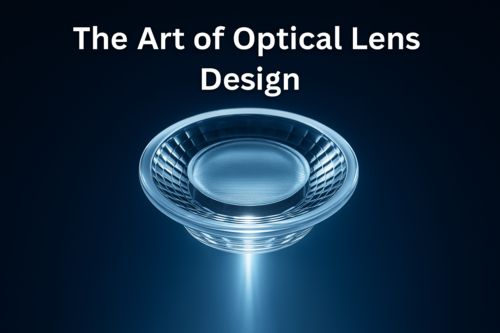
  • The Art of Optical Lens Design: Sculpting Light for Maximum LED Efficiency

    The Art of Optical Lens Design: Sculpting Light for Maximum LED Efficiency

    .gtr-container-x7y2z9 {
    font-family: Verdana, Helvetica, “Times New Roman”, Arial, sans-serif;
    color: #333;
    line-height: 1.6;
    padding: 15px;
    max-width: 100%;
    box-sizing: border-box;
    overflow-x: hidden;
    }

    .gtr-container-x7y2z9__main-title {
        font-size: 18px;
        font-weight: bold;
        margin-bottom: 20px;
        text-align: left;
        color: #0056b3;
        padding-bottom: 10px;
        border-bottom: 2px solid #e0e0e0;
    }
    
    .gtr-container-x7y2z9__section-subtitle {
        font-size: 16px;
        font-weight: bold;
        margin-top: 25px;
        margin-bottom: 15px;
        text-align: left;
        color: #0056b3;
    }
    
    .gtr-container-x7y2z9__section-title {
        font-size: 16px;
        font-weight: bold;
        margin-top: 30px;
        margin-bottom: 15px;
        text-align: left;
        color: #0056b3;
        padding-bottom: 5px;
        border-bottom: 1px solid #e0e0e0;
    }
    
    .gtr-container-x7y2z9__subsection-title {
        font-size: 14px;
        font-weight: bold;
        margin-top: 20px;
        margin-bottom: 10px;
        text-align: left;
        color: #0056b3;
    }
    
    .gtr-container-x7y2z9 p {
        font-size: 14px;
        margin-bottom: 1em;
        text-align: left !important;
        word-break: normal;
        overflow-wrap: normal;
    }
    
    .gtr-container-x7y2z9 strong {
        font-weight: bold;
    }
    
    .gtr-container-x7y2z9 em {
        font-style: italic;
    }
    
    .gtr-container-x7y2z9__divider {
        border: none;
        border-top: 1px solid #ccc;
        margin: 25px 0;
    }
    
    .gtr-container-x7y2z9 ul,
    .gtr-container-x7y2z9 ol {
        margin: 0 0 1em 0;
        padding: 0;
        list-style: none !important;
    }
    
    .gtr-container-x7y2z9 ul li,
    .gtr-container-x7y2z9 ol li {
    font-size: 14px;
        margin-bottom: 0.5em;
        padding-left: 20px;
        position: relative;
        text-align: left !important;
    list-style: none !important;
    

    }

    .gtr-container-x7y2z9 ul li::before {
        content: "•" !important;
        color: #0056b3;
        font-size: 1.2em;
        position: absolute !important;
        left: 0 !important;
        top: 0;
    }
    
    .gtr-container-x7y2z9 ol {
        counter-reset: list-item;
    }
    
    .gtr-container-x7y2z9 ol li::before {
        content: counter(list-item) "." !important;
        color: #0056b3;
        font-weight: bold;
        position: absolute !important;
        left: 0 !important;
        top: 0;
        width: 18px;
        text-align: right;
    }
    
    .gtr-container-x7y2z9 .gtr-table-wrapper {
        overflow-x: auto;
        margin-bottom: 1em;
    }
    
    .gtr-container-x7y2z9 table {
        width: 100%;
        border-collapse: collapse !important;
        border-spacing: 0 !important;
        margin-bottom: 1em;
        border: 1px solid #ccc !important;
        word-break: normal;
        overflow-wrap: normal;
    }
    
    .gtr-container-x7y2z9 th,
    .gtr-container-x7y2z9 td {
        padding: 10px !important;
        text-align: left !important;
        vertical-align: top !important;
        border: 1px solid #ccc !important;
        font-size: 14px;
    }
    
    .gtr-container-x7y2z9 th {
        font-weight: bold !important;
        background-color: #f0f0f0;
        color: #333;
    }
    
    .gtr-container-x7y2z9 tr:nth-child(even) {
        background-color: #f9f9f9;
    }
    
    @media (min-width: 768px) {
        .gtr-container-x7y2z9 {
            padding: 25px 50px;
            max-width: 960px;
            margin: 0 auto;
        }
    
        .gtr-container-x7y2z9__main-title {
            font-size: 18px;
            margin-bottom: 30px;
        }
    
        .gtr-container-x7y2z9__section-title {
            font-size: 16px;
            margin-top: 40px;
            margin-bottom: 20px;
        }
    
        .gtr-container-x7y2z9__section-subtitle {
            font-size: 16px;
            margin-top: 30px;
            margin-bottom: 15px;
        }
    
        .gtr-container-x7y2z9__subsection-title {
            font-size: 14px;
            margin-top: 25px;
            margin-bottom: 10px;
        }
    
        .gtr-container-x7y2z9 .gtr-table-wrapper {
            overflow-x: visible;
        }
    }
    

    The Art of Optical Lens Design: Sculpting Light for Maximum LED Efficiency
    Introduction: From Raw Light to Refined Brilliance

    LED technology has revolutionized the lighting world. Compared with traditional incandescent or fluorescent sources, LEDs offer superior energy efficiency, longer lifespans, and unparalleled flexibility in application. Yet, the real magic of LEDs does not lie solely in the semiconductor chip itself—it lies in how that light is shaped, directed, and diffused.

    This transformation from a raw, harsh emission into elegant, purposeful illumination is the result of optical lens design. The lens acts as the artist’s brush, sculpting photons into meaningful patterns. Whether it’s illuminating a roadway, accentuating architectural textures, or creating the soft glow of indoor lighting, optical lenses are the invisible designers of how we perceive and experience light.

    In this article, we’ll explore the art and science of optical lens design for LEDs—covering principles, materials, geometries, simulations, real-world applications, and emerging innovations that are redefining what efficiency means in modern lighting.

    1. Understanding LED Light and Its Challenges

    Before diving into lens design, it’s crucial to understand how LEDs emit light. Unlike conventional bulbs that radiate in all directions, LEDs are directional sources. A bare LED chip typically emits light in a Lambertian pattern—strongest perpendicular to the surface and decreasing with angle.

    This directional output presents both opportunities and challenges:

    • Opportunity: Designers can target light precisely where it’s needed, improving efficiency.

    • Challenge: Without proper optical management, the beam can appear spotty, uneven, or cause glare.

    To maximize light utility, optical components—lenses, reflectors, and diffusers—are used to control, shape, and smooth the beam distribution. Of these, the primary lens directly above the LED chip plays the most influential role in determining optical performance.

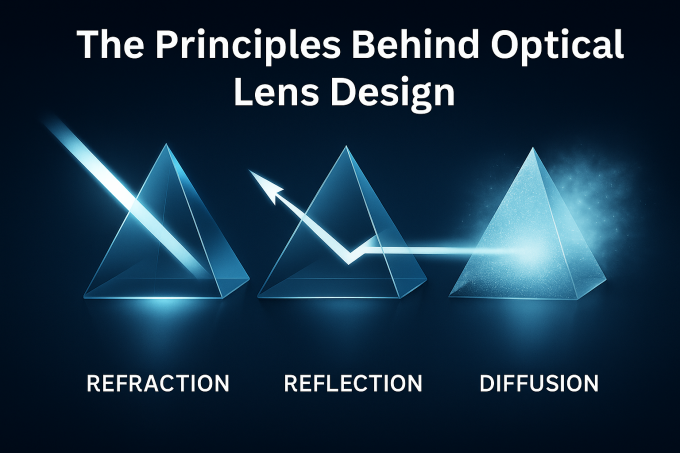
    2. The Principles Behind Optical Lens Design

    The Art of Optical Lens Design: Sculpting Light for Maximum LED Efficiency  0

    Optical lens design revolves around fundamental physical phenomena: refraction, reflection, and diffusion.

    • Refraction – When light passes through materials with different refractive indices (e.g., air and plastic), its path bends. This property allows designers to direct light at precise angles.

    • Reflection – Some lenses incorporate reflective surfaces to redirect light, especially in hybrid optics or total internal reflection (TIR) systems.

    • Diffusion – Microstructures or surface texturing scatter light, producing a soft and uniform output.

    The goal of design is to balance these effects to achieve the required beam angle, intensity profile, and illumination uniformity.

    For example:

    • A narrow beam (10–20°) lens is ideal for spotlighting.

    • A wide beam (60–120°) lens works for ambient or general lighting.

    • A batwing distribution ensures even horizontal illumination for streetlights.

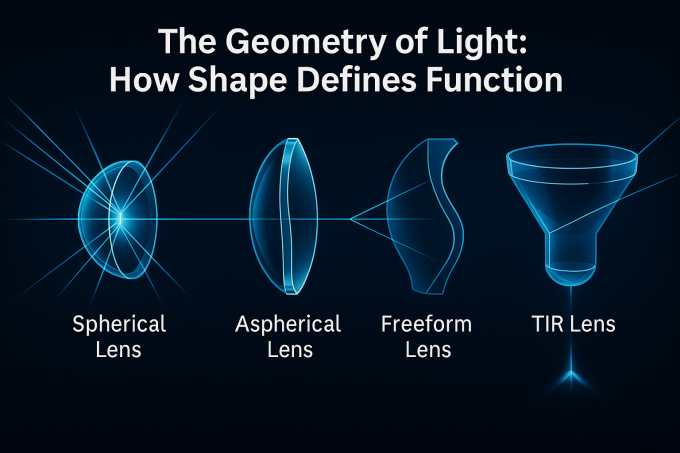
    3. The Geometry of Light: How Shape Defines Function

    The Art of Optical Lens Design: Sculpting Light for Maximum LED Efficiency  1

    The shape—or geometry—of a lens determines how light propagates. Engineers manipulate curvature, thickness, and angles to sculpt the beam pattern.

    a. Spherical and Aspherical Lenses

    A spherical lens is simple but prone to optical aberrations. In contrast, aspherical lenses use a non-uniform curvature that reduces distortion and delivers sharper, more uniform beams—especially valuable for compact, high-brightness LEDs.

    b. Freeform Optical Surfaces

    Advancements in computer-aided design allow for freeform surfaces, which break away from symmetrical constraints. These surfaces can create custom light distributions, such as asymmetric roadway patterns or complex accent lighting in architecture.

    c. TIR (Total Internal Reflection) Lenses

    TIR lenses combine refraction and reflection. Light entering the lens reflects internally and exits through a precisely shaped exit surface. This design captures nearly all emitted light, offering exceptional efficiency (up to 90–95% transmission).

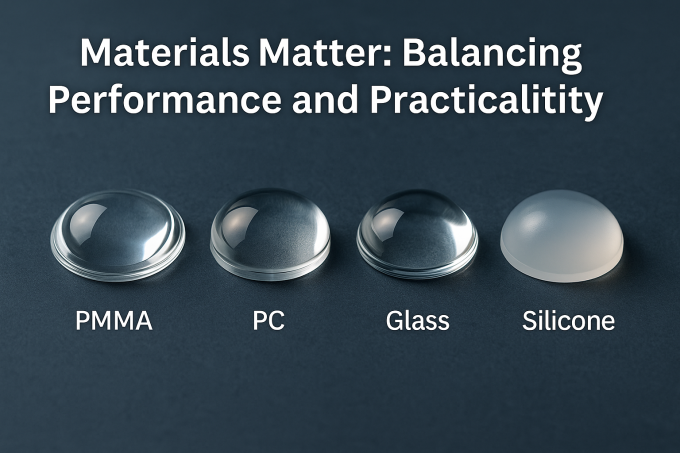
    4. Materials Matter: Balancing Performance and Practicality

    The Art of Optical Lens Design: Sculpting Light for Maximum LED Efficiency  2

    Material choice directly affects light transmission, durability, and thermal stability. The most common materials for LED lenses include:

    Material Refractive Index Key Advantages Common Applications
    PMMA (Acrylic) ~1.49 Excellent optical clarity, low cost Indoor fixtures, decorative lights
    Polycarbonate (PC) ~1.59 Impact resistance, heat tolerance Street lighting, automotive
    Glass ~1.52 Stability, UV resistance High-end optics, harsh environments
    Silicone ~1.41 Flexible, high-temperature resilience Automotive, outdoor, encapsulation

    Each material requires unique molding or polishing methods. For instance, while PMMA offers clarity, it scratches easily; PC resists impact but yellows over time if not UV-stabilized. Therefore, optical engineers must consider environmental exposure, lifespan, and manufacturing constraints when selecting materials.

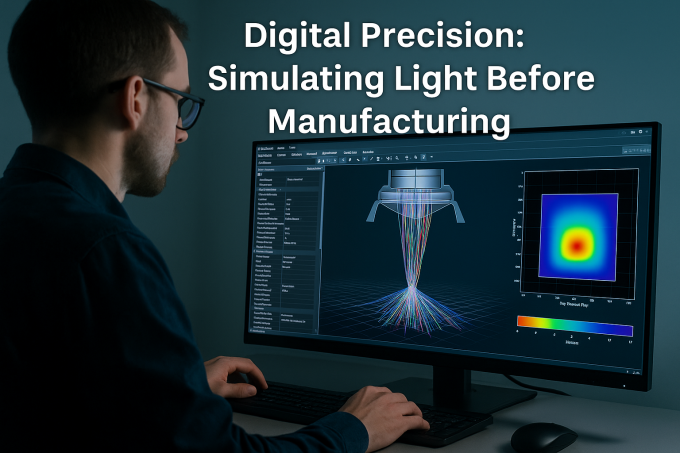
    5. Digital Precision: Simulating Light Before Manufacturing

    The Art of Optical Lens Design: Sculpting Light for Maximum LED Efficiency  3

    The era of trial-and-error in lens design is long gone. Today’s engineers rely on powerful optical simulation software—such as Zemax, LightTools, or TracePro—to model light behavior digitally.

    Ray Tracing

    This method simulates the paths of millions of photons through the optical system. It reveals how rays interact with surfaces, predicting brightness distribution (illuminance maps) and identifying losses or hotspots.

    Optimization Algorithms

    Designers set performance goals—like uniformity, intensity, or glare reduction—and algorithms automatically adjust parameters to achieve them. These simulations reduce development cycles dramatically.

    Prototyping and Validation

    After digital optimization, rapid prototyping techniques like 3D printing or CNC machining allow for quick physical validation before committing to mass production molds.

    6. Manufacturing Precision: From Design to Reality

    Transforming a digital model into a flawless optical component requires micron-level accuracy.

    Injection Molding

    The most common technique for plastic lenses. The molten polymer is injected into a precision-polished mold, cooled, and released. Mold surface quality directly impacts lens clarity—any imperfection can scatter light and reduce transmission.

    Diamond Turning and Polishing

    For glass or high-end polymer optics, diamond turning machines sculpt lens surfaces with nanometer precision. Post-processing like anti-reflective coatings further enhances efficiency.

    Micro-Structured Surfaces

    Some lenses incorporate microscopic textures to manage diffusion or reduce glare. These are produced using laser etching or lithography.

    Every step—from mold design to coating—affects the final optical performance. Consistency in manufacturing ensures that the designed beam profile is faithfully reproduced across thousands of units.

    7. Real Applications: Where Lens Design Meets Purpose

    The Art of Optical Lens Design: Sculpting Light for Maximum LED Efficiency  4

    Optical lenses shape light differently across industries. Let’s look at some real-world scenarios where design precision translates to performance impact.

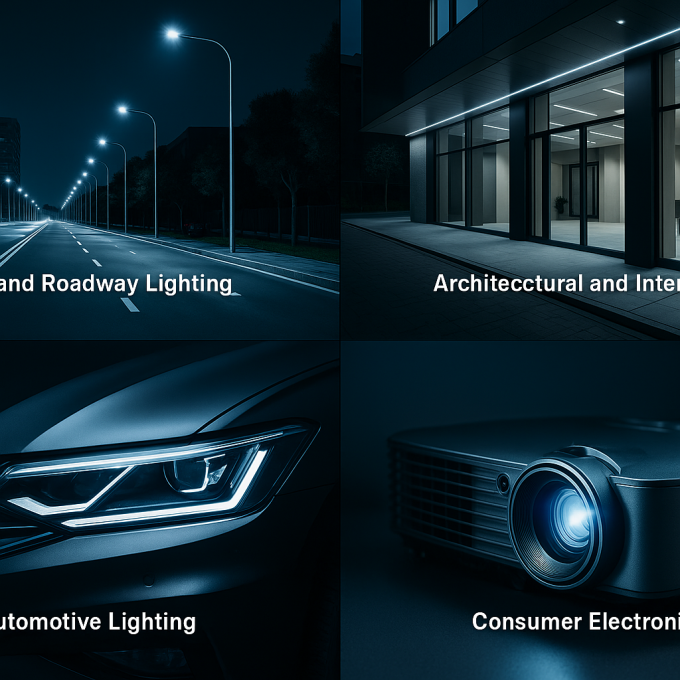
    a. Street and Roadway Lighting

    Uniform light distribution reduces dark zones and glare, improving visibility and safety. Lenses here often use batwing or asymmetric patterns to direct light along the road while minimizing spillover.

    b. Architectural and Interior Lighting

    Designers use custom optics to accentuate forms, highlight textures, or blend ambiance. In such spaces, aesthetic light quality—not just brightness—defines success.

    c. Automotive Lighting

    Headlights, taillights, and ambient vehicle lighting all depend on compact, heat-resistant lenses. Modern vehicles employ TIR optics and freeform geometry to meet both regulatory and stylistic requirements.

    d. Consumer Electronics

    From smartphone flashes to projectors, miniaturized lenses focus light with precision. In these contexts, optical tolerances are often under 10 micrometers—illustrating how extreme precision underpins visual clarity.

    8. Balancing Efficiency with Visual Comfort

    An efficient lighting system isn’t just about lumens per watt—it’s also about human perception. Excessive brightness or glare reduces usability and comfort, even if the system is technically efficient.

    To address this, designers employ:

    • Diffusing microtextures to soften sharp beams.

    • Anti-glare coatings for reflective control.

    • Optical blending structures to merge multiple LED sources into a seamless output.

    This balance of physics and psychology embodies the “art” in optical design. True efficiency is human efficiency—light that enhances both performance and well-being.

    9. Innovations Driving the Future of LED Optics

    As lighting technology evolves, so does lens design. The next generation of optical systems will combine smart materials, adaptive geometry, and artificial intelligence.

    a. Smart Lenses

    Materials that change refractive properties under voltage or temperature—known as electroactive polymers—can dynamically adjust beam shape.

    b. AI-Driven Optimization

    Machine learning models can predict optimal geometries based on target distributions, drastically reducing design time and computational load.

    c. Nanostructured Surfaces

    Engineers are experimenting with metasurfaces—nanoscopic textures that manipulate light at sub-wavelength levels, achieving unprecedented control over polarization and diffusion.

    d. Sustainability Integration

    Future lenses will increasingly prioritize biodegradable polymers and recyclable composites, closing the loop in eco-friendly design without compromising optical performance.

    10. Case Study: A Streetlight Revolution

    A practical example illustrates how lens design translates into real-world efficiency gains.

    A municipal streetlight project aimed to upgrade outdated sodium lamps to LEDs while cutting energy consumption by 50%. Engineers used an asymmetric TIR lens array to spread light evenly across the road surface without illuminating adjacent buildings.

    The results were striking:

    • Energy savings: 58% reduction in power usage.

    • Light uniformity: Improved by 35%.

    • Glare reduction: Decreased driver discomfort by 40%.

    • Maintenance interval: Extended from 2 years to 7 years.

    This case demonstrates how intelligent optical engineering can meet both functional and environmental goals—proof that efficiency is as much about direction as it is about brightness.

    Conclusion: The Intersection of Science and Art

    Optical lens design sits at the intersection of science, engineering, and artistry. It requires a deep understanding of light physics, precision manufacturing, and aesthetic sensitivity. Each lens is a small masterpiece—a silent architect shaping the way light interacts with our world.

    As LEDs continue to advance, lenses will remain the bridge between raw photonic power and human experience. The future of lighting will not be defined merely by brighter or cheaper LEDs, but by how beautifully, intelligently, and efficiently we can shape their light.

  • Commercial Kitchen Lighting Optimization: Bright & Efficient GU10 LED Bulbs

    Commercial Kitchen Lighting Optimization: Bright & Efficient GU10 LED Bulbs

    .gtr-container-x9y0z1 {
    font-family: Verdana, Helvetica, “Times New Roman”, Arial, sans-serif;
    color: #333;
    line-height: 1.6;
    padding: 15px; /* Default padding for mobile /
    box-sizing: border-box;
    overflow-x: hidden; /
    Prevent component itself from causing horizontal scroll unless explicitly allowed for tables */
    }

    .gtr-container-x9y0z1 .gtr-section-heading {
        font-size: 18px;
        font-weight: bold;
        margin-top: 25px;
        margin-bottom: 15px;
        text-align: left;
    }
    
    .gtr-container-x9y0z1 p {
        font-size: 14px;
        margin-bottom: 10px;
        text-align: left !important;
    }
    
    .gtr-container-x9y0z1 strong {
        font-weight: bold;
    }
    
    .gtr-container-x9y0z1 .gtr-separator {
        border: none;
        border-top: 1px solid #eee;
        margin: 20px 0;
    }
    
    .gtr-container-x9y0z1 ul,
    .gtr-container-x9y0z1 ol {
        margin-left: 0;
        padding-left: 0;
        list-style: none !important;
        margin-bottom: 10px;
    }
    
    .gtr-container-x9y0z1 ul li,
    .gtr-container-x9y0z1 ol li {
    position: relative;
        padding-left: 1.8em; /* Adjusted padding for custom bullets/numbers */
        margin-bottom: 5px;
        font-size: 14px;
        text-align: left !important;
    list-style: none !important;
    

    }

    .gtr-container-x9y0z1 ul li::before {
        content: "•" !important;
        position: absolute !important;
        left: 0 !important;
        color: #333 !important;
        font-size: 1em !important;
        line-height: 1.6;
        width: 1.5em; /* Ensure consistent spacing for bullet */
        text-align: left;
    }
    
    .gtr-container-x9y0z1 ol li::before {
        content: counter(list-item) "." !important; /* Use built-in list-item counter */
        position: absolute !important;
        left: 0 !important;
        color: #333 !important;
        font-size: 1em !important;
        line-height: 1.6;
        width: 1.5em; /* Adjust width for number alignment */
        text-align: right;
    }
    
    .gtr-container-x9y0z1 a {
        color: #007bff; /* A standard link color */
        text-decoration: none;
    }
    
    .gtr-container-x9y0z1 a:hover {
        text-decoration: underline;
    }
    
    .gtr-container-x9y0z1 .gtr-table-wrapper {
        width: 100%;
        overflow-x: auto;
        margin-bottom: 20px;
    }
    
    .gtr-container-x9y0z1 table {
        width: 100%;
        border-collapse: collapse !important;
        border-spacing: 0 !important;
        margin-bottom: 0 !important; /* Reset default table margin */
        font-size: 14px;
        min-width: 600px; /* Ensure table is scrollable on small screens if content is wide */
    }
    
    .gtr-container-x9y0z1 table th,
    .gtr-container-x9y0z1 table td {
        border: 1px solid #ccc !important;
        padding: 8px !important;
        text-align: left !important;
        vertical-align: top !important;
        word-break: normal; /* Ensure words don't break */
        overflow-wrap: normal; /* Ensure words don't break */
    }
    
    .gtr-container-x9y0z1 table th {
        font-weight: bold !important;
        background-color: #f0f0f0 !important;
    }
    
    .gtr-container-x9y0z1 table tr:nth-child(even) {
        background-color: #f9f9f9 !important;
    }
    
    .gtr-container-x9y0z1 .gtr-image-wrapper {
        margin-top: 15px;
        margin-bottom: 15px;
        text-align: center; /* To center the image if it has auto margins */
    }
    
    /* Responsive adjustments for PC */
    @media (min-width: 768px) {
        .gtr-container-x9y0z1 {
            padding: 25px 50px; /* More padding for larger screens */
        }
    
        .gtr-container-x9y0z1 .gtr-section-heading {
            font-size: 20px; /* Slightly larger for PC */
            margin-top: 30px;
            margin-bottom: 20px;
        }
    
        .gtr-container-x9y0z1 p {
            margin-bottom: 12px;
        }
    
        .gtr-container-x9y0z1 ul li,
        .gtr-container-x9y0z1 ol li {
            margin-bottom: 8px;
        }
    
        .gtr-container-x9y0z1 table {
            min-width: auto; /* Allow table to shrink on PC if content fits */
        }
    }
    

    Introduction

    In commercial kitchens, lighting is more than just a functional necessity—it directly influences operational efficiency, food safety, and staff performance. Traditional GU10 halogen bulbs, once favored for their warm glow, have become increasingly costly due to high energy consumption, frequent replacements, and maintenance demands.

    This guide explores how GU10 LED bulbs offer an optimal solution for commercial kitchens. It provides a detailed analysis of energy savings, lighting performance, installation considerations, and maintenance strategies, serving as a commercial LED project example for hotels, restaurants, and large-scale catering operations. This resource aims to assist lighting engineers and procurement managers in making informed decisions regarding hotel energy-saving LED projects, GU10 retrofits, and cost-effective lighting solutions.

    Why Choose GU10 LED Bulbs for Commercial Kitchens?

    Commercial kitchens often operate 12–16 hours per day, necessitating efficient, durable, and high-quality lighting. GU10 LED bulbs are ideal because they combine focused illumination, energy efficiency, and long lifespan.

    Key Advantages for B2B Buyers:

    • Energy Savings: GU10 LEDs consume 70–80% less power than 35–50W halogen bulbs, significantly reducing electricity costs.

    • Long Lifespan: Typical GU10 LED bulbs last 25,000–50,000 hours, 10–50 times longer than halogen bulbs, drastically reducing maintenance frequency.

    • High CRI for Food Safety: CRI >90 ensures accurate color rendering, essential for inspecting food freshness and doneness. (tecolite.com)

    • Reduced HVAC Load: Low heat output minimizes the burden on kitchen air conditioning systems, adding energy savings.

    • Dimmable & Compatible: Many GU10 LEDs are compatible with triac, forward-phase, and smart dimming systems.

    Commercial Kitchen Lighting Optimization: Bright & Efficient GU10 LED Bulbs  0

    Pre-Retrofit Analysis: Power Consumption and Maintenance Challenges

    A mid-sized hotel kitchen example illustrates the costs associated with traditional halogen lighting (based on $0.15/kWh):

    Area Bulb Type Wattage per Bulb Quantity Daily Hours Monthly kWh Annual Cost (USD)
    Main Kitchen GU10 Halogen 50W 60 12 1,080 $162.00
    Prep Area GU10 Halogen 50W 40 12 720 $108.00
    Corridor & Pantry GU10 Halogen 50W 30 16 720 $108.00
    Dining Area GU10 Halogen 50W 20 14 420 $63.00
    Total: 150 Bulbs 7,500W 150 2,970 kWh $5,292.00

    Identified Challenges:

    • Frequent Replacements: Bulbs require replacement every ~2,000 hours, leading to 100–200 bulb changes annually.

    • High Heat Output: Halogens raise ambient temperatures, straining HVAC systems.

    • High Energy Costs: Lighting accounts for a significant portion of total facility energy consumption.

    Planning the GU10 Retrofit

    The hotel partnered with a certified LED manufacturer to implement a GU10 retrofit, aiming to reduce energy usage while improving lighting quality and compliance.

    Retrofit Specifications:

    • Replacement Type: 7.5W GU10 LED bulbs (equivalent to 50W halogen)

    Illuminance Standard: Target lux levels meet FDA Food Code or equivalent safety standards:

    Food Prep/Task Zones: 50 Foot-Candles (~540 Lux)

    • General Work/Storage: 20 Foot-Candles (~215 Lux)

    Color Temperatures:

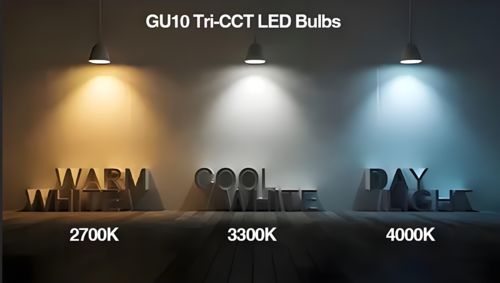
    2700K warm white for dining and ambient lighting

    • 4000K neutral white for task zones such as prep and cooking areas

    Ingress Protection (IP Rating): Fixtures must be IP44 or higher to protect against moisture and splashes

    • Certifications: CE & RoHS

    Expected Lifespan: 25,000–50,000 hours

    Projected Benefits Pre-Installation:

    • 70–75% energy savings

    • Maintenance frequency reduced by over 90%

    • Improved uniformity and color accuracy (CRI >90)

    Post-Retrofit Analysis: Measured Results

    Area LED Bulbs Wattage per Bulb Quantity Monthly kWh Annual Cost (USD) Savings %
    Main Kitchen GU10 LED 7.5W 60 162 $291.60 85%
    Prep Area GU10 LED 7.5W 40 108 $194.40 85%
    Corridor & Pantry GU10 LED 7.5W 30 108 $194.40 85%
    Dining Area GU10 LED 7.5W 20 63 $113.40 85%
    Total: 150 Bulbs 1,125W 150 441 kWh $793.80 85%

    Overall Energy Reduction: ~85%
    Maintenance Reduction: Bulb replacements reduced by over 90%
    CO₂ Emissions: Reduced by ~25–30 tons/year

    Key Takeaways:

    • High CRI LEDs maintained accurate color rendering for food safety and presentation.

    • Superior thermal performance reduced heat contribution to the kitchen, stabilizing the working environment.

    Commercial Kitchen Lighting Optimization: Bright & Efficient GU10 LED Bulbs  1

    Procurement and Maintenance Recommendations

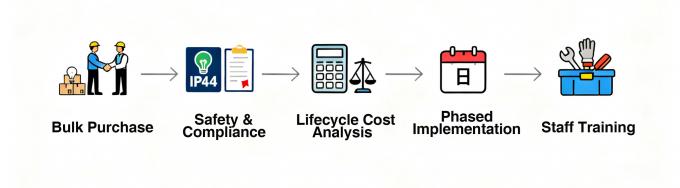
    • Bulk Sourcing: Negotiate volume discounts with certified GU10 LED manufacturers meeting required specs (CRI 90+, 4000K).

    • Safety & Compliance: Ensure fixtures meet IP44 or higher for moisture protection and hygiene.

    • Lifecycle Cost Analysis : Consider electricity, bulb replacements, and maintenance labor in total ownership cost.

    • Phased Implementation: Schedule installation during off-peak hours to minimize operational disruption.

    • Staff Training: Train facility teams on LED characteristics and proper cleaning/maintenance procedures for IP-rated fixtures.

    Commercial Kitchen Lighting Optimization: Bright & Efficient GU10 LED Bulbs  2

    Conclusion

    This GU10 LED case study demonstrates that a strategic retrofit can transform commercial kitchen lighting: reducing energy costs by 85%, cutting maintenance frequency, and maintaining optimal color rendering and brightness for safety and quality.

    For commercial buyers, facility managers, and B2B procurement teams, investing in high-quality GU10 LEDs ensures energy efficiency, long-term operational savings, and compliance with international safety standards.

    Call to Action:

    Ready to upgrade your commercial kitchen lighting? Contact us today to discuss tailored GU10 LED solutions that fit your specific needs and budget.

  • Over-Temperature Protected LED Bulbs for Enclosed Fixtures: Safe & Reliable Choice for Commercial Projects

    Over-Temperature Protected LED Bulbs for Enclosed Fixtures: Safe & Reliable Choice for Commercial Projects

    .gtr-container-k9p2q7 {
    font-family: Verdana, Helvetica, “Times New Roman”, Arial, sans-serif;
    color: #333;
    line-height: 1.6;
    padding: 15px;
    box-sizing: border-box;
    max-width: 100%;
    overflow-x: hidden;
    }

    .gtr-container-k9p2q7 p {
        font-size: 14px;
        margin-bottom: 1em;
        text-align: left !important;
    }
    
    .gtr-container-k9p2q7 strong {
        font-weight: bold;
    }
    
    .gtr-container-k9p2q7 em {
        font-style: italic;
    }
    
    .gtr-container-k9p2q7 hr {
        border: none;
        border-top: 1px solid #eee;
        margin: 2em 0;
    }
    
    .gtr-container-k9p2q7 .gtr-k9p2q7-title {
        font-size: 18px;
        font-weight: bold;
        margin-bottom: 1.5em;
        color: #0056b3;
        text-align: left;
    }
    
    .gtr-container-k9p2q7 .gtr-k9p2q7-subtitle {
        font-size: 16px;
        font-weight: bold;
        margin-top: 2em;
        margin-bottom: 1em;
        color: #0056b3;
        text-align: left;
    }
    
    .gtr-container-k9p2q7 .gtr-k9p2q7-sub-subtitle {
        font-size: 15px;
        font-weight: bold;
        margin-top: 1.5em;
        margin-bottom: 0.8em;
        color: #333;
        text-align: left;
    }
    
    .gtr-container-k9p2q7 ul,
    .gtr-container-k9p2q7 ol {
        margin: 1em 0;
        padding-left: 20px;
        list-style: none !important;
    }
    
    .gtr-container-k9p2q7 ul li,
    .gtr-container-k9p2q7 ol li {
    position: relative;
        margin-bottom: 0.5em;
        padding-left: 15px;
        font-size: 14px;
        text-align: left;
    list-style: none !important;
    

    }

    .gtr-container-k9p2q7 ul li::before {
        content: "•" !important;
        position: absolute !important;
        left: 0 !important;
        color: #0056b3;
        font-size: 1.2em;
        line-height: 1;
    }
    
    .gtr-container-k9p2q7 ol {
        counter-reset: list-item;
    }
    
    .gtr-container-k9p2q7 ol li::before {
        content: counter(list-item) "." !important;
        position: absolute !important;
        left: 0 !important;
        color: #0056b3;
        font-weight: bold;
        width: 15px;
        text-align: right;
        margin-right: 5px;
    }
    
    .gtr-container-k9p2q7 .gtr-k9p2q7-table-wrapper {
        width: 100%;
        overflow-x: auto;
        margin: 1.5em 0;
    }
    
    .gtr-container-k9p2q7 table {
        width: 100%;
        border-collapse: collapse !important;
        border-spacing: 0 !important;
        margin: 0 !important;
        font-size: 14px;
        min-width: 600px;
    }
    
    .gtr-container-k9p2q7 th,
    .gtr-container-k9p2q7 td {
        border: 1px solid #ccc !important;
        padding: 8px !important;
        text-align: left !important;
        vertical-align: top !important;
        word-break: normal;
        overflow-wrap: normal;
    }
    
    .gtr-container-k9p2q7 th {
        font-weight: bold !important;
        background-color: #f0f0f0 !important;
        color: #333;
    }
    
    .gtr-container-k9p2q7 tr:nth-child(even) {
        background-color: #f9f9f9 !important;
    }
    
    .gtr-container-k9p2q7 p > em {
        display: block;
        text-align: center;
        font-size: 12px;
        color: #666;
        margin-top: 0.5em;
    }
    
    .gtr-container-k9p2q7 .gtr-k9p2q7-cta-link {
        display: inline-block;
        padding: 10px 20px;
        margin-top: 1.5em;
        background-color: #007bff;
        color: #fff;
        text-decoration: none;
        border-radius: 5px;
        font-weight: bold;
        transition: background-color 0.3s ease;
        font-size: 14px;
    }
    
    .gtr-container-k9p2q7 .gtr-k9p2q7-cta-link:hover {
        background-color: #0056b3;
    }
    
    @media (min-width: 768px) {
        .gtr-container-k9p2q7 {
            padding: 30px;
        }
    
        .gtr-container-k9p2q7 .gtr-k9p2q7-title {
            font-size: 24px;
        }
    
        .gtr-container-k9p2q7 .gtr-k9p2q7-subtitle {
            font-size: 20px;
        }
    
        .gtr-container-k9p2q7 .gtr-k9p2q7-sub-subtitle {
            font-size: 18px;
        }
    
        .gtr-container-k9p2q7 table {
            min-width: auto;
        }
    }
    

    Introduction

    In commercial lighting, choosing the right LED bulb is more than just about brightness—it’s about safety, reliability, and long-term performance. Enclosed fixtures, commonly used in hotels, offices, retail spaces, and residential complexes, trap heat and place extraordinary stress on the light source. Standard LED bulbs can overheat in such environments, leading to premature lumen depreciation, color shift, or even safety hazards.

    To address this challenge, TECO has developed GU10 LED bulbs with over-temperature protection (OTP) integrated via NTC chips in the driver circuit. This solution ensures safe, reliable operation even in thermally demanding enclosed fixtures.

    This article explores the technical principles of driver-integrated NTC OTP, its advantages over other solutions, practical applications across commercial projects, and why TECO’s GU10 LEDs are the preferred choice for B2B buyers.

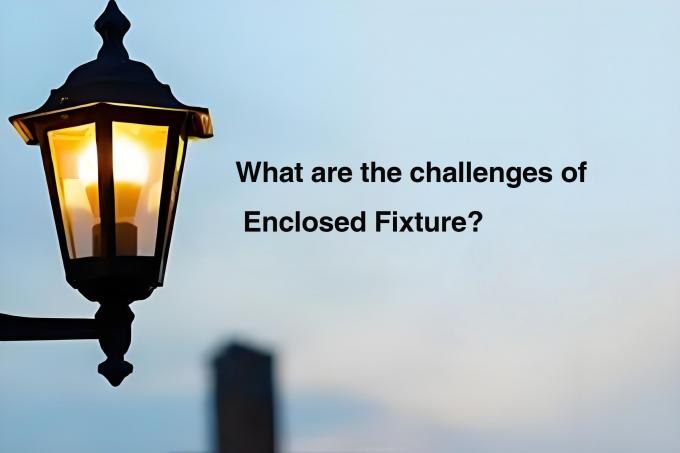
    Challenges of Enclosed Fixtures

    While enclosed fixtures enhance aesthetics and reduce glare, they trap heat, creating risks for LEDs:

    • Limited Ventilation: Reduced airflow leads to higher internal temperatures.

    • Thermal Stress: Excessive heat accelerates lumen depreciation, shortens lifespan, and affects color rendering.

    • Safety Concerns: Overheating can cause flickering, premature failure, or safety hazards.

    For commercial projects, these issues translate into higher operational costs, dissatisfied clients, and potential liabilities for contractors and distributors.

    Over-Temperature Protected LED Bulbs for Enclosed Fixtures: Safe & Reliable Choice for Commercial Projects  0

    Over-Temperature Protection via NTC in Driver Circuit
    What Is NTC and How It Works

    Definition:
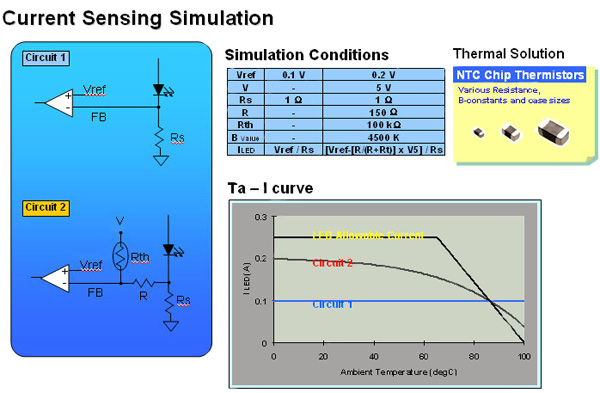
    An NTC (Negative Temperature Coefficient) thermistor is a temperature-sensitive resistor whose resistance decreases as the temperature rises. In TECO’s GU10 LED bulbs, the NTC is integrated directly into the LED driver circuit, enabling the driver to continuously monitor its own temperature and the heat affecting the LED.

    Working Principle:

    • Temperature Sensing: The NTC thermistor is positioned near the driver’s heat source. As temperature rises, resistance decreases.

    • Voltage Signal Conversion: The resistance change produces a voltage signal that the driver’s control circuit interprets.

    • Protective Response: When the driver temperature exceeds a preset threshold (typically around 85°C), the driver reduces LED current or dims output to lower heat generation.

    • Self-Recovery: Once the temperature drops below the threshold, full power is restored automatically, ensuring continuous operation without manual intervention.

    Advantages of Driver-Integrated NTC OTP:

    • Direct Thermal Feedback: Measures the actual heat source for accurate protection.

    • Fast Response: Immediate output adjustment prevents thermal overshoot.

    • Compact & Cost-Efficient: Minimal additional components required.

    • Reliable & Low Maintenance: Passive sensing with driver logic ensures stability across varying conditions.

    Over-Temperature Protected LED Bulbs for Enclosed Fixtures: Safe & Reliable Choice for Commercial Projects  1

    Comparison with Other Over-Temperature Protection Solutions

    Feature NTC in Driver (TECO) PTC Thermistor OTP Microcontroller / IC-Based OTP
    Placement Inside driver, monitors actual heat source On PCB or near LED Integrated with MCU / driver circuit
    Response Speed Fast, dynamic Slower, triggers at set point Fast, programmable
    Complexity Simple, integrates easily Simple, may require external circuit High, requires firmware & IC
    Cost Low Low to medium Medium to high
    Precision Moderate, practical for LED thermal control Moderate High, programmable thresholds
    Reliability Very reliable, less prone to interference Reliable but slower High if properly designed
    Applications GU10 LED bulbs, enclosed fixtures Spotlights, general-purpose LEDs High-end smart lighting, dimmable/variable-wattage LEDs

    Insights for B2B Buyers:

    • TECO’s driver-integrated NTC solution is optimized for enclosed GU10 fixtures, where driver heat is the main contributor to thermal stress.

    • Compared to PTC thermistors, NTC offers faster and more dynamic response, reducing thermal stress and extending bulb lifespan.

    • Microcontroller- or IC-based OTP systems provide programmable thresholds but add complexity and cost, making them less suitable for standard commercial GU10 applications.

    Advantages of OTP-Enabled GU10 LED Bulbs

    • Enhanced Safety: OTP prevents overheating, protecting both lamp and fixture.

    • Extended Lifespan: Reduced thermal stress maintains lumen output and color stability, reaching up to 40,000 hours.

    • Lower Maintenance: Fewer replacements and reduced labor costs in large-scale projects.

    • Consistent Energy Efficiency: Even during temporary output reduction, energy savings remain superior to halogen or CFL.

    • Regulatory Compliance: CE, CB, and RoHS certifications, including thermal testing, ensure international installation approval.

    • Project Reliability: OTP ensures dependable performance, enhancing contractor and distributor credibility.

    Applications Across Commercial Projects

    Hotels:

    • Hallways, guest rooms, and lobbies often use enclosed downlights.

    • TECO OTP GU10 bulbs maintain safe operation during extended usage periods.

    Offices:

    • Conference rooms and open-plan workspaces benefit from stable, glare-free illumination.

    • Continuous operation without thermal degradation ensures productivity and reliability.

    Retail Spaces:

    • Display lighting in enclosed fixtures demands color accuracy.

    • High CRI options (up to Ra98) preserve merchandise appearance while managing heat effectively.

    Residential Projects:

    • Apartments with recessed ceilings rely on consistent illumination and long bulb life.

    Public Buildings:

    • Airports, hospitals, museums, and government buildings require long-lasting, safe LED solutions.

    Over-Temperature Protected LED Bulbs for Enclosed Fixtures: Safe & Reliable Choice for Commercial Projects  2


    Selecting the Right OTP GU10 LED Bulb

    B2B buyers should consider:

    • Enclosed Fixture Compatibility: Check datasheet specifications.

    • Thermal Thresholds: Request NTC activation data.

    • Performance Options: TECO offers 5W, 5.5W, 7.5W models; beam angles 10°–60°.

    • High CRI: Up to Ra98 for retail and hospitality applications.

    • Certifications: CE, CB, RoHS.

    • OEM/ODM Customization: Private label, packaging, dimming compatibility, beam angle and color temperature adjustments.

    TECO’s Expertise and B2B Support

    • Innovation: Driver-integrated NTC OTP for enclosed GU10 fixtures.

    • ODM Solutions: Custom packaging, labeling, and technical customization.

    • Quality Control: Rigorous thermal, lumen, and dimming tests ensure reliable performance.

    • Global Compliance: CE, CB, RoHS certifications simplify international procurement.

    • B2B Focus: Scalable production ensures reliable supply for distributors and contractors.

    Over-Temperature Protected LED Bulbs for Enclosed Fixtures: Safe & Reliable Choice for Commercial Projects  3

    Call to Action

    For B2B buyers, selecting GU10 LED bulbs with driver-integrated NTC OTP ensures safe, reliable, and long-lasting performance in enclosed fixtures.

    Contact TECO today to:

    • Request samples of OTP-enabled GU10 LED bulbs

    • Receive detailed thermal performance reports and certifications

    • Explore OEM/ODM customization options

    • Get bulk procurement pricing

    Reach TECO Lighting Team and secure reliable lighting solutions for your next commercial project.
    Conclusion

    Over-temperature protection is essential for enclosed fixtures. TECO’s driver-integrated NTC OTP GU10 LED bulbs offer safe, durable, and cost-effective lighting solutions for hotels, offices, retail spaces, and public buildings. By proactively managing heat, TECO ensures extended product life, consistent performance, and high reliability, making these bulbs the preferred choice for B2B buyers worldwide.

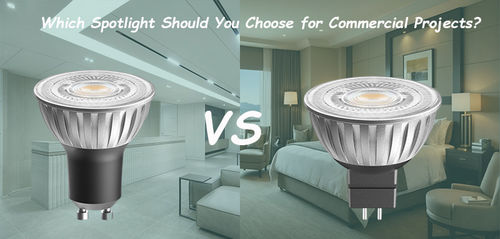
  • LED MR16 vs LED GU10: Which Spotlight Should You Choose for Commercial Projects?

    LED MR16 vs LED GU10: Which Spotlight Should You Choose for Commercial Projects?

    .gtr-container-x7y2z9 {
    font-family: Verdana, Helvetica, “Times New Roman”, Arial, sans-serif;
    color: #333;
    line-height: 1.6;
    padding: 15px;
    max-width: 100%;
    box-sizing: border-box;
    overflow-x: hidden;
    }

    .gtr-container-x7y2z9 .gtr-heading-2 {
        font-size: 18px;
        font-weight: bold;
        margin-top: 25px;
        margin-bottom: 15px;
        color: #0056b3;
        padding-bottom: 5px;
        border-bottom: 2px solid #e0e0e0;
        text-align: left;
    }
    
    .gtr-container-x7y2z9 .gtr-heading-3 {
        font-size: 16px;
        font-weight: bold;
        margin-top: 20px;
        margin-bottom: 10px;
        color: #555;
        text-align: left;
    }
    
    .gtr-container-x7y2z9 p {
        font-size: 14px;
        margin-bottom: 10px;
        text-align: left !important;
        word-break: normal;
        overflow-wrap: normal;
    }
    
    .gtr-container-x7y2z9 .gtr-separator {
        border: none;
        border-top: 1px solid #e0e0e0;
        margin: 30px 0;
    }
    
    .gtr-container-x7y2z9 ul {
        list-style: none !important;
        margin: 10px 0 10px 0 !important;
        padding: 0 !important;
    }
    
    .gtr-container-x7y2z9 ul li {
        position: relative;
        padding-left: 20px;
        margin-bottom: 8px;
        font-size: 14px;
        text-align: left !important;
    }
    
    .gtr-container-x7y2z9 ul li::before {
        content: "•";
        position: absolute;
        left: 0;
        color: #0056b3;
        font-weight: bold;
        font-size: 14px;
        line-height: 1.6;
    }
    
    .gtr-container-x7y2z9 ol {
        list-style: none !important;
        margin: 10px 0 10px 0 !important;
        padding: 0 !important;
    }
    
    .gtr-container-x7y2z9 ol li {
        position: relative;
        padding-left: 25px;
        margin-bottom: 8px;
        font-size: 14px;
        text-align: left !important;
    }
    
    .gtr-container-x7y2z9 ol li::before {
        content: counter(list-item) ".";
        counter-increment: none;
        position: absolute;
        left: 0;
        color: #0056b3;
        font-weight: bold;
        font-size: 14px;
        line-height: 1.6;
        width: 20px;
        text-align: right;
    }
    
    .gtr-container-x7y2z9 .gtr-table-wrapper {
        overflow-x: auto;
        margin-top: 20px;
        margin-bottom: 20px;
    }
    
    .gtr-container-x7y2z9 table {
        width: 100%;
        border-collapse: collapse !important;
        border-spacing: 0 !important;
        margin: 0 !important;
        font-size: 14px;
        min-width: 600px;
    }
    
    .gtr-container-x7y2z9 th,
    .gtr-container-x7y2z9 td {
        border: 1px solid #ccc !important;
        padding: 8px 12px !important;
        text-align: left !important;
        vertical-align: top !important;
        word-break: normal;
        overflow-wrap: normal;
    }
    
    .gtr-container-x7y2z9 th {
        background-color: #f0f0f0;
        font-weight: bold !important;
        color: #333;
    }
    
    .gtr-container-x7y2z9 tbody tr:nth-child(even) {
        background-color: #f9f9f9;
    }
    
    .gtr-container-x7y2z9 strong {
        font-weight: bold;
    }
    
    .gtr-container-x7y2z9 .gtr-caption {
        font-style: italic;
        color: #666;
        margin-top: 20px;
        font-size: 13px;
        text-align: left !important;
    }
    
    @media (min-width: 768px) {
        .gtr-container-x7y2z9 {
            padding: 25px;
        }
    
        .gtr-container-x7y2z9 .gtr-heading-2 {
            font-size: 20px;
            margin-top: 35px;
            margin-bottom: 20px;
        }
    
        .gtr-container-x7y2z9 .gtr-heading-3 {
            font-size: 18px;
            margin-top: 25px;
            margin-bottom: 12px;
        }
    
        .gtr-container-x7y2z9 table {
            min-width: auto;
        }
    }
    

    Introduction

    Selecting the right LED spotlight is critical for commercial projects, from hotel lobbies to retail stores and office spaces. Two of the most widely used options are LED MR16 and LED GU10 spotlights. Both offer energy efficiency and long lifespans, but they differ significantly in technical characteristics, installation requirements, and application suitability LED spotlight comparison.

    This guide provides an in-depth comparison of LED MR16 vs LED GU10, supported by real-world use cases, cost analysis, and commercial insights commercial lighting case studies. It is specifically designed for B2B buyers, project managers, and architects in Europe and North America LED lighting market Europe North America.

    Understanding LED MR16 and LED GU10
    LED MR16 Spotlight Basics

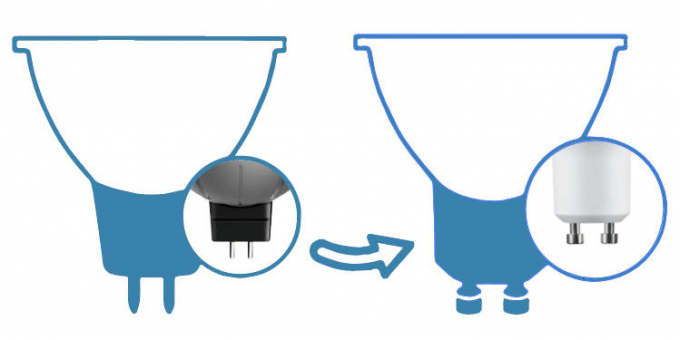
    • Lamp Base: GU5.3 two-pin base

    • Voltage: 12V low-voltage system

    • Applications: Accent lighting, track lighting, recessed fixtures

    • Power Range: 3W–7.5W LED replacements

    • Beam Angles: Narrow (10°–60°)

    Key Advantages:

    • Low voltage improves safety in enclosed or damp environments

    • Narrow beams are ideal for precise accent lighting, such as artwork, retail displays, or decorative lighting accent lighting examples

    LED GU10 Spotlight Basics

    • Lamp Base: GU10 twist-lock base

    • Voltage: 110V/230V mains power (direct connection)

    • Applications: General illumination, track lighting, retrofit projects

    • Power Range: 3W–10W

    • Beam Angles: Wide range (10°–60°+)

    Key Advantages:

    • Easy plug-and-play installation, no transformer required

    • Flexible beam angles suitable for both accent and ambient lighting

    • Smart lighting integration compatible (Zigbee, Tuya, Wi-Fi) smart GU10 LED lighting

    LED MR16 vs LED GU10: Which Spotlight Should You Choose for Commercial Projects?  0

    Technical Comparison: LED MR16 vs LED GU10

    Feature LED MR16 LED GU10 Notes/Benefits
    Voltage 12V low-voltage (requires transformer) 110V/230V mains MR16 safer for damp spaces; GU10 simpler direct connection
    Lamp Base GU5.3 two-pin GU10 twist-lock MR16 needs matching sockets; GU10 easier replacement
    Beam Angle Narrow (10°–60°) Wide range (10°–60°+) Narrow beams for accents, wide beams for ambient coverage
    Dimming Phase-cut compatible Phase-cut + smart system compatible GU10 supports IoT & smart lighting integration
    Heat Dissipation Dependent on transformer & fixture Aluminum heat sink, high durability GU10 better long-term performance
    Lifespan 25,000–40,000 hours 25,000–40,000 hours GU10 generally longer-lasting
    CRI High CRI available High CRI available Both suitable for color-critical applications

    Notes: MR16 requires compatible transformer, which may affect flicker and lifespan LED transformer effects on flicker.

    Applications in Commercial Projects
    Hospitality (Hotels & Restaurants)

    • LED MR16:

    12V low-voltage ensures safety in guest rooms, corridors, and bathrooms

    • Focused beams ideal for artwork, wall grazing, and decorative accents

    • Narrow beam angles allow precise lighting without spill hotel accent lighting examples

    LED GU10:

    Suitable for lobbies, banquet halls, and dining areas

    • Easy retrofit and maintenance

    • Compatible with smart lighting for ambiance control

    Recommendation:

    • Guest rooms, corridors → LED MR16

    • Public spaces → LED GU10

    Retail & Showrooms

    • LED MR16:

    Precise accent lighting for product displays

    • Narrow beams (10°–36°) enhance high-value items or feature areas

    LED GU10:

    General lighting across aisles

    • Flexible track lighting for evolving layouts

    Recommendation:

    • Display cabinets → LED MR16

    • Storewide lighting → LED GU10

    Offices & Educational Spaces

    • LED MR16:

    Task-specific lighting for lab or presentation areas

    • LED GU10:

    Uniform ambient lighting for offices, classrooms, and meeting rooms

    • Easy integration with smart dimming and scene control smart office LED systems

    Recommendation:

    • Workstations / classrooms → LED GU10

    • Task-specific or highlight areas → LED MR16

    Museums & Galleries

    • LED MR16:

    High CRI ensures accurate color rendering for artworks

    • Narrow, adjustable beams protect sensitive exhibits museum lighting high CRI

    LED GU10:

    Provides general illumination for audience pathways and large rooms

    • Easy to install and maintain

    Recommendation:

    • Exhibit spotlighting → LED MR16

    • Visitor areas → LED GU10

    Summary Table

    Scenario LED MR16 LED GU10
    Hotels Guest rooms, corridors (safety low-voltage, precise beams) Lobby, banquet halls (easy install, maintenance low)
    Retail Display lighting (focus) General lighting (coverage)
    Offices Task-specific lighting Ambient workspaces, smart control
    Museums Artworks (high CRI, narrow beams) Visitor areas (uniform light)

    Cost & Maintenance Considerations

    Factor LED MR16 LED GU10
    Initial Cost Higher (transformer needed) Moderate (plug-and-play)
    Maintenance Transformer + bulb replacement Bulb replacement only
    Lifespan 25,000–40,000 hours 25,000–40,000 hours
    Energy Efficiency Excellent Excellent

    ROI Example (LED-only comparison):

    • Replace 100 LED MR16 bulbs (7.5W) with LED GU10 bulbs in a 200 m² retail space:

    Power consumption reduced from 750W (MR16 system including transformer losses) → 700W GU10

    • Annual electricity saving ≈ €1,200

    • Payback period ≈ 18–20 months retail LED retrofit ROI example

    Market Insights & Trends

    • Smart & Tunable Lighting:

    GU10 LEDs increasingly support Tri-CCT, tunable white, and IoT controls smart commercial LED lighting trends

    • MR16 LEDs still widely used in low-voltage retrofit projects

    High CRI Demand:

    Commercial spaces prioritize CRI 90+ for color-critical applications (retail, museums, hotels)

    • Energy Regulations:

    EU energy labeling, US DLC/UL compliance favors GU10 for new projects due to easier certification EU US LED energy standards

    • Maintenance & Lifecycle:

    GU10 reduces long-term maintenance and installation costs

    • MR16 remains preferred for specialized low-voltage installations where safety is critical

    LED MR16 vs LED GU10: Which Spotlight Should You Choose for Commercial Projects?  1

    How to Choose for Your Commercial Project

    • Evaluate Existing Infrastructure:

    Low-voltage system → MR16

    • Standard mains → GU10

    Determine Lighting Goals:

    Accent lighting → MR16

    • General or flexible lighting → GU10

    Consider Smart & Control Systems:

    GU10 easier for IoT integration commercial IoT lighting integration

    • Budget & ROI:

    GU10 offers faster payback in most retrofit/new-build commercial projects

    Conclusion

    Both LED MR16 and LED GU10 have clear advantages depending on the project:

    • LED MR16: Focused accent lighting, low-voltage safety, high CRI applications

    • LED GU10: Easy installation, flexible beam angles, smart control, and lower maintenance

    For new commercial projects, GU10 is often preferred for ease, versatility, and ROI, while MR16 remains valuable for existing low-voltage systems or precision spotlighting.

    By understanding technical specs, application scenarios, costs, and market trends, businesses can confidently select the spotlight that maximizes efficiency, aesthetics, and long-term value.

  • Case Study: How a Hotel Reduced 70% Energy Costs with GU10 Retrofit

    Case Study: How a Hotel Reduced 70% Energy Costs with GU10 Retrofit

    .gtr-container-cs789 {
    font-family: Verdana, Helvetica, “Times New Roman”, Arial, sans-serif;
    color: #333;
    line-height: 1.6;
    padding: 15px;
    max-width: 100%;
    box-sizing: border-box;
    }

    .gtr-container-cs789__section-title {
    font-size: 18px;
    font-weight: bold;
    margin-top: 25px;
    margin-bottom: 15px;
    color: #0056b3;
    border-bottom: 1px solid #eee;
    padding-bottom: 8px;
    }

    .gtr-container-cs789 p {
    font-size: 14px;
    margin-bottom: 1em;
    text-align: left !important;
    word-break: normal;
    overflow-wrap: normal;
    }

    .gtr-container-cs789 strong {
    font-weight: bold;
    color: #0056b3;
    }

    .gtr-container-cs789 ul {
    list-style: none !important;
    margin: 0 0 1em 0 !important;
    padding: 0 !important;
    }

    .gtr-container-cs789 ul li {
    position: relative;
    padding-left: 20px;
    margin-bottom: 0.5em;
    font-size: 14px;
    text-align: left !important;
    }

    .gtr-container-cs789 ul li::before {
    content: “•”;
    color: #0056b3;
    position: absolute;
    left: 0;
    top: 0;
    font-weight: bold;
    font-size: 16px;
    line-height: 1.6;
    }

    .gtr-container-cs789 ol {
    list-style: none !important;
    margin: 0 0 1em 0 !important;
    padding: 0 !important;
    }

    .gtr-container-cs789 ol li {
    position: relative;
    padding-left: 25px;
    margin-bottom: 0.5em;
    font-size: 14px;
    text-align: left !important;
    }

    .gtr-container-cs789 ol li::before {
    content: counter(list-item) “.”;
    counter-increment: none;
    color: #0056b3;
    position: absolute;
    left: 0;
    top: 0;
    font-weight: bold;
    font-size: 14px;
    line-height: 1.6;
    width: 20px;
    text-align: right;
    }

    .gtr-container-cs789 a {
    color: #007bff;
    text-decoration: none;
    }

    .gtr-container-cs789 a:hover {
    text-decoration: underline;
    }

    .gtr-container-cs789 img {
    max-width: 100%;
    height: auto;
    display: block;
    margin-bottom: 1em;
    }

    @media (min-width: 768px) {
    .gtr-container-cs789 {
    padding: 25px 40px;
    max-width: 960px;
    margin: 0 auto;
    }

    .gtr-container-cs789__section-title {
        margin-top: 35px;
        margin-bottom: 20px;
    }
    

    }

    Introduction

    Rising energy costs and sustainability goals are pushing the hospitality industry to rethink lighting strategies. Hotels, in particular, consume significant electricity due to their round-the-clock operation—guest rooms, corridors, lobbies, and restaurants must remain well-lit for comfort and safety. Traditional halogen and incandescent spotlights, while once popular for their warm ambiance, have become increasingly costly to maintain.

    This case study explores a real-world GU10 LED case study, focusing on how a mid-sized business hotel achieved a 70% reduction in energy costs by replacing outdated halogen bulbs with modern GU10 LED lamps. The process illustrates how a GU10 retrofit can deliver substantial energy savings, extend lamp life, and improve guest experience without compromising lighting quality. For procurement managers and facility operators, this commercial LED project example provides practical insights into planning and executing a lighting retrofit in a hospitality setting.

    Pre-Retrofit Situation: Energy and Maintenance Challenges

    Before the retrofit, the hotel relied heavily on 50W halogen GU10 spotlights across key areas:

    • Guest Rooms: Each room used 8–10 halogen GU10 bulbs for general and accent lighting.

    • Corridors: Long hallways required continuous illumination for guest safety, consuming large amounts of electricity.

    • Lobby and Restaurant: High ceilings and decorative lighting created both aesthetic appeal and maintenance difficulties.

    Energy Consumption Analysis (Pre-Retrofit):

    • Total installed lamps: ~1,200 units

    • Average wattage per lamp: 50W

    • Operating hours: 12–16 hours per day

    • Monthly electricity usage: ~28,800 kWh

    • Average monthly lighting cost: 4,320 (based on0.15/kWh)

    In addition to high power consumption, halogen bulbs required frequent replacement—every 2,000 hours on average. This led to additional labor costs, frequent disruption in guest areas, and storage needs for replacement stock.

    Case Study: How a Hotel Reduced 70% Energy Costs with GU10 Retrofit  0

    The Retrofit Plan: Transitioning to GU10 LED

    After an energy audit, the hotel partnered with a LED bulb manufacturer specializing in hospitality solutions. The goal was to reduce operating expenses while maintaining the warm, welcoming atmosphere expected in hotel environments.

    Retrofit Specifications:

    • Replacement Type: 7.5W GU10 LED bulbs (equivalent brightness to 50W halogen)

    • Color Temperatures: 2700K (warm white) for guest rooms and lobby, 3000K for corridors and dining areas

    • Beam Angles: 36° for focused lighting in rooms, 60° for wider distribution in hallways

    • Certifications: CE, RoHS compliance to meet safety and regulatory requirements

    • Warranty: 3 years for aluminum housing versions

    Projected Benefits Before Installation:

    • Energy reduction of up to 70%

    • Lifespan of 25,000–40,000 hours (10–15 times longer than halogen)

    • Lower maintenance costs due to fewer replacements

    • Compatibility with existing GU10 fixtures, minimizing installation complexity

    Implementation Process: Step-by-Step Execution

    The retrofit project was completed in phases to minimize guest disruption.

    • Pilot Phase (20 rooms):
      The maintenance team replaced halogen bulbs with GU10 LED alternatives in a trial set of rooms. Guest feedback was gathered regarding light comfort and color quality. Results were positive, with guests noting no visible difference from halogen lighting.

    Corridor Upgrade:
    Following successful pilot testing, the corridors were upgraded with 3000K GU10 LEDs. This provided a balance between brightness and comfort for continuous use.

    • Public Areas:
      The lobby, reception, and restaurant were retrofitted with a mix of 2700K and 3000K LEDs. Decorative fixtures were adapted where necessary, but most GU10 sockets were directly compatible.

    Full Rollout:
    Over six weeks, the hotel replaced all 1,200 halogen bulbs. The project was completed without closing any rooms, thanks to careful scheduling and night-shift maintenance.

    Results: Energy and Cost Savings Achieved

    Case Study: How a Hotel Reduced 70% Energy Costs with GU10 Retrofit  1

    Post-Retrofit Energy Analysis:

    • Total installed lamps: ~1,200 units

    • Average wattage per lamp: 7.5W

    • Operating hours: 12–16 hours per day

    • Monthly electricity usage: ~4,320 kWh

    • Average monthly lighting cost: $648

    Key Outcomes:

    • 70% energy savings: Monthly lighting costs reduced from 4,320 to648.

    • Maintenance savings: Lamp replacement frequency dropped by 85%, reducing staff workload and operational disruption.

    • Sustainability impact: Annual carbon emissions reduced by approximately 35 tons (based on average grid emission factors).

    • Guest satisfaction: Lighting quality remained consistent, with no negative feedback. In fact, some guests commented on improved brightness and ambiance in public areas.

    Lessons Learned for B2B Procurement Managers

    • Start with an Audit: Assess baseline energy use to create a business case.

    • Test Before Scaling: Pilot installations ensure guest comfort and technical compatibility.

    • Choose Certified Products: Ensure CE/RoHS compliance to meet safety and export standards.

    • Plan Phased Rollout: Gradual implementation minimizes operational disruptions.

    • Calculate ROI: This hotel achieved payback in under 12 months, a critical metric for financial justification.

    This LED cost reduction example highlights the value of considering lifecycle costs—not just upfront prices—when selecting lighting products for commercial spaces.

    Conclusion

    This case study demonstrates how a practical GU10 LED case study can translate into measurable savings for the hospitality sector. By implementing a GU10 retrofit, the hotel cut lighting energy consumption by 70%, reduced maintenance demands, and improved sustainability credentials—all while maintaining guest comfort.

    For commercial buyers and facility managers, this commercial LED project example underscores the strategic benefits of energy-efficient lighting. Investing in high-quality GU10 LEDs can deliver not just immediate cost savings, but also long-term operational reliability and sustainability compliance.

  • Top 10 GU10 LED Bulb Brands Compared: Which One Is Right for You?

    Top 10 GU10 LED Bulb Brands Compared: Which One Is Right for You?

    .gtr-container-d7e8f9 {
    font-family: Verdana, Helvetica, “Times New Roman”, Arial, sans-serif;
    color: #333;
    line-height: 1.6;
    padding: 15px;
    box-sizing: border-box;
    max-width: 100%;
    overflow-x: hidden; /* Prevent horizontal scroll on the main container */
    }

    .gtr-container-d7e8f9 p {
    font-size: 14px;
    margin-bottom: 1em;
    text-align: left !important;
    }

    .gtr-container-d7e8f9 .gtr-d7e8f9-caption {
    font-size: 13px;
    color: #666;
    margin-bottom: 1em;
    font-style: italic;
    text-align: left !important;
    }

    .gtr-container-d7e8f9 .gtr-d7e8f9-heading-2 {
    font-size: 18px;
    font-weight: bold;
    margin-top: 2em;
    margin-bottom: 1em;
    color: #222;
    text-align: left !important;
    }

    .gtr-container-d7e8f9 .gtr-d7e8f9-heading-3 {
    font-size: 16px;
    font-weight: bold;
    margin-top: 1.5em;
    margin-bottom: 0.8em;
    color: #222;
    text-align: left !important;
    }

    .gtr-container-d7e8f9 .gtr-d7e8f9-key-info {
    font-size: 14px;
    font-weight: bold;
    margin-bottom: 1em;
    display: block;
    text-align: left !important;
    }

    .gtr-container-d7e8f9 .gtr-d7e8f9-separator {
    border-top: 1px solid #eee;
    margin: 2em 0;
    }

    .gtr-container-d7e8f9 ul,
    .gtr-container-d7e8f9 ol {
    list-style: none !important;
    margin: 1em 0 !important;
    padding: 0 !important;
    }

    .gtr-container-d7e8f9 ul li {
    position: relative;
    padding-left: 25px;
    margin-bottom: 0.5em;
    font-size: 14px;
    text-align: left !important;
    }

    .gtr-container-d7e8f9 ul li::before {
    content: “•”;
    color: #007bff; /* A subtle industrial blue */
    font-size: 1.2em;
    position: absolute;
    left: 0;
    top: 0;
    line-height: inherit;
    }

    .gtr-container-d7e8f9 ol li {
    position: relative;
    padding-left: 30px;
    margin-bottom: 0.5em;
    font-size: 14px;
    text-align: left !important;
    }

    .gtr-container-d7e8f9 ol li::before {
    content: counter(list-item) “.”;
    counter-increment: none; /* li increments automatically /
    color: #007bff; /
    A subtle industrial blue */
    font-weight: bold;
    position: absolute;
    left: 0;
    top: 0;
    width: 25px;
    text-align: right;
    line-height: inherit;
    }

    .gtr-container-d7e8f9 strong {
    font-weight: bold;
    }

    .gtr-container-d7e8f9 a {
    color: #007bff;
    text-decoration: none;
    }

    .gtr-container-d7e8f9 a:hover {
    text-decoration: underline;
    }

    .gtr-container-d7e8f9 .gtr-d7e8f9-table-wrapper {
    overflow-x: auto;
    margin: 1.5em 0;
    }

    .gtr-container-d7e8f9 table {
    width: 100%;
    border-collapse: collapse !important;
    border-spacing: 0 !important;
    margin: 0 !important;
    font-size: 14px;
    min-width: 600px; /* Ensure table is scrollable on small screens */
    }

    .gtr-container-d7e8f9 th,
    .gtr-container-d7e8f9 td {
    border: 1px solid #ccc !important;
    padding: 8px !important;
    text-align: left !important;
    vertical-align: top !important;
    word-break: normal !important; /* Prevent breaking words /
    overflow-wrap: normal !important; /
    Prevent breaking words */
    }

    .gtr-container-d7e8f9 th {
    font-weight: bold !important;
    background-color: #f8f8f8; /* Light background for headers */
    color: #333;
    }

    .gtr-container-d7e8f9 tbody tr:nth-child(even) {
    background-color: #f9f9f9; /* Zebra striping */
    }

    .gtr-container-d7e8f9 tbody tr:hover {
    background-color: #f0f0f0;
    }

    .gtr-container-d7e8f9 .gtr-d7e8f9-contact-info {
    margin-top: 2em;
    font-size: 14px;
    text-align: left !important;
    }

    .gtr-container-d7e8f9 .gtr-d7e8f9-contact-info strong {
    color: #007bff;
    }

    /* Responsive adjustments */
    @media (min-width: 768px) {
    .gtr-container-d7e8f9 {
    padding: 25px 50px;
    }

    .gtr-container-d7e8f9 .gtr-d7e8f9-heading-2 {
        font-size: 20px;
    }
    
    .gtr-container-d7e8f9 .gtr-d7e8f9-heading-3 {
        font-size: 18px;
    }
    
    .gtr-container-d7e8f9 table {
        min-width: auto; /* Allow table to shrink on larger screens */
    }
    

    }

    Buying GU10 LED bulbs without a proper brand comparison can lead to poor performance, wasted money, or missed business opportunities.

    The top GU10 LED bulb brands differ significantly in brightness, efficiency, lifespan, and pricing. A clear comparison helps buyers choose the best fit for their projects.

    For wholesale buyers, the choice of brand directly impacts both long-term costs and customer satisfaction. This guide breaks down the top 10 GU10 LED brands and reveals how they truly stack up.

    Key Factors to Consider When Choosing a GU10 LED Bulb

    Top 10 GU10 LED Bulb Brands Compared: Which One Is Right for You?  0

    Many buyers get stuck focusing only on wattage. But the quality of a GU10 LED bulb depends on much more.

    The main factors include lumen output (brightness), color temperature (Kelvin), dimmability, Color Rendering Index (CRI), certifications, lifespan, and warranty.
    Dive Deeper: Why These Factors Matter

    While wattage indicates power consumption, lumens measure actual brightness. For instance, a 4.5W GU10 LED can effectively replace a 50W halogen bulb.

    Other key factors for buyers to check:

    • Color Temperature (Kelvin): 2700K (warm) is ideal for home environments, 4000K (cool) for kitchens or offices, and 6500K (daylight) for retail or exhibition spaces.

    • CRI (Color Rendering Index): A CRI above 90 ensures natural, accurate colors, which is crucial for galleries or showrooms.

    • Dimmability: Not all GU10s are dimmable, and compatibility with dimmer switches helps avoid flickering.

    • Certifications (CE, RoHS, Energy Label): These are mandatory for compliance and smooth customs clearance.

    • Lifespan: Top brands offer 25,000–50,000 hours, a significant jump from a halogen bulb’s 1,000 hours.

    • Warranty: A 2–5 year warranty reflects a manufacturer’s confidence in product quality.

    A thorough understanding of these factors helps buyers reduce risks and ensure a consistent supply of high-quality products.

    An Overview of 10 Leading GU10 LED Brands

    Here’s what makes each brand stand out:

    • Philips – Known for high CRI, long lifespan, and a strong presence in the European market.

    • Osram (LEDVANCE) – Offers reliable dimming and a wide range of competitive products.

    • GE Lighting – A pioneer in LED technology with a strong foothold in the US market.

    • Sylvania – Popular in the retail and hospitality sectors due to its advanced dimmable models.

    • Megaman – Stands out for its eco-friendly and innovative designs, with a strong presence in the UK.

    • Crompton – An established UK brand with a wide selection of budget-friendly options.

    • Energizer – Known for its affordable pricing and strong B2C retail sales, expanding into B2B.

    • JCB Lighting – Trusted for its durable construction and rugged builds, ideal for engineering projects.

    • Prolite – Offers unique colored GU10 LEDs in hues like blue, green, and magenta.

    • Teco – A manufacturer focused on B2B wholesale buyers, engineering contractors, and rebranding projects. We offer OEM/ODM customization and boast four production lines, with products rated for 25,000–50,000 hours, CRI 90+, and CE/RoHS certifications for smooth export to Europe, the USA, and Southeast Asia.

    Side-by-Side Comparison Table
    Caption: A quick reference table highlighting the key specifications of popular GU10 LED models.

    This table highlights the key specs of popular GU10 LED models across the top brands.

    Brand Wattage Lumens CRI Lifespan (hrs) Dimmable Special Features
    Philips 5-7W 400–600 90 25,000–40,000 Yes Best dimming quality
    Osram 4.3–8W 350–535 80–90 15,000–25,000 Yes Trusted in EU projects
    GE 5W 400+ 90+ 25,000+ Yes LED pioneer
    Sylvania 4–5W 345+ 80–90 25,000 Yes Popular in hospitality
    Megaman 4.5–6W 400+ 85+ 25,000+ Yes Eco-friendly
    Crompton 4–6W 350–400 80 15,000–20,000 Yes Budget options
    Energizer 4–5W 345–400 80 15,000 Yes Low-cost retail focus
    JCB 3–5W 235–400 80 10,000–15,000 Yes Rugged builds
    Prolite 3–7W 250–400 80 15,000–20,000 Yes Colored GU10
    Teco 5.5–8W 500–600 98 25,000–50,000 Yes ODM, logo customization

    (Data compiled from manufacturer datasheets, distributor listings, and Teco production specs)

    Editor’s Picks: The Best GU10 LED Brands
    Best for Premium Consumer Projects: Philips

    With reliable quality, high CRI, and strong brand recognition, Philips is the ideal choice for high-end projects where brand matters.

    Best for B2B Wholesale & ODM: Teco

    As a factory-direct manufacturer, Teco offers highly competitive wholesale pricing and full customization for logos and packaging. Its long lifespan and high CRI make it the best choice for buyers looking to build their own brand.

    Best for Professional Projects: Osram

    Trusted by contractors and engineers, Osram is known for its excellent dimming compatibility and energy efficiency, making it perfect for large-scale projects.

    Choosing the Right Brand for Your Project

    Top 10 GU10 LED Bulb Brands Compared: Which One Is Right for You?  1

    For projects requiring brand recognition, choose Philips or Osram. For budget-sensitive projects, brands like Crompton or Energizer are reliable options. For OEM/ODM wholesale and customization, Teco is the best choice.
    Dive Deeper: Matching Brands to Buyer Needs

    • European Retail Chains: Philips or Osram, due to their strong CE and energy label certifications.

    • Hospitality Projects: Sylvania or Megaman, which offer high CRI and excellent dimmable options.

    • Construction/Engineering: JCB or Energizer, which are durable and ideal for low-cost bulk orders.

    • Art Galleries/Showrooms: Philips or Prolite, which provide CRI above 90.

    • Wholesale Rebranding: Teco, which offers factory-direct pricing and extensive customization for private labels.

    Common Questions B2B Buyers Ask

    Top 10 GU10 LED Bulb Brands Compared: Which One Is Right for You?  2

    Q1: Which GU10 brand has the best warranty?

    A: Philips, Osram, and Teco typically offer 3–5 years of warranty, which is longer than most.

    Q2: Which brand is most customizable for rebranding?

    A: While several brands offer some customization, Teco specializes in OEM/ODM services, including laser-engraved logos and custom packaging, making it a leading choice for rebranding projects.

    Q3: Which brand offers the brightest GU10 LED?

    A: Philips Master 6.2W reaches 575 lumens, while Teco’s 6W GU10 delivers 500 lumens with a high CRI of 90+.

    Q4: Which brand is best for budget-sensitive markets?

    A: Energizer, JCB, and Teco (due to factory-direct pricing) consistently win bulk deals in cost-sensitive markets.

    Q5: Do all brands provide CE and RoHS certifications?

    A: The top brands do, but it’s always crucial to verify certificates before importing to ensure compliance.

    Conclusion

    The choice of a GU10 LED brand depends on your project’s specific goals and budget. Compare specifications, verify certifications, and choose a brand that provides the best balance of cost, performance, and customization.

    Partner with Teco Today

    If you are a wholesaler, contractor, or brand owner looking for factory-direct GU10 LED bulbs, Teco is your trusted partner.

    • Four production lines in China for a stable supply.

    • OEM/ODM customization with your logo and packaging.

    • Top-quality dimmable GU10 LED bulbs with CRI 90+.

    • CE, RoHS, and Energy Label certifications for global export.

    • Main markets: Europe, Saudi Arabia, UAE, USA, Singapore, Vietnam, Taiwan.

  • Understanding GU10 LED Certifications – CE, RoHS & Energy Labels: What Buyers Must Know

    Understanding GU10 LED Certifications – CE, RoHS & Energy Labels: What Buyers Must Know

    .gtr-container-a7b3c9d1 {
    font-family: Verdana, Helvetica, “Times New Roman”, Arial, sans-serif;
    color: #333;
    line-height: 1.6;
    padding: 15px;
    max-width: 900px;
    margin: 0 auto;
    box-sizing: border-box;
    }

    .gtr-container-a7b3c9d1__section {
      margin-bottom: 30px;
      padding-bottom: 15px;
      border-bottom: 1px solid #eee;
    }
    
    .gtr-container-a7b3c9d1__section:last-of-type {
      border-bottom: none;
      margin-bottom: 0;
      padding-bottom: 0;
    }
    
    .gtr-container-a7b3c9d1__main-title {
      font-size: 18px;
      font-weight: bold;
      margin-bottom: 20px;
      text-align: center;
      color: #0056b3;
    }
    
    .gtr-container-a7b3c9d1__section-title {
      font-size: 18px;
      font-weight: bold;
      margin-top: 30px;
      margin-bottom: 15px;
      color: #0056b3;
      text-align: left;
    }
    
    .gtr-container-a7b3c9d1__subsection-title {
      font-size: 16px;
      font-weight: bold;
      margin-top: 25px;
      margin-bottom: 10px;
      color: #0056b3;
      text-align: left;
    }
    
    .gtr-container-a7b3c9d1 p {
      font-size: 14px;
      margin-bottom: 10px;
      text-align: left !important;
      word-break: normal;
      overflow-wrap: normal;
    }
    
    .gtr-container-a7b3c9d1 strong {
      font-weight: bold;
    }
    
    .gtr-container-a7b3c9d1 img {
      max-width: 100%;
      height: auto;
      display: block;
      margin: 20px auto;
      border: 1px solid #ddd;
      box-shadow: 0 2px 5px rgba(0, 0, 0, 0.1);
    }
    
    .gtr-container-a7b3c9d1 table {
      width: 100%;
      border-collapse: collapse !important;
      margin: 20px 0;
      font-size: 14px;
      table-layout: fixed;
    }
    
    .gtr-container-a7b3c9d1 th,
    .gtr-container-a7b3c9d1 td {
      border: 1px solid #ccc !important;
      padding: 10px !important;
      text-align: left !important;
      vertical-align: top !important;
      word-break: normal;
      overflow-wrap: normal;
    }
    
    .gtr-container-a7b3c9d1 th {
      background-color: #f0f0f0;
      font-weight: bold;
      color: #333;
    }
    
    .gtr-container-a7b3c9d1 tr:nth-child(even) {
      background-color: #f9f9f9;
    }
    
    .gtr-container-a7b3c9d1 ul {
      list-style: none !important;
      margin: 15px 0 !important;
      padding: 0 !important;
    }
    
    .gtr-container-a7b3c9d1 ul li {
      position: relative;
      padding-left: 25px;
      margin-bottom: 8px;
      font-size: 14px;
      text-align: left !important;
    }
    
    .gtr-container-a7b3c9d1 ul li::before {
      content: "•";
      position: absolute;
      left: 0;
      color: #0056b3;
      font-weight: bold;
      font-size: 18px;
      line-height: 1;
      top: 0;
    }
    
    .gtr-container-a7b3c9d1 ol {
      list-style: none !important;
      margin: 15px 0 !important;
      padding: 0 !important;
      counter-reset: list-item;
    }
    
    .gtr-container-a7b3c9d1 ol li {
      position: relative;
      padding-left: 30px;
      margin-bottom: 8px;
      font-size: 14px;
      text-align: left !important;
      counter-increment: none;
    }
    
    .gtr-container-a7b3c9d1 ol li::before {
      content: counter(list-item) ".";
      counter-increment: none;
      position: absolute;
      left: 0;
      color: #0056b3;
      font-weight: bold;
      width: 25px;
      text-align: right;
    }
    
    .gtr-container-a7b3c9d1__faq-item {
      margin-bottom: 15px;
      padding-bottom: 10px;
      border-bottom: 1px dashed #eee;
    }
    
    .gtr-container-a7b3c9d1__faq-item:last-of-type {
      border-bottom: none;
    }
    
    .gtr-container-a7b3c9d1__faq-question {
      font-weight: bold;
      color: #0056b3;
      margin-bottom: 5px;
    }
    
    .gtr-container-a7b3c9d1__faq-answer {
      margin-left: 15px;
    }
    
    .gtr-container-a7b3c9d1__table-wrapper {
      overflow-x: auto;
      margin: 20px 0;
    }
    
    @media (min-width: 768px) {
      .gtr-container-a7b3c9d1 {
        padding: 25px;
      }
    
      .gtr-container-a7b3c9d1__main-title {
        font-size: 20px;
      }
    
      .gtr-container-a7b3c9d1__section-title {
        font-size: 18px;
      }
    
      .gtr-container-a7b3c9d1__subsection-title {
        font-size: 16px;
      }
    
      .gtr-container-a7b3c9d1 p {
        font-size: 14px;
      }
    }
    

    Switching to GU10 LED bulbs without checking certifications can be risky. Many buyers overlook this step and face compliance or quality problems later.

    GU10 LED certifications like CE, RoHS, and Energy Labels prove compliance, safety, and efficiency. They help buyers meet regulations, avoid fines, and gain customer trust.

    When I source GU10 LEDs for wholesale, certifications are my first checkpoint. Let’s break down why they matter and how to verify them before buying.

    Why Certifications Matter for GU10 LED Bulbs?

    Without the right certifications, GU10 LED bulbs can face customs rejection, recalls, or safety hazards.

    Certifications ensure GU10 LED bulbs are safe, eco-friendly, and legally compliant in target markets. They protect both importers and end users.

    Dive Deeper: The Role of Certifications

    In my years of working with lighting buyers, I’ve seen orders worth thousands blocked at customs simply because certifications were missing or fake. CE marks, RoHS labels, and EU energy labels are not just stamps on packaging; they are proof that a product has been tested against strict safety and efficiency standards.

    For example, GU10 LEDs are widely used across Europe, the Middle East, and the USA. In Europe, CE marking is mandatory for entry. RoHS compliance shows the bulb is free from hazardous materials like lead or mercury. Energy labels determine efficiency classes, influencing how retailers display and price bulbs.

    Buyers like European wholesaler I often deal with, prefer certified products because they cut the risk of fines and strengthen their brand reputation. Skipping this step often leads to shipment delays, costly returns, or even lawsuits.

    CE Certification: Essential for European Market?

    Many assume CE is just a logo, but it’s much more.

    CE certification proves GU10 LEDs meet European safety, health, and environmental requirements, making them legally sellable in the EU market.

    Understanding GU10 LED Certifications – CE, RoHS & Energy Labels: What Buyers Must Know  0

    Dive Deeper: What CE Really Means

    The CE mark isn’t optional if you plan to sell in Europe. It’s a declaration that the manufacturer followed EU directives such as Low Voltage (LVD) and Electromagnetic Compatibility (EMC).

    For GU10 LEDs, CE guarantees:

    • Electrical safety at 220–240V operation

    • Protection against fire or overheating

    • Safe electromagnetic behavior (no interference with other electronics)

    When I prepare product catalogs for EU buyers, the CE logo is usually the first thing they ask about. Some even request the Declaration of Conformity (DoC) before they sign a purchase order.

    I once worked with a supplier who claimed to have CE certification, but when I asked for the full test reports, they only had a low-quality scanned logo. That raised red flags immediately. Real CE certification always comes with documentation from accredited labs, not just packaging labels.

    RoHS Certification: Environmental Compliance?

    RoHS is about more than eco-friendly marketing.

    RoHS certification ensures GU10 LEDs are free from restricted hazardous substances like mercury, cadmium, or lead, protecting both users and the environment.

    Understanding GU10 LED Certifications – CE, RoHS & Energy Labels: What Buyers Must Know  1

    Dive Deeper: Why RoHS Matters

    RoHS stands for “Restriction of Hazardous Substances.” For GU10 LEDs, compliance means the bulbs are safer to handle, recycle, and dispose of.

    Many European and American buyers now refuse to purchase lighting products without RoHS compliance. Some retailers even list it as a condition in their supplier agreements.

    Here’s a quick table of restricted substances under RoHS:

    Substance Limit (ppm)
    Lead (Pb) 1000
    Mercury (Hg) 1000
    Cadmium (Cd) 100
    Hex. Chromium 1000
    PBB / PBDE 1000

    Once, I received a complaint from a contractor in the UAE who unknowingly purchased GU10 bulbs without RoHS. His client later discovered toxic materials in lab tests, and he lost the project. Since then, I always emphasize RoHS compliance to prevent such disasters.
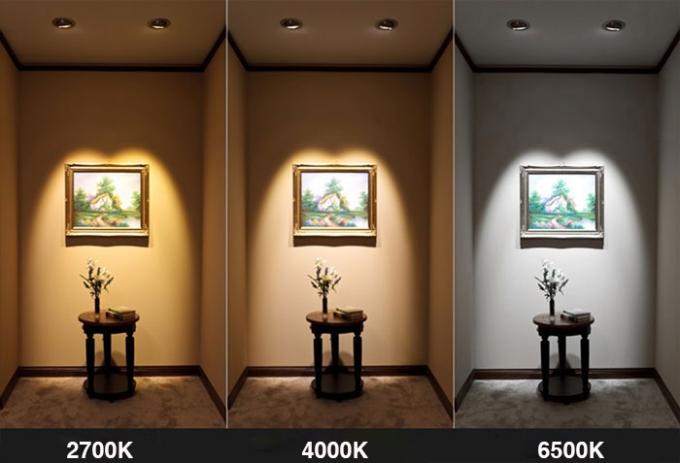
    Energy Labels: Efficiency and Market Acceptance?

    Shoppers compare bulbs by energy labels before price.

    Energy labels classify GU10 LEDs by efficiency, helping buyers predict cost savings and encouraging eco-friendly choices.

    Dive Deeper: The Power of Energy Labels

    The EU energy label uses a scale from A (most efficient) to G (least efficient). Since September 2021, the new label system has simplified the ratings, making them stricter.

    For GU10 LEDs, an A or B rating boosts market acceptance. Retailers love displaying high-efficiency products because customers trust them more.

    In my own orders, I noticed that GU10 LEDs with “A” labels outsell lower-rated products by a big margin, even if they cost slightly more. Buyers associate these labels with long lifespan, reduced energy bills, and better quality.

    The Energy Saving Trust estimated that GU10 LEDs can cut household costs from £11 per year (halogen) to just £2 per year. When I present this data in client meetings, it always closes deals faster.

    Risks of Ignoring Certifications?

    Skipping certifications may save costs upfront, but the risks are high.

    Without proper certifications, GU10 LED shipments risk customs rejection, fines, product recalls, and reputation damage.

    Dive Deeper: Real-World Risks

    Uncertified GU10 LEDs might still work, but they carry hidden dangers: fire hazards, toxic materials, or poor efficiency. Importers bear the financial and legal consequences if things go wrong.

    In 2019, a European distributor I know had 20,000 GU10 bulbs seized at customs because of fake CE markings. The shipment was destroyed, and he lost nearly €100,000.

    This is why I always warn new buyers: if a supplier cannot show test reports and certification numbers, walk away. The short-term “savings” are not worth the long-term risks.

    How to Verify Supplier Certifications?

    Understanding GU10 LED Certifications – CE, RoHS & Energy Labels: What Buyers Must Know  2

    Many suppliers claim certifications, but not all are real.

    To verify GU10 LED certifications, request test reports, cross-check lab accreditation, and confirm authenticity via EU databases.

    Dive Deeper: Practical Verification Steps

    Here’s how I personally verify certifications:

    • Request Full Reports – Not just logos, but detailed certificates with issue date, product model, and test lab details.

    • Check Lab Accreditation – Ensure the testing lab is ISO/IEC 17025 accredited.

    • Cross-Verify Online – Use EU databases to check CE and RoHS certificates.

    • Inspect Consistency – Certificate details must match the product’s SKU, wattage, and design.

    • Ask for DoC – The Declaration of Conformity must be signed by the manufacturer.

    When I meet suppliers at exhibitions, I always carry a checklist. If they hesitate to share documents or send blurred scans, that’s a clear warning. Professional suppliers will provide certificates confidently and transparently.

    FAQ

    Q: Can I sell GU10 LEDs in Europe without CE certification?

    A: No. CE certification is mandatory for legal entry into the EU.

    Q: Is RoHS certification required in the USA?

    A: While not mandatory in all states, many large retailers demand it as a condition.

    Q: Do energy labels affect B2B wholesale buyers?

    A: Yes. Even if wholesalers focus on price, retailers use labels to attract customers.

    Q: Can certificates be faked?

    A: Yes, which is why buyers must verify with accredited labs or official EU databases.

    Conclusion

    GU10 LED certifications protect buyers from risks and strengthen trust in the market. Always verify CE, RoHS, and energy labels before purchase.

  • Selectable CCT GU10 LED Bulb – Switchable Color Temperature with DIP & Wall Switch Contro

    Selectable CCT GU10 LED Bulb – Switchable Color Temperature with DIP & Wall Switch Contro

    .gtr-container-k7p2q9 {
    font-family: Verdana, Helvetica, “Times New Roman”, Arial, sans-serif;
    color: #333;
    line-height: 1.6;
    padding: 20px;
    max-width: 100%;
    box-sizing: border-box;
    }

    .gtr-container-k7p2q9 p {
        font-size: 14px;
        margin-bottom: 1em;
        text-align: left !important;
        word-break: normal;
        overflow-wrap: normal;
    }
    
    .gtr-container-k7p2q9 .gtr-section-title {
        font-size: 18px;
        font-weight: bold;
        margin-top: 2em;
        margin-bottom: 1em;
        color: #0056b3;
        padding-bottom: 5px;
        border-bottom: 1px solid #eee;
        text-align: left !important;
    }
    
    .gtr-container-k7p2q9 hr {
        border: none;
        border-top: 1px solid #ddd;
        margin: 30px 0;
    }
    
    .gtr-container-k7p2q9 img {
        max-width: 100%;
        height: auto;
        display: block;
        margin: 20px auto;
        box-shadow: 0 2px 8px rgba(0, 0, 0, 0.1);
        border-radius: 4px;
    }
    
    .gtr-container-k7p2q9 a {
        color: #007bff;
        text-decoration: none;
    }
    
    .gtr-container-k7p2q9 a:hover {
        text-decoration: underline;
    }
    
    .gtr-container-k7p2q9 .gtr-table-wrapper {
        overflow-x: auto;
        margin-bottom: 20px;
    }
    
    .gtr-container-k7p2q9 table {
        width: 100%;
        border-collapse: collapse !important;
        border-spacing: 0 !important;
        margin-bottom: 1em;
        font-size: 14px;
        min-width: 600px;
    }
    
    .gtr-container-k7p2q9 th,
    .gtr-container-k7p2q9 td {
        border: 1px solid #ccc !important;
        padding: 12px 15px !important;
        text-align: left !important;
        vertical-align: top !important;
        word-break: normal;
        overflow-wrap: normal;
    }
    
    .gtr-container-k7p2q9 th {
        background-color: #f8f8f8;
        font-weight: bold !important;
        color: #333;
    }
    
    .gtr-container-k7p2q9 tbody tr:nth-child(even) {
        background-color: #f2f2f2;
    }
    
    .gtr-container-k7p2q9 ul {
        list-style: none !important;
        margin: 0 0 1em 0 !important;
        padding: 0 !important;
    }
    
    .gtr-container-k7p2q9 ul li {
        position: relative;
        padding-left: 25px;
        margin-bottom: 8px;
        font-size: 14px;
        text-align: left !important;
    }
    
    .gtr-container-k7p2q9 ul li::before {
        content: "•";
        color: #007bff;
        font-weight: bold;
        position: absolute;
        left: 0;
        top: 0;
        font-size: 16px;
        line-height: 1.6;
    }
    
    .gtr-container-k7p2q9 ol {
        list-style: none !important;
        margin: 0 0 1em 0 !important;
        padding: 0 !important;
    }
    
    .gtr-container-k7p2q9 ol li {
        position: relative;
        padding-left: 30px;
        margin-bottom: 8px;
        font-size: 14px;
        text-align: left !important;
    }
    
    .gtr-container-k7p2q9 ol li::before {
        content: counter(list-item) ".";
        counter-increment: none;
        color: #007bff;
        font-weight: bold;
        position: absolute;
        left: 0;
        top: 0;
        font-size: 14px;
        line-height: 1.6;
        width: 20px;
        text-align: right;
    }
    
    @media (min-width: 768px) {
        .gtr-container-k7p2q9 {
            padding: 30px 40px;
            max-width: 960px;
            margin: 0 auto;
        }
    
        .gtr-container-k7p2q9 .gtr-section-title {
            font-size: 22px;
            margin-top: 2.5em;
            margin-bottom: 1.2em;
        }
    
        .gtr-container-k7p2q9 p {
            font-size: 15px;
        }
    
        .gtr-container-k7p2q9 th,
        .gtr-container-k7p2q9 td {
            padding: 10px 15px !important;
        }
    
        .gtr-container-k7p2q9 table {
            min-width: auto;
        }
    
        .gtr-container-k7p2q9 .gtr-table-wrapper {
            overflow-x: visible;
        }
    }
    

    Many distributors and wholesalers struggle with stocking multiple GU10 bulbs in different color temperatures to meet diverse customer needs. The GU10 three-stage color temperature solution eliminates this challenge by offering 2700K, 3300K, and 4000K in one product—reducing inventory pressure while increasing flexibility for resale and project installations.

    GU10 LED three-stage color temperature bulbs let users switch between 2700K, 3300K, and 4000K using either a DIP switch or a wall switch, offering flexible lighting control.

    This article will guide you step by step, from the basic concept to controls, B2B benefits, and real applications.

    Understanding GU10 Three-Stage Color Temperature?

    Selectable CCT GU10 LED Bulb – Switchable Color Temperature with DIP & Wall Switch Contro  0

    Color temperature defines how “warm” or “cool” a light looks. A three-stage GU10 LED allows switching between 2700K, 3300K, and 4000K.

    • 2700K → Warm white, cozy, soft atmosphere

    • 3300K → Natural white, balanced, versatile

    • 4000K → Cool white, bright, functional

    This range is carefully chosen. It avoids extreme cool tones and instead focuses on practical indoor applications like hotels, offices, retail, and homes.

    By consolidating three options in one bulb, wholesalers reduce SKU complexity and contractors gain flexibility in projects.

    DIP Switch Control – How It Works?

    Selectable CCT GU10 LED Bulb – Switchable Color Temperature with DIP & Wall Switch Contro  1

    DIP switch control means there is a small built-in switch at the base of the GU10 bulb. Installers set the desired color temperature before fitting.

    The DIP switch fixes one of the three stages (2700K, 3300K, or 4000K) until changed again manually.

    This is very useful for large projects where uniform lighting is needed. Contractors can set all bulbs to 3300K before installation, avoiding errors during operation.

    Wall Switch Three-Stage Color Temperature – Setup & Advantages?

    Selectable CCT GU10 LED Bulb – Switchable Color Temperature with DIP & Wall Switch Contro  2

    Wall switch control works differently. Instead of a manual switch, the bulb cycles color temperature each time the wall switch toggles on and off.

    Users simply flip the switch to rotate through 2700K, 3300K, and 4000K without extra controllers.

    This option is ideal for residential projects and retail retrofits where end-users want flexibility. For instance, a homeowner can change from bright cool white (4000K) for cleaning to warm white (2700K) for evening relaxation by just flipping the switch.

    DIP Switch vs Wall Switch: Pros & Cons

    Feature DIP Switch Control Wall Switch Control
    Setup Pre-set before installation Change anytime via wall switch
    Best use Hotels, offices, large projects Homes, retail, small retrofits
    Flexibility Fixed once installed Flexible for end-user
    Consistency Ensures uniform CCT across many fixtures May vary if users change settings
    Installation Requires pre-setting bulbs No extra step, user-controlled
    Risk of error Low once set Higher if users switch unintentionally

    Key Benefits for B2B Applications?

    For B2B buyers, Tri-CCT GU10 LEDs bring several clear advantages:

    • Reduced inventory pressure – One SKU replaces three separate CCT options.

    • Greater project flexibility – Contractors can adapt to different spaces on-site.

    • Lower return rate – Buyers no longer complain that the “color looks wrong.”

    • Easy cross-market sales – Works in retail, hospitality, office, and residential.

    How to Choose the Right GU10 LED with Three-Stage Color Temperature?

    Selectable CCT GU10 LED Bulb – Switchable Color Temperature with DIP & Wall Switch Contro  3

    When selecting, I recommend focusing on:

    • Color temperature range (2700K–4000K with 3300K as middle stage).

    • Control type (DIP switch for fixed setups, wall switch for flexibility).

    • Lumen output (ensure ≥500lm for general spotlight use).

    • CRI rating (CRI >80 for natural color rendering, CRI >90 for premium projects).

    • Certifications (CE, RoHS, Energy Star).

    • Dimming compatibility (phase-cut vs. trailing-edge dimmers).

    Applications & Case Examples?
    Application by Color Temperature

    Stage Color Temperature Typical Application
    2700K Warm white Hotel rooms, lounges, residential living areas
    3300K Natural white Retail shops, restaurants, general commercial spaces
    4000K Cool white Offices, task lighting, conference rooms

    Case Example:
    A contractor in Singapore equipped a mixed-use building with DIP switch GU10s. Offices used 4000K for productivity, retail stores preferred 3300K, while lounges kept 2700K for warmth. With one product, they satisfied multiple tenant needs and simplified spare parts management.

    Installation Tips and Common Issues?

    Tips:

    • Always check if the driver supports dimming before pairing with dimmers.

    • Confirm voltage compatibility (AC220-240V or AC110V depending on region).

    • Pre-set DIP switch before ceiling installation to avoid rework.

    • Label the wall switch cycle function for end-users.

    Common Issues:

    • Flicker with old dimmers – solved by checking compatibility list.

    • User confusion – wall switch models need instructions to avoid “wrong color” complaints.

    • Loose fitting – always use certified GU10 sockets.

    Conclusion

    GU10 three-stage color temperature LEDs (2700K / 3300K / 4000K) solve inventory, design, and user preference issues. They give buyers flexible control, reduce costs, and open wider applications.

    Author
    Chanfone Sun – Teco (Dimmable LED spotlight manufacturer)