Huizhou Henhui Electronics Technology Co., Ltd.

分类: 未分类

  • GU10 LED Bulb Wholesale for European Buyers: How to Secure Stable Supply, Competitive Prices, and Certified Quality

    GU10 LED Bulb Wholesale for European Buyers: How to Secure Stable Supply, Competitive Prices, and Certified Quality

    Many European buyers enter GU10 LED bulb wholesale with a simple objective: lower purchase price.
    Months later, problems appear—unstable deliveries, inconsistent batches, dimming complaints, or missing compliance documents. At that point, price is no longer the issue.

    GU10 LED bulb wholesale in Europe succeeds only when supply stability, sustainable pricing, and EU compliance are managed together as one system—not negotiated separately.

    This guide explains how European buyers can build a GU10 LED wholesale sourcing model that survives scale, audits, and long-term market pressure, rather than relying on short-term pricing or supplier promises.

    Three Key Targets for EU GU10 Wholesale: Supply, Price, and Compliance

    European GU10 wholesale is not a single-variable decision. It is a three-axis balance.

    For GU10 LED bulb wholesale in Europe, success depends on achieving stable supply, competitive pricing, and certified compliance at the same time.

    Why these three targets cannot be separated

    Many buyers attempt to optimize only one factor:

    • the lowest unit price

    • the fastest delivery

    • the cheapest certificate

    This approach often works for the first order—and fails on the second.

    In the EU market:

    • unstable supply breaks retail and project commitments

    • missing or incorrect compliance blocks customs clearance

    • inconsistent quality damages distributor and end-customer trust

    A professional GU10 LED wholesale supplier for Europe must support all three targets simultaneously.

    Target 1: Supply stability

    Supply stability means:

    • predictable lead times

    • repeatable specifications

    • controlled materials and processes

    It matters far more than short-term speed.

    Target 2: Competitive price, not the cheapest price

    Wholesale success depends on:

    • margin stability

    • long-term cost control

    • predictable landed cost

    The cheapest quotation often hides future cost.

    Target 3: EU compliance as a baseline, not an option

    For European buyers, compliance responsibility does not sit with the factory.

    CE, RoHS, and energy labeling are legal obligations of the EU importer.
    They are commercial risks, not paperwork details.

    The wholesale mindset shift

    Successful European buyers stop asking:

    “How cheap is this GU10 bulb?”

    And start asking:

    “How stable is this supply over the next 24 months?”

    How to Assess Supply Stability: Capacity, Planning, and Materials

    GU10 LED Bulb Wholesale for European Buyers: How to Secure Stable Supply, Competitive Prices, and Certified Quality  0

    Supply stability is rarely visible in samples. It reveals itself through factory structure.

    Stable GU10 LED bulb supply comes from disciplined capacity planning, controlled materials, and production focus—not from promises.

    Capacity is more than production lines

    When evaluating a factory, buyers should ask:

    • How many production lines are dedicated to GU10?

    • Are those lines shared with many unrelated SKUs?

    • Is GU10 a core product or a secondary item?

    Factories that treat GU10 as a core category behave very differently from general lighting factories.

    Planning discipline

    Stable suppliers plan production weeks ahead, not days.

    Signs of strong planning include:

    • forecast-based scheduling

    • fixed monthly capacity allocation

    • buffer stock for critical materials

    Red flags include:

    • constant “urgent order” language

    • shifting delivery commitments

    • repeated reconfirmation of lead times

    Material control and BOM stability

    European buyers should ask directly:

    • How often do LED chips change?

    • Are drivers fixed or substituted based on price?

    • Is housing thickness and material controlled?

    Silent BOM changes are the main cause of:

    • CCT drift

    • dimming inconsistency

    • lifetime variation

    Professional factories freeze BOMs and require written approval before any change.

    Supplier dependency risk

    A stable factory maintains:

    • long-term LED chip partners

    • fixed driver suppliers

    • in-house assembly control

    Factories that frequently change upstream suppliers transfer risk downstream to buyers.

    Quick checklist: Supply stability evaluation

    • Dedicated GU10 production lines

    • Fixed BOM with change notification process

    • Forecast-based production planning

    • Stable LED chip and driver partners

    • Batch traceability in production

    If several of these are missing, long-term stability is unlikely.

    How to Secure Competitive Pricing Sustainably: Cost Structure and Negotiation

    Competitive pricing is not achieved by pushing quotes down.
    It is achieved by structuring cost correctly.

    Sustainable GU10 LED bulk pricing depends on cost transparency and long-term negotiation logic—not short-term pressure.

    Understanding real GU10 cost structure

    A GU10 LED bulb cost typically includes:

    Cost Element Risk if Uncontrolled
    LED chips Color and lumen drift
    Driver Flicker and dimming failure
    Housing Thermal instability
    Labor Assembly inconsistency
    QC and aging Early field failure
    Certification Import risk
    Factory margin Supplier survival

    Factories that cut cost blindly usually cut stability first.

    Why short-term price pressure backfires

    Aggressive price squeezing often leads to:

    • driver downgrades

    • thinner housings

    • reduced aging tests

    • silent component substitution

    These changes rarely appear on the invoice.
    They appear later as complaints, returns, and warranty claims.

    Sustainable pricing strategies for EU buyers

    European buyers achieve better long-term pricing by:

    • committing annual volumes

    • standardizing SKUs

    • locking specifications

    • allowing production planning

    Factories reward predictability far more than pressure.

    Negotiation questions that work

    Instead of asking:

    “Can you go lower?”

    Ask:

    • Which cost elements are fixed?

    • What volume stabilizes pricing?

    • Which specification changes reduce cost safely?

    This positions the buyer as a long-term partner rather than a transactional customer.

    Private-label advantage

    Working with a private-label GU10 LED manufacturer allows buyers to:

    • remove unnecessary features

    • optimize packaging

    • align cost with market positioning

    This is where ODM pricing consistently outperforms branded products.

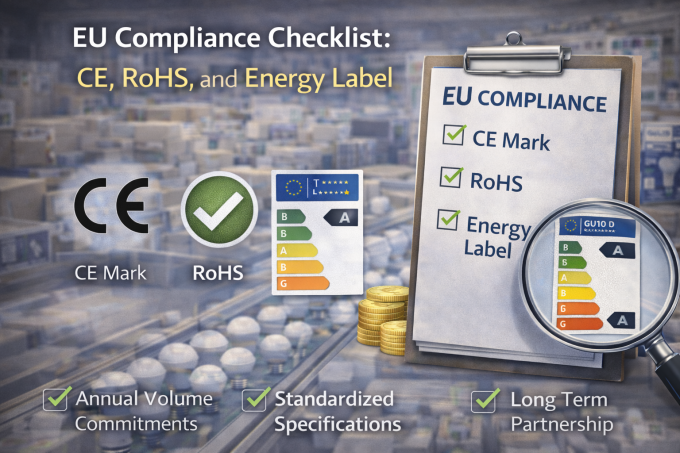
    EU Compliance Checklist: CE, RoHS, and Energy Label
    GU10 LED Bulb Wholesale for European Buyers: How to Secure Stable Supply, Competitive Prices, and Certified Quality  1

    Compliance is not documentation. It is legal responsibility.

    Certified GU10 LED bulbs for the EU market must meet CE, RoHS, and energy labeling requirements exactly—not approximately.

    CE marking essentials

    CE compliance requires:

    • Low Voltage Directive (LVD)

    • EMC compliance

    • complete technical documentation

    Buyers should request:

    • EU Declaration of Conformity

    • test reports from accredited laboratories

    CE marking without traceable reports has no legal value.

    RoHS compliance

    RoHS controls hazardous substances.

    Buyers should require:

    • RoHS test reports

    • material declarations

    • consistency across production batches

    A single RoHS failure can block an entire shipment.

    Energy labeling and EPREL

    EU energy labeling requires:

    • correct energy class

    • accurate QR code data

    • EPREL database registration

    Incorrect labeling leads to fines, relabeling, or product withdrawal.

    Quick compliance verification checklist

    • DoC matches exact model number

    • Test reports cover wattage, CCT, and dimming version

    • EPREL registration completed

    • Energy label reflects current EU regulation

    If any item is unclear, risk remains with the importer.

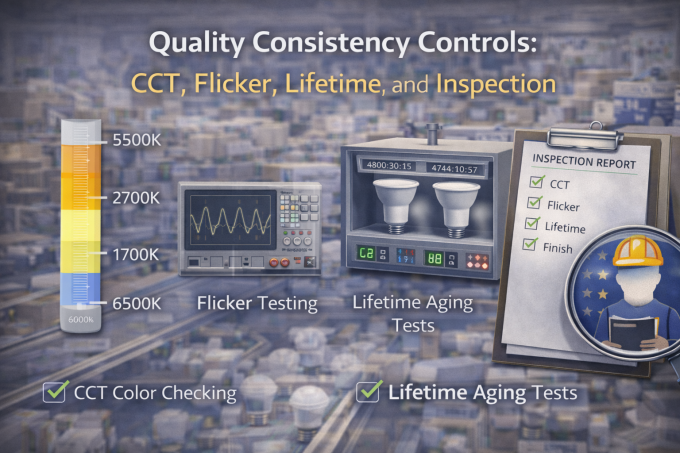
    Quality Consistency Controls: CCT, Flicker, Lifetime, and Inspection
    GU10 LED Bulb Wholesale for European Buyers: How to Secure Stable Supply, Competitive Prices, and Certified Quality  2

    Quality consistency determines whether wholesale scales smoothly or collapses.

    GU10 LED bulb wholesale in Europe requires tight control over CCT, flicker, lifetime, and inspection processes.

    CCT and color consistency

    Buyers should confirm:

    • MacAdam ellipse level

    • fixed LED binning across batches

    Color inconsistency quickly destroys retail and project credibility.

    Flicker and driver stability

    Flicker causes:

    • eye strain complaints

    • hospitality project rejection

    • brand damage

    European buyers should require:

    • flicker measurement data

    • stable driver behavior at low voltage

    • clear dimmer compatibility boundaries

    Lifetime and thermal management

    Lifetime claims depend on structure, not marketing.

    Buyers should ask for:

    • LM-80 data

    • TM-21 projections

    • real aging test procedures

    Inspection and traceability

    Reliable factories perform:

    • incoming material inspection

    • in-process checks

    • aging tests

    • final functional tests

    Batch traceability enables accountability and root-cause analysis.

    Contract Terms That Lock Risk: Warranty, Compensation, and Lead Time

    Contracts convert promises into enforceable behavior.

    Strong contracts are essential for stable GU10 LED wholesale in Europe.

    Key clauses should define:

    • warranty duration and failure definition

    • compensation thresholds

    • lead time commitments

    • mandatory change notification

    Silent changes are one of the biggest wholesale risks.

    Best-Practice Model: Primary Supplier + Backup Supplier + Standardized SKUs

    Professional European buyers rarely rely on a single factory.

    The most resilient GU10 LED wholesale model uses a primary supplier, a qualified backup supplier, and standardized SKUs.

    This structure:

    • reduces dependency risk

    • strengthens negotiation leverage

    • stabilizes long-term supply

    Backup suppliers must be pre-tested and contract-ready, not theoretical.

    Conclusion

    GU10 LED bulb wholesale for European buyers succeeds when supply stability, competitive pricing, and EU-certified quality are deliberately structured—not negotiated reactively.

    Teco supports GU10 LED bulb wholesale buyers in Europe with a focus on long-term stability, certified compliance, and predictable pricing.

    As a private-label GU10 LED manufacturer, we support:

    • stable GU10 LED supply programs

    • CE, RoHS, and EU energy label compliance

    • ODM and private-label projects

    • bulk planning for European markets

    Email: [email protected]
    Website: www.tecolite.com

    If you are evaluating GU10 wholesale sourcing, tell us:

    • annual volume

    • target EU markets

    • compliance and dimming requirements

    We will help you design a GU10 wholesale supply model that works beyond the first order.
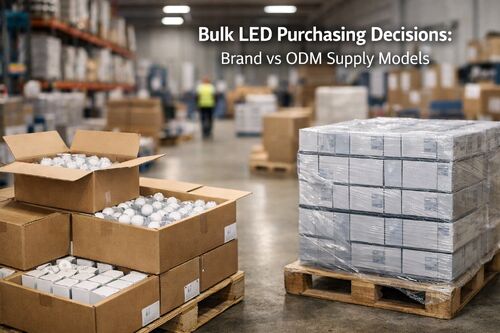
  • Philips Light Bulbs vs ODM LED Bulbs: A Practical Guide for Bulk Purchasing Decisions

    Philips Light Bulbs vs ODM LED Bulbs: A Practical Guide for Bulk Purchasing Decisions

    Bulk LED purchasing is rarely a simple price comparison. Many sourcing problems emerge months after the first shipment—when specifications change, replacements become difficult, or long-term costs rise unexpectedly.

    The real question in bulk LED procurement is not whether Philips or ODM LED bulbs are “better,” but which supply model aligns with your purchasing volume, risk tolerance, and long-term supply strategy.

    This article explains the structural differences between Philips-branded LED bulbs and ODM LED bulbs, analyzes their cost and risk profiles, and provides a practical framework to help B2B buyers choose the right option—or combine both—based on real application scenarios.

    Understanding the Fundamental Difference: Brand-Controlled vs Buyer-Controlled Supply

    Philips Light Bulbs vs ODM LED Bulbs: A Practical Guide for Bulk Purchasing Decisions  0

    Philips and ODM LED bulbs are built on fundamentally different supply-chain philosophies.

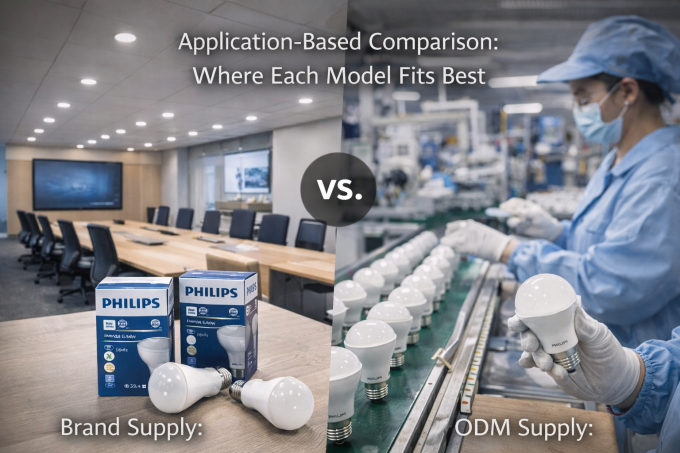
    Philips represents a brand-controlled product model, while ODM represents a buyer-controlled manufacturing model.

    Who controls the product?

    With Philips LED bulbs:

    • Product specifications are fixed by the brand

    • Lifecycle changes are brand-driven

    • Buyers select from predefined SKUs

    • Product discontinuation is outside buyer control

    With ODM LED bulbs:

    • Buyers define performance, structure, and packaging

    • Factories manufacture to specification

    • Buyers control long-term SKU continuity

    • Changes require buyer approval

    This difference in control is more important than brand reputation or unit price, especially for repeat or long-term bulk purchasing.

    What “bulk purchasing” means in each model

    For Philips, bulk purchasing typically means:

    • Volume-based discounts on standard products

    • Consistent documentation and certification

    • Limited flexibility beyond catalog offerings

    For ODM suppliers, bulk purchasing means:

    • Long production runs

    • Cost optimization through stable BOMs

    • Deeper technical coordination with the buyer

    The same term—bulk—leads to very different supply behaviors.

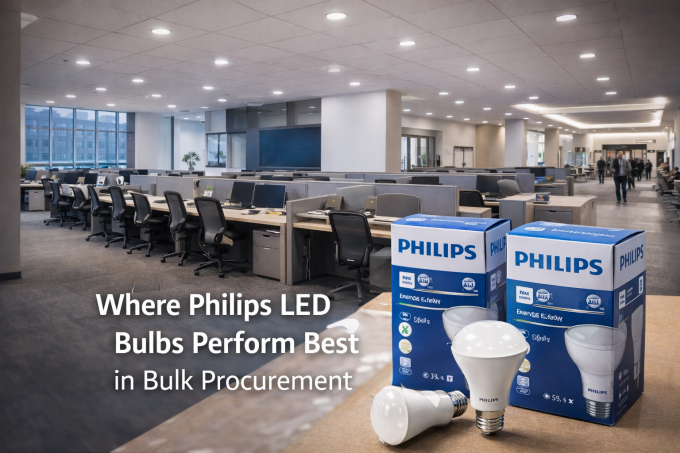
    Where Philips LED Bulbs Perform Best in Bulk Procurement

    Philips Light Bulbs vs ODM LED Bulbs: A Practical Guide for Bulk Purchasing Decisions  1

    Philips remains a benchmark supplier for buyers who prioritize predictability and reduced decision complexity.

    Philips LED bulbs perform best when stability, documented compliance, and reduced buyer responsibility are critical.

    Strengths of the Philips model

    Philips offers advantages in areas such as:

    • Consistent product performance across regions

    • Well-maintained certification and documentation

    • Established compatibility with control systems

    • Structured warranty and after-sales processes

    For buyers with limited technical resources, this model shifts much of the operational risk to the brand.

    Typical use cases for Philips in bulk purchasing

    Philips is often preferred when:

    • Brand recognition is required for approval

    • Projects involve public or institutional procurement

    • Documentation scrutiny is high

    • Technical risk must be minimized

    In these cases, higher unit cost is often accepted as a trade-off for reduced uncertainty.

    Structural limitations to consider

    However, Philips sourcing also has constraints:

    • Limited customization options

    • Forced product updates or discontinuation

    • Less control over long-term SKU availability

    • Pricing flexibility constrained by brand structure

    For buyers managing multi-year supply programs, these factors can become restrictive.

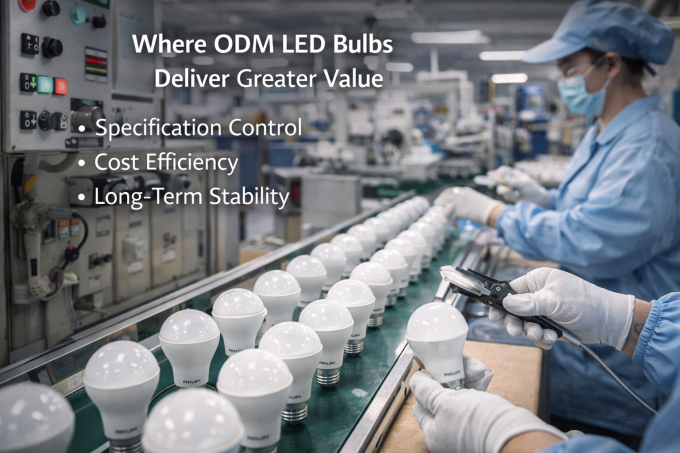
    Where ODM LED Bulbs Deliver Greater Value

    Philips Light Bulbs vs ODM LED Bulbs: A Practical Guide for Bulk Purchasing Decisions  2

    ODM LED bulbs operate under a fundamentally different logic.

    ODM suppliers deliver value when buyers seek cost efficiency, specification control, and long-term supply continuity.

    Cost efficiency through manufacturing focus

    ODM pricing benefits from:

    • Factory-direct production

    • Lower brand and marketing overhead

    • Optimization across large production volumes

    For high-volume purchases, cost differences can be significant—especially when specifications remain stable over time.

    Customization as a structural advantage

    ODM suppliers can manufacture to buyer-defined requirements, including:

    • Lumen output and power

    • Color temperature and CRI targets

    • Beam angles and optical structure

    • Dimming behavior and driver configuration

    • Packaging and private labeling

    This allows buyers to avoid paying for unnecessary features and tailor products to specific markets.

    Long-term product lifecycle control

    One often overlooked advantage of ODM sourcing is lifecycle stability.

    Buyers can:

    • Maintain the same model for multiple years

    • Avoid forced redesigns

    • Ensure consistent field performance across batches

    For wholesalers, residential developers, and repeat-order customers, this stability often outweighs initial cost savings.

    Responsibilities that shift to the buyer

    ODM sourcing requires buyers to actively manage:

    • Technical specifications

    • Compatibility testing

    • Quality control expectations

    • Change notification and approval processes

    ODM rewards prepared buyers with clear requirements and disciplined supplier management.

    Application-Based Comparison: Where Each Model Fits Best

    Philips Light Bulbs vs ODM LED Bulbs: A Practical Guide for Bulk Purchasing Decisions  0

    Different environments amplify different strengths.

    Hotels and hospitality

    Hotels prioritize guest comfort, reliability, and operational simplicity.

    • Philips: Often used in premium or brand-sensitive areas where predictability is critical

    • ODM: Common in guest rooms and large deployments where cost and consistency matter

    Many hospitality projects adopt a hybrid approach.

    Commercial and retail spaces

    Commercial environments emphasize efficiency and scalability.

    • Philips: Suitable for flagship or corporate-standard locations

    • ODM: Well suited for retail chains and cost-sensitive rollouts

    ODM’s flexibility often aligns better with large commercial programs.

    Residential developments

    Residential bulk buyers typically focus on:

    • Cost control

    • Long-term availability

    • Reduced maintenance

    ODM LED bulbs generally perform better in these scenarios due to stable specifications and repeat production.

    Large-scale and infrastructure projects

    For large projects:

    • Philips reduces coordination risk

    • ODM reduces financial exposure

    The deciding factor is usually who carries technical and operational responsibility.

    Cost vs Risk: How Bulk Buyers Should Think About Trade-Offs

    Philips Light Bulbs vs ODM LED Bulbs: A Practical Guide for Bulk Purchasing Decisions  4

    Bulk LED procurement decisions should evaluate total cost over time, not unit price alone.

    Cost considerations

    • Philips typically has higher upfront unit cost

    • ODM offers lower unit cost, especially at scale

    However, cost evaluation must include:

    • Replacement rates

    • Re-certification needs

    • Internal quality management effort

    Risk distribution

    Risk Area Philips Model ODM Model
    Design responsibility Brand Buyer
    Product continuity Brand-controlled Buyer-controlled
    Quality variability Lower Depends on specification
    Change management Limited buyer influence Buyer-managed

    Experienced buyers often prefer ODM because risks are visible and controllable. Less experienced buyers may prefer Philips because risks are externalized.

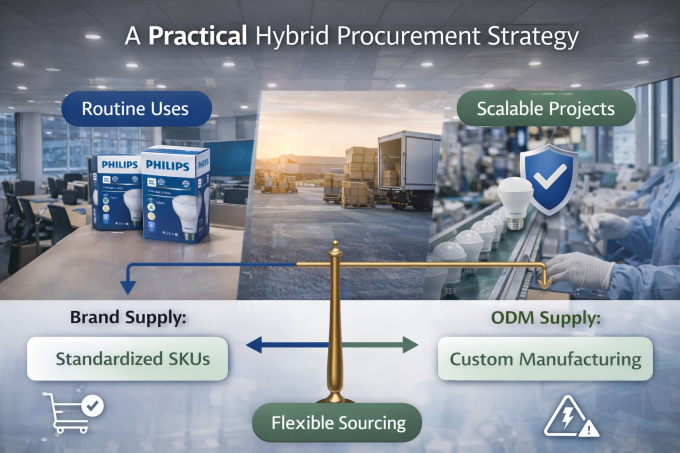
    A Practical Hybrid Procurement Strategy

    Philips Light Bulbs vs ODM LED Bulbs: A Practical Guide for Bulk Purchasing Decisions  5

    Many professional buyers do not choose one model exclusively.

    A hybrid procurement strategy combines the strengths of Philips and ODM while managing risk by application.

    How hybrid sourcing typically works

    Common approaches include:

    • Philips for high-visibility or approval-critical areas

    • ODM for large-volume, repeat installations

    This allows buyers to balance cost efficiency with risk control.

    Key rules for hybrid sourcing

    Hybrid strategies work best when:

    • Product roles are clearly defined

    • Overlap between models is minimized

    • Specifications are aligned across suppliers

    Random mixing without structure creates operational complexity.

    A Buyer’s Checklist for Bulk LED Purchasing Decisions

    Before committing to Philips, ODM, or a hybrid strategy, buyers should confirm:

    • Are specifications frozen and documented?

    • Is change notification (PCN) required and enforced?

    • Are certifications valid for the target market?

    • Has dimming and control compatibility been tested?

    • Is long-term availability guaranteed?

    • Who handles failures and replacements?

    These questions reveal whether a supply model truly fits your business.

    Conclusion

    Philips LED bulbs and ODM LED bulbs serve different bulk purchasing needs. Philips offers brand-backed stability and reduced decision complexity, while ODM provides cost efficiency, customization, and long-term supply control.

    The better option is not universal—it depends on how you manage risk, scale, and product continuity.

    Teco supports B2B buyers evaluating ODM LED bulbs as part of long-term, cost-controlled procurement strategies.

    We specialize in:

    • ODM GU10, MR16, and LED bulb programs

    • Stable specifications and repeat production

    • Compatibility testing and documentation support

    • Hybrid sourcing strategies alongside global brands

    Our role is not to replace brands blindly, but to help buyers choose the supply structure that fits their business model.

    Email: [email protected]
    Website: www.tecolite.com

    Tell us your purchasing volume, target market, and risk priorities.
    We will help you determine whether Philips, ODM, or a hybrid approach is the right fit for your bulk LED procurement.

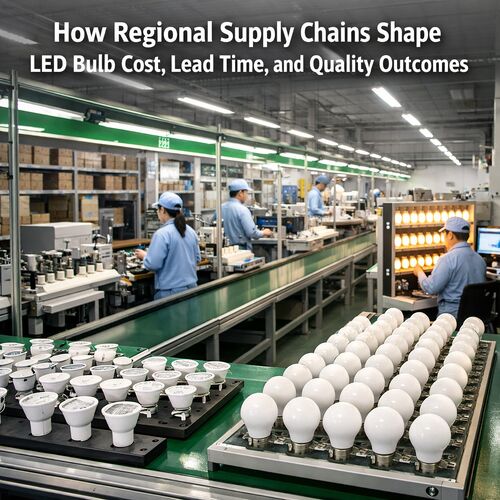
  • How Regional Supply Chains Shape LED Bulb Cost, Lead Time, and Quality Outcomes

    How Regional Supply Chains Shape LED Bulb Cost, Lead Time, and Quality Outcomes

    Many B2B buyers compare LED bulbs primarily by unit price. Months later, they encounter unstable lead times, inconsistent quality, and rising hidden costs. In most cases, the problem is not the bulb itself—it is the regional supply chain structure behind the product.

    In China’s LED industry, regional supply chains behave differently.
    For standardized LED bulbs such as GU10, MR16, and A60, regions like Zhejiang prioritize stability and repeatability, while more flexible regions such as Guangdong prioritize responsiveness and adjustment. These structural differences directly shape how costs accumulate, how reliably orders ship, and how consistent quality remains over time.

    Understanding this relationship helps buyers avoid false savings and choose suppliers that support long-term programs rather than short-term pricing wins.

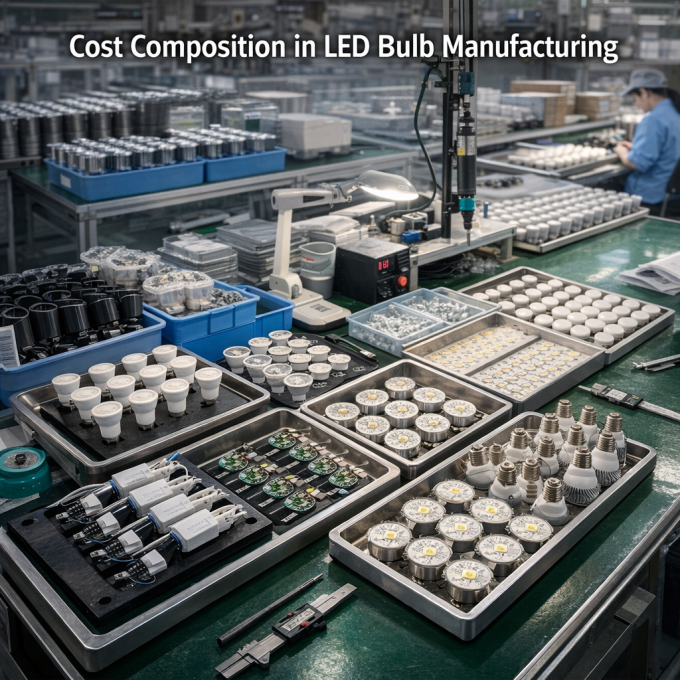
    Cost Composition in LED Bulb Manufacturing

    How Regional Supply Chains Shape LED Bulb Cost, Lead Time, and Quality Outcomes  0

    LED bulb cost is not a single number. It is the result of structural decisions embedded in the supply chain.

    In stability-oriented regions such as Zhejiang, cost control focuses on process discipline and long-term predictability. In flexibility-oriented regions such as Guangdong, cost control often emphasizes short-term adaptability. Both approaches can produce similar initial quotes, but their long-term behavior differs significantly.

    What actually makes up LED bulb cost

    A typical LED bulb cost includes:

    Cost Element Description
    LED chips Light source consistency and binning
    Driver Electrical stability and lifespan
    Housing Thermal and mechanical structure
    Assembly labor Yield and repeatability
    Quality control Inspection, aging, and testing
    Certification Compliance maintenance
    Overhead Factory operation costs
    Risk buffer Defects, rework, returns

    The quoted unit price reflects how these elements are managed, not just how much they cost.

    Structural cost behavior by region

    Stability-driven supply chains typically emphasize:

    • frozen BOMs

    • long-term supplier contracts

    • yield optimization over time

    Flexibility-driven supply chains often rely on:

    • frequent component sourcing changes

    • short-term pricing adjustments

    • rapid substitution to meet timelines

    Both models can appear competitive initially. Only one remains predictable over time.

    Upfront savings versus structural cost

    Low initial pricing often comes from:

    • reduced aging tests

    • looser binning tolerance

    • minimal QC buffers

    These choices lower the first invoice but increase downstream risk.

    Stable supply chains invest more upfront to prevent downstream cost rather than reacting to it later.

    Why buyers misjudge cost

    Most buyers compare:

    • unit price

    Few buyers compare:

    • cost stability over 12–24 months

    • re-certification exposure

    • internal QC and return handling cost

    Regional supply chain behavior determines which costs remain hidden until scale exposes them.

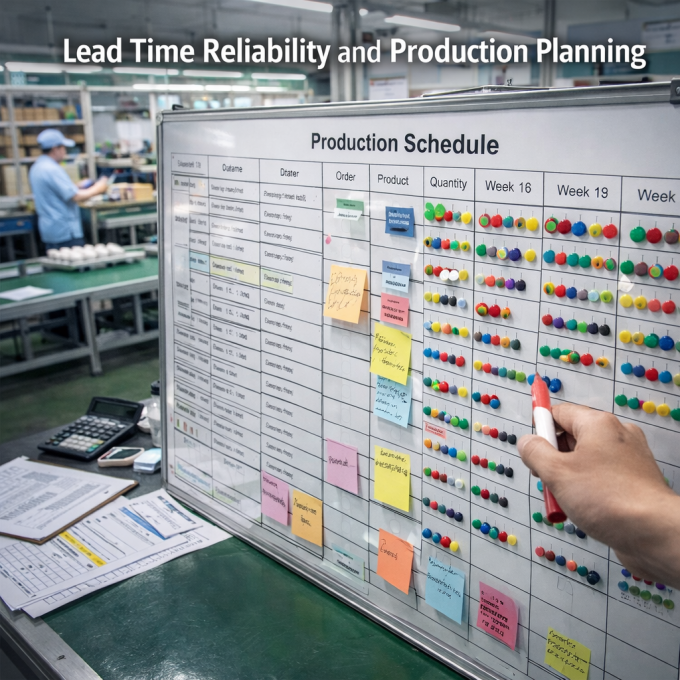
    Lead Time Reliability and Production Planning

    How Regional Supply Chains Shape LED Bulb Cost, Lead Time, and Quality Outcomes  1

    Lead time issues are rarely caused by a single late shipment. They come from how factories plan production and allocate capacity.

    Stable regions such as Zhejiang optimize for production rhythm and commitment protection. Flexible regions such as Guangdong optimize for rapid adjustment and reprioritization.

    What drives LED bulb lead time

    Key lead time drivers include:

    • LED chip availability

    • driver sourcing

    • housing production

    • assembly capacity

    • aging and QC duration

    The difference lies in how tightly these steps are coordinated.

    Long-run versus short-run production logic

    Some regions favor:

    • long production runs

    • fewer SKUs

    • predictable schedules

    Others favor:

    • mixed SKUs

    • short runs

    • frequent changeovers

    Long-run logic reduces planning noise.
    Short-run logic increases responsiveness but reduces predictability.

    Speed versus reliability

    Fast is not the same as reliable.

    Aspect Stable Supply Chains Flexible Supply Chains
    Quoted lead time Moderate Often shorter
    Delivery accuracy High Variable
    Schedule changes Rare Common
    Priority shifts Low Frequent

    Buyers often prefer faster quotes.
    Operations teams depend on reliable delivery.

    Behavior under market disruption

    During component shortages or logistics disruptions:

    • stable supply chains tend to protect existing orders

    • flexible supply chains often reallocate capacity toward higher-margin or urgent orders

    This difference only becomes visible under pressure.

    For inventory-driven businesses, reliability matters more than speed.

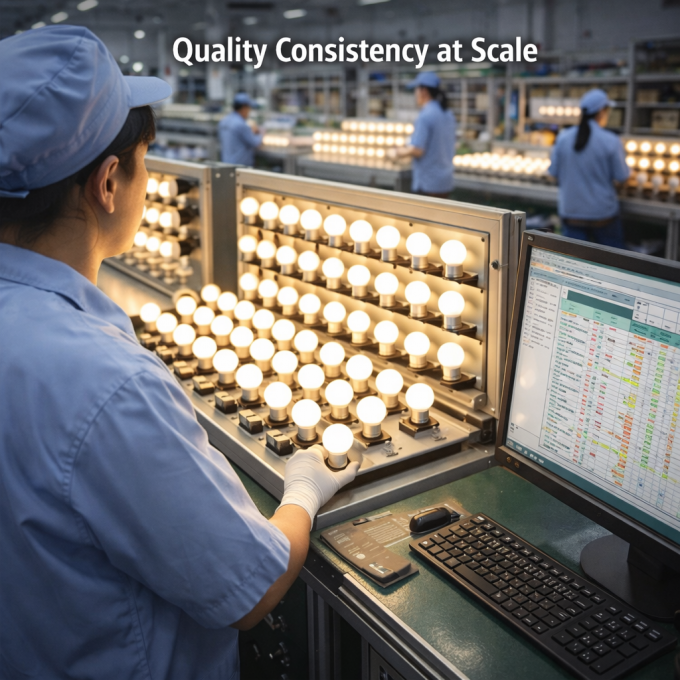
    Quality Consistency at Scale

    How Regional Supply Chains Shape LED Bulb Cost, Lead Time, and Quality Outcomes  2

    Quality problems rarely appear in the first sample. They emerge when orders scale.

    LED bulbs are mass-installed, visually comparable, and electrically sensitive. Small variation becomes obvious quickly.

    Why bulbs expose inconsistency

    Typical symptoms include:

    • color shift between batches

    • inconsistent dimming behavior

    • early thermal-related failures

    These issues damage brand trust and distributor confidence.

    Sources of batch variation

    Variation usually comes from:

    • LED bin changes

    • driver substitutions

    • housing tolerance drift

    • assembly process deviation

    Supply chains differ in how aggressively they prevent these changes.

    Process-driven versus adjustment-driven quality

    Process-driven regions emphasize:

    • fixed work instructions

    • frozen BOMs

    • long-term supplier alignment

    Adjustment-driven regions rely more on:

    • inspection after change

    • correction after failure

    Prevention performs better at scale than correction.

    Scale amplifies small decisions

    A 0.5% defect rate appears minor.

    At scale:

    • 1,000 bulbs → 5 failures

    • 50,000 bulbs → 250 failures

    Returns, replacements, and reputation cost follow.

    Documentation and traceability

    Stable supply chains usually maintain:

    • batch traceability

    • component history

    • aging and test records

    This allows fast root-cause analysis.

    In less structured environments, problems are harder to resolve conclusively.

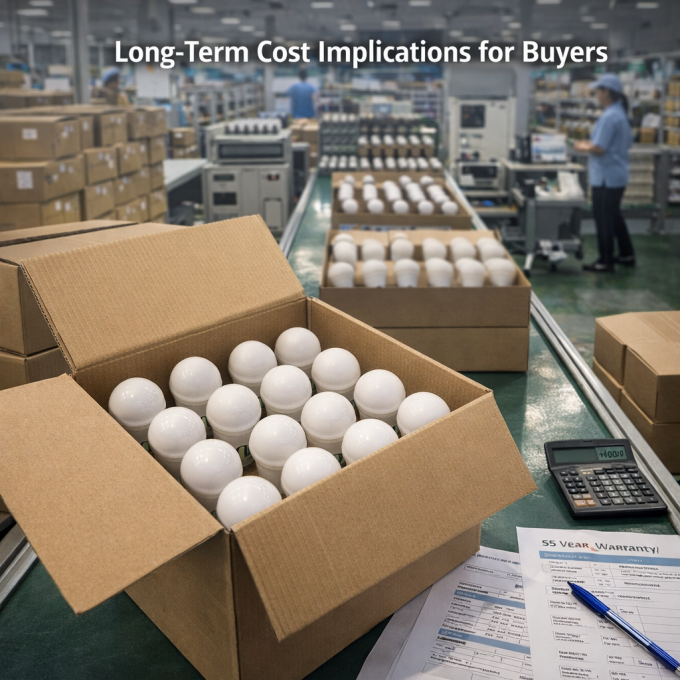
    Long-Term Cost Implications for Buyers

    How Regional Supply Chains Shape LED Bulb Cost, Lead Time, and Quality Outcomes  3

    The real cost of LED bulbs is revealed over time, not on the invoice.

    Stable supply chains reduce operational friction. Flexible supply chains shift more responsibility onto the buyer.

    Hidden long-term costs

    Common overlooked costs include:

    • re-certification

    • internal QC labor

    • inventory write-offs

    • customer complaints

    • warranty replacements

    These costs rarely appear in the quoted price.

    Cost behavior over product life

    In unstable supply chains, buyers often encounter:

    • silent component changes

    • performance drift

    • unexpected price adjustments

    Each change triggers internal cost.

    Stable supply chains reduce the frequency of these events.

    Brand and reputation impact

    For wholesalers and brand owners:

    • inconsistent bulbs increase return rates

    • quality disputes strain distributor relationships

    Recovering trust costs more than saving cents per unit.

    Inventory and cash flow pressure

    Unstable lead times force buyers to:

    • hold higher safety stock

    • delay launches

    • lock cash in inventory

    Predictable supply chains reduce these pressures.

    When flexibility still makes sense

    Flexible supply chains remain valuable when:

    • volumes are small

    • designs change frequently

    • speed outweighs continuity

    For standardized LED bulbs, continuity usually delivers lower total cost.

    Conclusion

    Regional supply chains shape LED bulb cost behavior, lead time reliability, and quality consistency. Stability-oriented regions favor predictability and long-term value, while flexibility-oriented regions trade consistency for speed.

    For standardized LED bulbs, long-term performance depends less on quoted price and more on how the supply chain behaves over time.

    Teco supports global B2B buyers sourcing GU10, MR16, and A60 LED bulbs with a focus on long-term cost stability, reliable lead times, and consistent quality.

    Our manufacturing base operates in Zhejiang, where supply chain structure prioritizes:

    • frozen specifications

    • predictable production planning

    • low batch variation

    • compliance-focused export markets

    If you are evaluating LED bulb suppliers and want to understand not just price, but supply chain behavior:

    Email: [email protected]
    Website: www.tecolite.com

    Tell us your order volume, target market, and growth horizon.
    We help buyers choose supply chains that remain stable after the first order—not just competitive on it.

  • Which LED Supply Chain Fits Your Business Model: Wholesale, Brand, or Projects

    Which LED Supply Chain Fits Your Business Model: Wholesale, Brand, or Projects

    Many LED sourcing problems are not caused by poor factories or weak quality control.
    They come from choosing the wrong supply chain for the wrong business model.

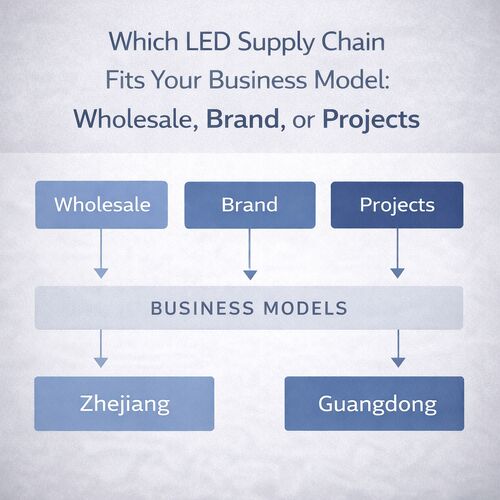
    Different LED business models—wholesale, private-label brands, and project-based lighting—operate under fundamentally different pressures. In China, this difference is most clearly reflected between Zhejiang and Guangdong, two regions optimized for very different types of LED business.

    Zhejiang and Guangdong serve different commercial logics. The right choice depends more on how you sell than on what you buy.

    Price sensitivity, SKU stability, customization depth, documentation discipline, and delivery rhythm are not the same across business models. This article explains how each model actually works, which supply chain fits it best, and where buyers most often make costly mistakes.

    Wholesale-Oriented LED Business Models

    Which LED Supply Chain Fits Your Business Model: Wholesale, Brand, or Projects  0

    Wholesale businesses live on repetition, margin control, and operational stability. Speed and novelty matter far less than predictability.

    Wholesale LED businesses require stable SKUs, consistent quality, and long-term cost control—not rapid customization.

    How wholesale LED businesses really operate

    A typical wholesale model involves:

    • large-volume purchasing

    • repeat orders of identical SKUs

    • inventory stocking

    • downstream price competition

    Profit depends on:

    • turnover speed

    • purchase consistency

    • low return rates

    Any disruption in product consistency directly damages margin.

    What wholesalers require from the supply chain

    Wholesale buyers depend on suppliers that can deliver:

    Requirement Why It Matters
    Frozen specifications Avoid re-approval cycles
    Stable BOM Prevent cost drift
    Consistent appearance Reduce customer complaints
    Predictable lead times Inventory planning
    Low defect rate Protect margin

    Frequent design changes or silent component substitutions create operational chaos.

    Why Zhejiang fits wholesale sourcing best

    Zhejiang supply chains are structurally aligned with wholesale logic.

    They emphasize:

    • standardized LED bulbs (GU10, MR16, E27, A60)

    • long production runs

    • conservative engineering

    • repeatability over novelty

    Factories are comfortable producing the same model for years with only internal yield improvements.

    This protects wholesalers from:

    • unexpected spec changes

    • re-certification risk

    • batch-to-batch variation

    Where wholesalers struggle in Guangdong

    Guangdong factories often operate with:

    • high SKU churn

    • frequent BOM adjustments

    • project-driven priorities

    For wholesale buyers, this flexibility creates risk.

    Common issues include:

    • silent component changes

    • inconsistent dimming behavior

    • rising QC workload

    These are structural issues, not individual factory failures.

    Wholesale takeaway:
    If your revenue depends on repeat sales of standardized LED bulbs, Zhejiang is usually the safer foundation. Guangdong may appear competitive initially, but long-term stability favors Zhejiang.

    Brand and OEM-Oriented LED Business Models

    Which LED Supply Chain Fits Your Business Model: Wholesale, Brand, or Projects  1

    Brand owners operate between wholesale and projects. They need differentiation, but cannot afford instability.

    Brand and OEM businesses require controlled customization, stable quality, and suppliers that respect long-term product identity.

    How brand-led LED businesses function

    Brand owners typically:

    • define product positioning

    • rely on OEM / ODM factories

    • sell under their own brand

    • carry reputational risk

    Unlike wholesalers, brand owners care deeply about:

    • appearance consistency

    • performance claims

    • customer perception

    A single quality issue can damage years of brand investment.

    What brand buyers need from suppliers

    Requirement Reason
    Controlled customization Differentiation without chaos
    Long-term SKU continuity Brand consistency
    Transparent change control Protect certification and claims
    Stable optical and thermal performance Customer trust
    OEM discipline Private-label integrity

    Brand buyers want progress without disruption.

    Zhejiang’s role for brand-led businesses

    Zhejiang is strong for brands when:

    • products are standardized bulbs or spotlights

    • differentiation is material, optics, or quality-based

    • long-term continuity matters

    Zhejiang factories tend to:

    • respect frozen designs

    • notify before changes

    • improve quietly without altering identity

    This suits brands selling into compliance-heavy markets such as Europe, Japan, and the Middle East.

    Guangdong’s role for brand-led businesses

    Guangdong can be powerful for brands that:

    • focus on fixtures rather than bulbs

    • value design differentiation

    • accept shorter product life cycles

    It enables:

    • unique fixture designs

    • faster product launches

    • system and control integration

    However, brands must actively manage:

    • version control

    • documentation discipline

    • internal technical review

    Brand takeaway:
    Zhejiang protects long-term product identity. Guangdong enables differentiation. Mixing both without strategy creates brand risk.

    Project and Contract-Based LED Business Models

    Which LED Supply Chain Fits Your Business Model: Wholesale, Brand, or Projects  2

    Project businesses operate under time pressure, specification changes, and coordination complexity.

    Project-based LED businesses require flexibility, engineering responsiveness, and system integration above all else.

    How project lighting businesses operate

    Project buyers include:

    • engineering contractors

    • lighting designers

    • system integrators

    • architectural lighting firms

    Their workflow involves:

    • tenders and drawings

    • client revisions

    • site constraints

    • installation deadlines

    Products are rarely final until late in the process.

    What project buyers require from suppliers

    Capability Why It Matters
    Drawing interpretation Fit real site conditions
    Rapid design modification Respond to change
    Driver and control integration System compatibility
    Small-batch production Reduce inventory risk
    Fast delivery Meet project timelines

    Project lighting punishes rigidity.

    Why Guangdong dominates project lighting

    Guangdong’s supply chain was built for exactly this environment.

    Its strengths include:

    • dense electronics ecosystem

    • driver and control integration

    • rapid prototyping

    • mechanical customization

    Factories are accustomed to:

    • modifying beam angles

    • resizing housings

    • adapting mounting systems

    • coordinating with control vendors

    This behavior is normal in projects.

    Why Zhejiang struggles with projects

    Zhejiang factories are optimized for:

    • stability

    • repetition

    • frozen BOMs

    When exposed to frequent changes, they may slow down or increase cost sharply.

    This is not incompetence—it is structural mismatch.

    Project takeaway:
    If your business depends on tenders, customization, and fast response, Guangdong is almost always the better fit.

    Matching Business Models with Zhejiang or Guangdong

    There is no universally “best” LED supply chain.

    The correct supply chain depends on your business model—not factory size or quoted price.

    Business model vs regional fit

    Business Model Best Fit Core Reason
    Wholesale Zhejiang Stability and repeatability
    Private-label bulb brand Zhejiang Long-term consistency
    Fixture or smart lighting brand Guangdong Design and integration
    Project / contract Guangdong Flexibility and speed
    Mixed portfolio Split sourcing Risk isolation

    Why misalignment causes problems

    When business model and supply chain do not match, buyers face:

    • unstable pricing

    • QC disputes

    • missed deadlines

    • internal rework

    • damaged customer trust

    These costs often surface only after scale.

    The myth of “one supplier for everything”

    Bulbs and fixtures behave differently.
    Wholesale and projects move at different speeds.

    Forcing one supply chain to serve all needs creates compromise everywhere.

    How mature buyers operate

    Experienced buyers often:

    • separate sourcing by product type

    • separate sourcing by sales channel

    • manage multiple supplier relationships

    This is not inefficiency—it is risk control.

    Common Mistakes in LED Supply Chain Selection

    Most sourcing failures repeat the same patterns.

    The biggest mistakes come from misunderstanding how supply chains behave under different business pressures.

    Mistake 1: Choosing based on unit price only

    Hidden costs appear later through BOM changes and QC disputes.

    Mistake 2: Assuming innovation equals suitability

    Innovation benefits projects, but destabilizes wholesale programs.

    Mistake 3: Treating bulbs and fixtures the same

    Bulbs require discipline. Fixtures require integration.

    Mistake 4: Underestimating internal capability

    Guangdong requires buyer-side technical control.

    Mistake 5: Ignoring long-term behavior

    Problems often appear in year two or three, not the first order.
    Final Decision Summary

    If your business relies on stability, repetition, and margin control, Zhejiang is usually the right foundation.
    If your business depends on customization, speed, and system integration, Guangdong is structurally stronger.
    If you operate across multiple channels, split sourcing is often the most resilient strategy.

    Conclusion

    The strongest LED supply chain is the one that fits your business model:
    Zhejiang for stability-driven wholesale and brands, Guangdong for customization-driven projects, and split sourcing for mature, diversified businesses.

    Most sourcing problems do not appear in the first order—they appear in the second or third year.

    Teco works with global B2B buyers across wholesale, brand, and project channels, helping them match the right LED supply chain to the right business model.

    Our core manufacturing base in Zhejiang focuses on:

    • GU10, MR16, A60 LED bulbs

    • long-term SKU stability

    • compliance-driven export markets

    We also coordinate with Guangdong-based partners for:

    • commercial fixtures

    • project lighting

    • custom and system-level solutions

    If you are reassessing your LED sourcing strategy:

    Email: [email protected]
    Website: www.tecolite.com

    Tell me how you sell.
    I will help you choose the supply chain that actually supports your business.

  • Why Commercial and Project Lighting Is Stronger in Guangdong

    Why Commercial and Project Lighting Is Stronger in Guangdong

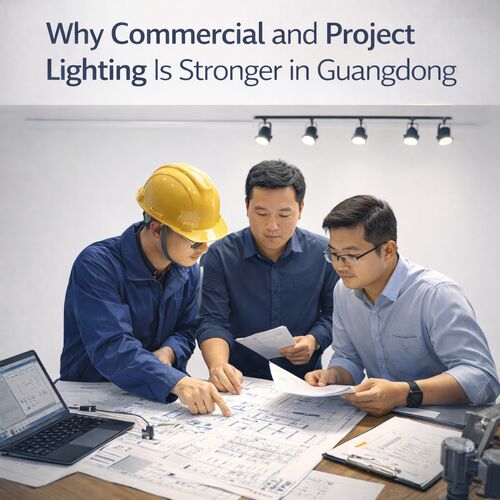
    Many buyers treat commercial and project lighting as a scaled-up version of bulb sourcing. This assumption often leads to delays, cost overruns, specification drift, and on-site coordination issues.

    Project lighting follows a fundamentally different logic from standardized lamps. Guangdong fits that logic better than any other region in China.

    Commercial and project lighting is stronger in Guangdong because this supply chain is built for system integration, customization, and rapid engineering response—not for frozen SKUs or long production runs.

    Understanding this distinction helps global buyers choose the right region before tender approval and site installation, rather than attempting to fix problems after shipment.

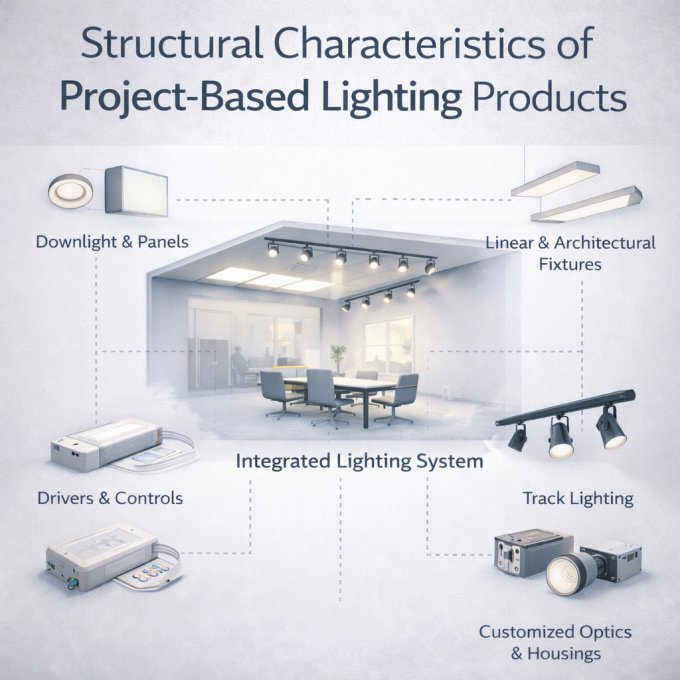
    Structural Characteristics of Project-Based Lighting Products

    Why Commercial and Project Lighting Is Stronger in Guangdong  0

    Project lighting behaves very differently from standardized bulb manufacturing. The product structure itself forces a different supply chain model.

    Project-based lighting is defined by variability, system integration, and coordination—not by volume efficiency or repetition.

    What makes project lighting structurally different

    Commercial and project lighting typically includes:

    • downlights and panels

    • linear and architectural fixtures

    • track systems

    • customized housings and optics

    These products are rarely supplied as standalone items. They are designed, delivered, and installed as part of an integrated lighting system.

    Key structural characteristics include:

    Characteristic Impact on Manufacturing
    Custom specifications Frequent drawing and BOM changes
    System integration Driver, control, optics coordination
    Project deadlines Compressed lead times
    Installation constraints Mechanical and mounting adaptation
    Visual consistency Tight bin and batch control

    Unlike bulbs, project lighting is not replaced individually. A failure affects entire spaces, not single luminaires.

    Short runs with high variation

    Most project orders involve:

    • small to medium batch sizes

    • customization per tender

    • time-driven delivery schedules

    In this environment, flexibility matters more than yield optimization.

    Rigid production models designed for long runs struggle to adapt without disruption.

    Specification-driven production

    Project lighting is controlled by:

    • technical drawings

    • lighting calculations

    • control protocols

    • compliance documentation

    Factories must interpret and respond to engineering inputs, not simply produce catalog SKUs.

    This structural requirement favors regions with dense engineering resources and fast supplier coordination.

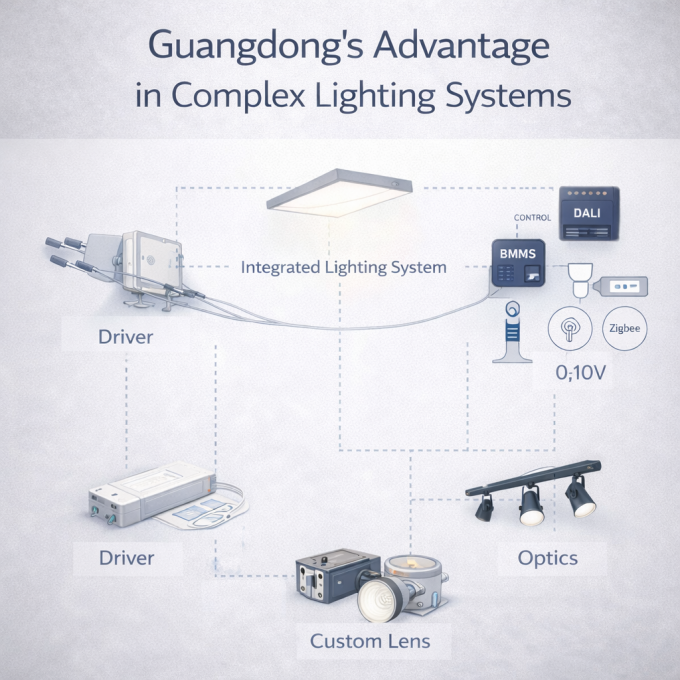
    Guangdong’s Advantage in Complex Lighting Systems

    Why Commercial and Project Lighting Is Stronger in Guangdong  1

    Guangdong’s dominance in project lighting is not accidental. It is structural.

    Guangdong excels in commercial lighting because its ecosystem integrates electronics, optics, mechanics, and controls within a tightly connected regional network.

    Electronics-first foundation

    Guangdong—especially Shenzhen, Zhongshan, and surrounding cities—developed alongside China’s electronics industry.

    This created deep expertise in:

    • LED drivers and power management

    • dimming behavior and flicker control

    • control interfaces and PCB design

    In project lighting, a fixture is not just a luminaire. It is an electronic system.

    Regions where electronics are secondary struggle to support this complexity.

    Control protocol integration

    Modern commercial projects often require compatibility with:

    • DALI

    • 0–10V

    • DMX

    • Zigbee or Bluetooth Mesh

    • building management systems

    Guangdong factories routinely collaborate with driver and control vendors to implement these requirements quickly.

    This capability is difficult to replicate in supply chains optimized for standardized lamps.

    Mechanical and optical customization

    Guangdong’s proximity to metalworking hubs such as Foshan enables:

    • rapid housing modification

    • custom extrusion profiles

    • non-standard mounting solutions

    These adjustments are common when:

    • ceiling depths change

    • architectural constraints appear

    • visual design requirements evolve

    Mechanical adaptation is treated as a normal part of production—not an exception.

    System-level engineering mindset

    Guangdong manufacturers typically evaluate products by asking:

    • How does this fixture behave under control?

    • How does it interact with adjacent luminaires?

    • How will installers commission it on site?

    This system-level thinking aligns with real project execution.

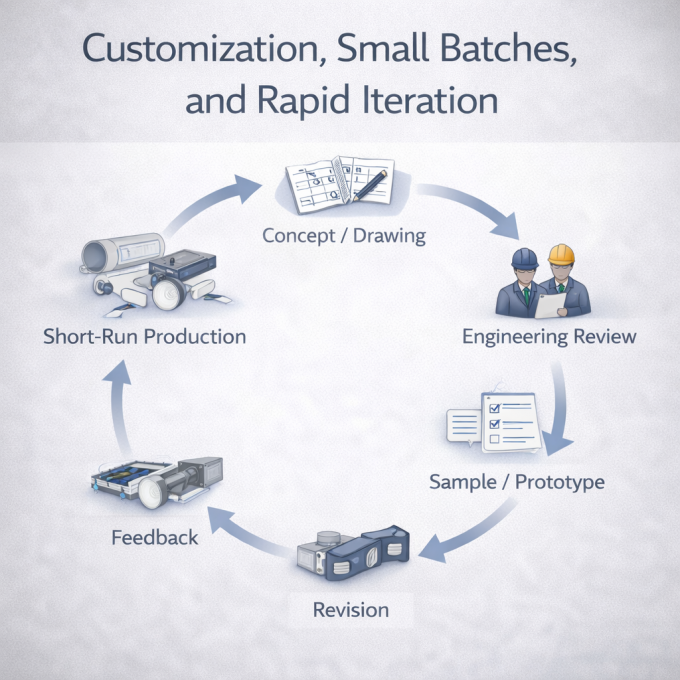
    Customization, Small Batches, and Rapid Iteration

    Why Commercial and Project Lighting Is Stronger in Guangdong  2

    In project lighting, customization is not a feature. It is the baseline.

    Guangdong supply chains are optimized for frequent customization, small batch production, and rapid iteration without resetting the entire factory.

    Handling small batches without disruption

    Guangdong factories are structured to manage:

    • mixed-SKU orders

    • parallel production lines

    • frequent changeovers

    This allows buyers to:

    • serve multiple projects simultaneously

    • reduce finished goods inventory

    • respond quickly to tender changes

    In standard-focused factories, small batches reduce efficiency.
    In Guangdong, they are expected.

    Fast sampling and revision cycles

    A typical project workflow in Guangdong looks like this:

    • Buyer submits drawings

    • Factory reviews and proposes adjustments

    • Sample produced within days

    • Feedback incorporated immediately

    • Production proceeds quickly

    This responsiveness is critical when:

    • architects revise layouts

    • consultants update specifications

    • site conditions differ from initial drawings

    Engineering responsiveness

    Guangdong factories usually maintain:

    • in-house engineers

    • direct access to driver suppliers

    • optical and mechanical partners

    This enables rapid answers to questions such as:

    • Can this fixture dim to 1% without instability?

    • Can beam angle change without housing redesign?

    • Can the driver fit a reduced enclosure depth?

    These are routine project questions, not exceptions.

    Managing design volatility

    Flexibility introduces design volatility.

    Specifications may:

    • evolve during execution

    • differ between projects

    • require strict version control

    This is not a flaw—it is the cost of speed.

    Guangdong rewards technically engaged buyers who manage documentation actively.

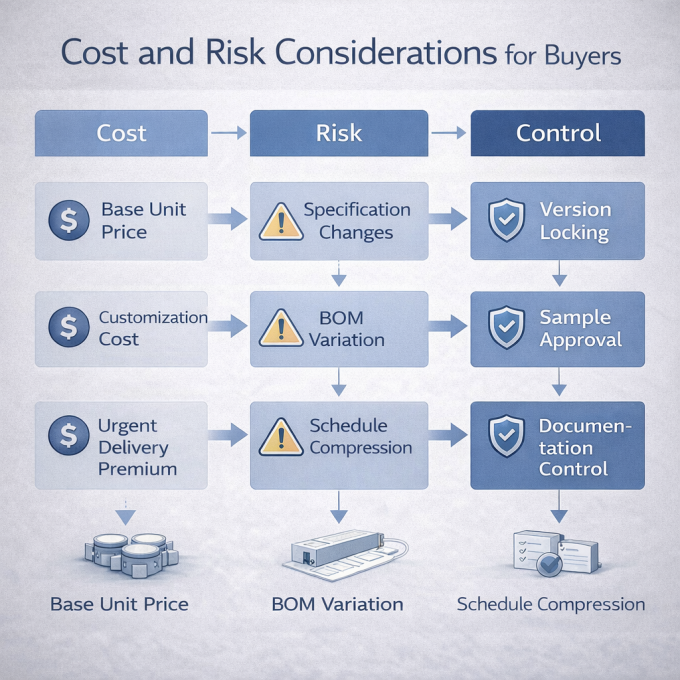
    Cost and Risk Considerations for Buyers

    Why Commercial and Project Lighting Is Stronger in Guangdong  3

    Guangdong’s strengths come with a different risk profile.

    Project lighting in Guangdong trades predictability for flexibility. Buyers must actively manage cost, documentation, and validation.

    Cost structure realities

    Project pricing in Guangdong is influenced by:

    • depth of customization

    • component availability

    • delivery urgency

    • control system complexity

    Cost Factor Typical Behavior
    Base unit price Often competitive
    Customization Variable
    Urgent delivery Premium
    BOM adjustments Possible

    Buyers focused only on unit price often underestimate total project cost.

    Specification drift risk

    Because designs evolve, risks include:

    • undocumented changes

    • mismatched drawings and production

    • installation surprises

    Mitigation requires:

    • clear version locking

    • confirmed samples

    • controlled change tracking

    Speed compresses risk—it does not eliminate it.

    Quality control complexity

    Project lighting QC is inherently more complex due to:

    • short runs

    • custom components

    • manual assembly variation

    Guangdong factories rely on:

    • functional testing

    • visual inspection

    • in-process checks

    Buyers should expect involvement in:

    • sample approval

    • pre-shipment validation

    This is normal in project-based supply chains.

    Buyer Profiles Best Suited for Guangdong Supply Chains

    Why Commercial and Project Lighting Is Stronger in Guangdong  4

    Guangdong performs best when buyer behavior aligns with its strengths.

    Guangdong supply chains suit buyers who manage projects, accept technical coordination, and value responsiveness over long-term SKU stability.

    Best-fit buyer types

    • engineering contractors and project integrators

    • architectural lighting brands

    • commercial lighting solution providers

    • smart building and system-oriented companies

    These buyers benefit from Guangdong’s speed and integration depth.

    Buyers who may struggle

    Guangdong is less suitable for buyers who:

    • require frozen SKUs

    • expect identical repeat orders

    • lack technical resources

    • prefer minimal communication

    Mismatch creates friction, not factory failure.

    Strategic sourcing reality

    Many mature buyers adopt a dual-region strategy:

    • standardized bulbs from Zhejiang

    • project and custom fixtures from Guangdong

    This reflects how China’s lighting supply chains are naturally structured.

    Conclusion

    Commercial and project lighting is stronger in Guangdong because this supply chain is optimized for system complexity, customization, and rapid engineering response rather than standardized mass production.

    Choosing Guangdong is not about chasing innovation.
    It is about matching supply chain behavior to product structure.

    While Teco’s core manufacturing base focuses on standardized LED bulbs in Zhejiang, we work closely with Guangdong-based partners for commercial, project, and custom lighting solutions when flexibility and system integration are required.

    We support B2B buyers by:

    • matching product types to the correct regional supply chain

    • coordinating specifications across multiple factories

    • reducing risk in project-based sourcing

    If you are sourcing commercial or project lighting from Guangdong:

    Email: [email protected]
    Website: www.tecolite.com

    Tell me your project type, timeline, and customization depth.
    I will help you decide whether Guangdong is the right supply chain—and how to manage it correctly.

  • Why LED Bulb Manufacturing Is Centered in Zhejiang Not Guangdong

    Why LED Bulb Manufacturing Is Centered in Zhejiang Not Guangdong

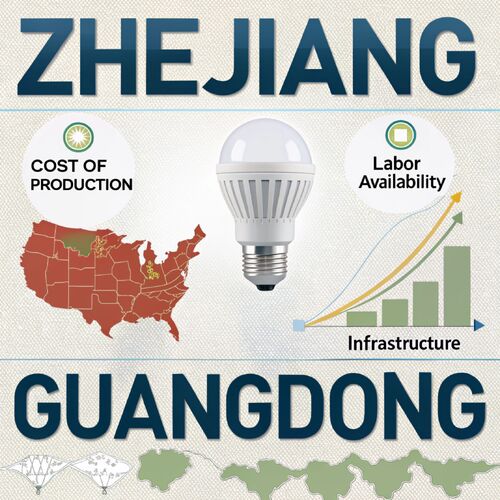
    Many global buyers assume Guangdong should dominate all LED lighting manufacturing because it is fast, innovative, and highly visible. That assumption often holds true for fixtures, projects, and smart lighting systems. However, when it comes to standardized LED bulbs—GU10, MR16, A60, and similar lamp formats—the center of gravity sits firmly in Zhejiang.

    LED bulb manufacturing concentrates in Zhejiang because bulbs demand structural discipline, process stability, and long-term consistency, not the flexibility and rapid iteration that define Guangdong’s supply chain.

    This distinction matters most for B2B buyers sourcing GU10, MR16, and A60 LED bulbs for export and long-term programs. Misunderstanding it frequently leads to quality drift, unstable pricing, repeated requalification, and avoidable sourcing risk.

    This difference is not accidental.
    It is structural.

    Structural Requirements of LED Bulb Manufacturing

    LED bulbs look simple. Manufacturing them well is not.

    LED bulb manufacturing rewards precision, repeatability, and thermal discipline far more than speed or feature innovation.

    What makes LED bulbs structurally demanding

    An LED bulb is a closed system. Once sealed, problems cannot be corrected.

    Key structural requirements include:

    • stable thermal paths

    • consistent driver behavior

    • tight mechanical tolerances

    • predictable LED binning

    • long-term lumen and color stability

    Small deviations appear quickly in real-world use.

    A minor driver change can cause:

    • flicker complaints

    • dimming instability

    • premature failure

    A slight housing variation can reduce heat dissipation and shorten product lifetime.

    Why bulbs punish inconsistency

    Unlike fixtures, bulbs are:

    • installed in large quantities

    • used in uncontrolled environments

    • replaced only after failure

    This means any defect scales rapidly.

    If a project installs 10,000 GU10 bulbs, a 1% defect rate is not marginal.
    It becomes visible, costly, and reputational.

    Certification pressure amplifies risk

    Bulbs face strict and ongoing compliance requirements:

    • CE and CB safety

    • EMC stability

    • thermal limits

    • consistent labeling

    Frequent component changes trigger:

    • re-testing

    • re-certification

    • customs and audit risk

    This structural reality favors factories that resist change, not those that embrace it.

    Why this creates regional concentration

    Supply chains evolve to fit product behavior.

    Bulbs punish flexibility.
    They reward discipline.

    This is the first reason LED bulb manufacturing concentrates in Zhejiang.

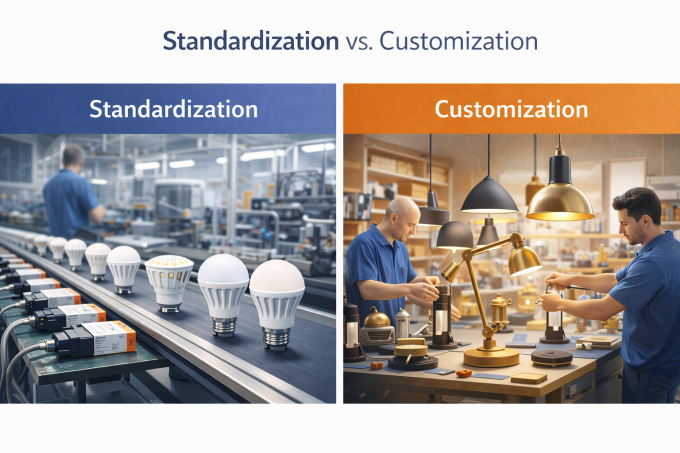
    Standardization vs. Customization

    The core difference between Zhejiang and Guangdong is not quality.
    It is philosophy.

    Zhejiang is built for standardization. Guangdong is built for customization. LED bulbs belong to the first category.

    Bulbs are standardized by nature

    LED bulbs compete on:

    • reliability

    • price stability

    • consistency over time

    Buyers expect:

    • the same SKU this year and next year

    • identical appearance across batches

    • no silent specification changes

    These expectations shape how factories must operate.

    Why customization conflicts with bulb logic

    Customization introduces:

    • BOM variation

    • assembly deviation

    • documentation complexity

    These factors increase risk in bulb production.

    Guangdong thrives on customization because:

    • project fixtures change frequently

    • each order may be different

    • system integration matters more than repeatability

    This logic works well for fixtures.
    It works poorly for bulbs.

    Standardization favors process-driven regions

    Why LED Bulb Manufacturing Is Centered in Zhejiang Not Guangdong  0

    Regions that excel in bulb manufacturing typically feature:

    • frozen designs

    • long production runs

    • narrow SKU ranges

    • yield-focused optimization

    Zhejiang’s industrial culture evolved around exactly this model.

    Why buyers often misjudge the difference

    Many buyers hear:

    “Guangdong is more advanced.”

    They interpret this as:

    “Guangdong must be better for everything.”

    In reality, advanced customization and advanced standardization are opposite skill sets.

    Bulb manufacturing requires the latter.

    Zhejiang’s Structural Advantages for Bulbs

    Zhejiang did not accidentally become the center of LED bulb manufacturing.
    Its advantages align directly with bulb requirements.

    Zhejiang’s supply chain supports LED bulb manufacturing through mechanical consistency, conservative engineering, and long-term process control.

    Mechanical manufacturing heritage

    Before LEDs, Zhejiang specialized in:

    • electrical hardware

    • metal components

    • die-cast aluminum

    • sockets and connectors

    These industries share essential traits with LED bulbs:

    • tolerance control

    • repetitive assembly

    • low defect tolerance

    When LEDs emerged, Zhejiang factories already understood how to build products that must not change.

    Thermal-first engineering mindset

    Bulb reliability depends heavily on heat management.

    Zhejiang manufacturers emphasize:

    • consistent aluminum housing thickness

    • repeatable surface treatment

    • controlled thermal interface materials

    Thermal design is treated as fixed infrastructure, not a negotiable variable.

    This improves:

    • lumen maintenance

    • color stability

    • driver lifespan

    Conservative engineering behavior

    Zhejiang engineering teams tend to:

    • optimize existing designs

    • avoid unnecessary changes

    • improve yield quietly

    A GU10 or MR16 model may remain unchanged for years.

    This frustrates novelty-driven buyers.
    It benefits reliability-driven buyers.

    Supplier relationship stability

    Zhejiang bulb factories typically maintain:

    • fixed LED chip suppliers

    • long-term driver partners

    • stable housing vendors

    Supplier changes require internal justification, not opportunistic price decisions.

    This reduces:

    • silent substitutions

    • performance drift

    • certification risk

    Production rhythm and yield focus

    Zhejiang factories favor:

    • fewer SKUs

    • longer production runs

    • higher yield targets

    This stabilizes:

    • pricing

    • delivery schedules

    • quality outcomes

    For B2B buyers, predictability often outweighs speed.

    Export discipline built into operations

    Zhejiang’s LED bulb industry grew alongside export markets.

    Factories are accustomed to:

    • European compliance audits

    • long documentation cycles

    • importer accountability

    This creates a risk-averse production culture well suited to bulbs.

    Limitations of Guangdong for Standard Bulb Production

    Guangdong is not weak.
    It is optimized for a different job.

    Guangdong’s strengths—flexibility, electronics integration, and rapid iteration—become liabilities in standardized bulb manufacturing.

    Electronics-first vs. structure-first approach

    Guangdong factories often begin with electronics:

    • driver innovation

    • control integration

    • feature expansion

    For bulbs, this leads to:

    • frequent driver changes

    • multiple BOM versions

    • unpredictable dimming behavior

    Bulbs require stability first, features second.

    High SKU churn environment

    Guangdong factories commonly manage:

    • many SKUs

    • short product life cycles

    • frequent updates

    This increases the risk of:

    • undocumented substitutions

    • inconsistent batches

    • downstream compliance issues

    Subcontractor dependency

    Guangdong supply chains often rely on:

    • multiple subcontractors

    • flexible sourcing

    • rapid vendor switching

    This supports speed.
    It reduces traceability.

    Bulb manufacturing benefits from tightly controlled, long-term supplier relationships.

    Cost volatility over time

    Initial pricing in Guangdong can be attractive.

    Over time, buyers often encounter:

    • BOM-driven price adjustments

    • spec changes justified by shortages

    • inconsistent long-term cost behavior

    Zhejiang factories are more likely to absorb volatility internally.

    Project mindset vs. program mindset

    Guangdong excels at:

    • project-based orders

    • one-off customization

    • short delivery cycles

    Bulb programs require:

    • multi-year continuity

    • stable specifications

    • predictable reorders

    This mismatch explains why Guangdong dominates fixtures but not bulbs.

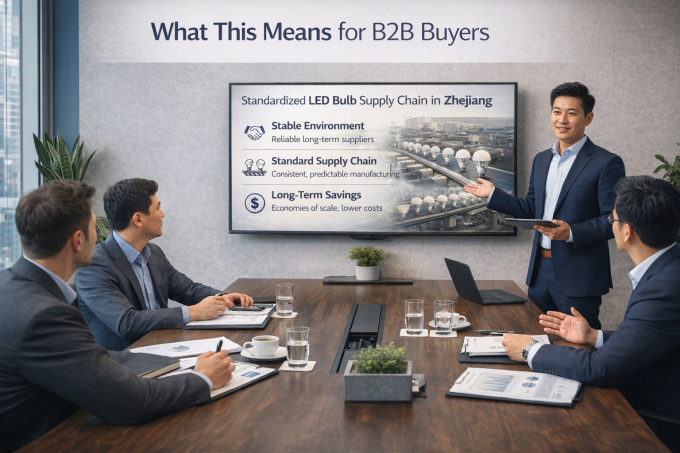
    What This Means for B2B Buyers

    Why LED Bulb Manufacturing Is Centered in Zhejiang Not Guangdong  1

    This regional distinction directly affects sourcing outcomes.

    B2B buyers who align bulb sourcing with Zhejiang’s strengths reduce risk, stabilize margins, and improve long-term supply reliability.

    For GU10, MR16, and A60 sourcing

    Zhejiang is usually the better foundation when you require:

    • consistent dimming behavior

    • stable thermal performance

    • unchanged SKUs across years

    • predictable reorders

    For brand owners

    Brand risk comes from inconsistency.

    Zhejiang suppliers are more likely to:

    • freeze designs

    • communicate changes proactively

    • protect long-term programs

    For wholesalers and distributors

    Operational efficiency depends on:

    • low return rates

    • minimal QC disputes

    • stable documentation

    Zhejiang’s approach reduces operational friction.

    For regulated markets

    Markets such as:

    • Europe

    • Japan

    • Middle East

    penalize inconsistency heavily.

    Zhejiang factories are structured to survive audits and long certification cycles.

    When Guangdong still makes sense

    Guangdong is often the correct choice when:

    • products are fixtures, not bulbs

    • customization is frequent

    • system integration is required

    The mistake is not choosing Guangdong.
    The mistake is choosing Guangdong for the wrong product type.

    A realistic sourcing strategy

    Many experienced buyers adopt a split approach:

    • bulbs from Zhejiang

    • fixtures and projects from Guangdong

    This mirrors how China’s supply chains are actually organized.

    Conclusion

    LED bulb manufacturing concentrates in Zhejiang because standardized lamps require process stability, conservative engineering, and long-term consistency—conditions that Zhejiang’s supply chain delivers more reliably than Guangdong’s flexibility-driven model.

    Teco manufactures GU10, MR16, and A60 LED bulbs in Zhejiang, focusing on stable B2B supply rather than short-term product cycles.
    We work exclusively with global buyers who value consistency, compliance, and predictable delivery.

    Our factory operates four production lines and serves markets across:

    • Europe

    • Saudi Arabia and UAE

    • USA

    • Singapore

    • Vietnam and Taiwan

    If you are evaluating Zhejiang vs. Guangdong for LED bulb sourcing:

    Email: [email protected]
    Website: www.tecolite.com

    Describe your product type and target market.
    We help buyers choose the supply chain that actually fits their business—before problems appear.

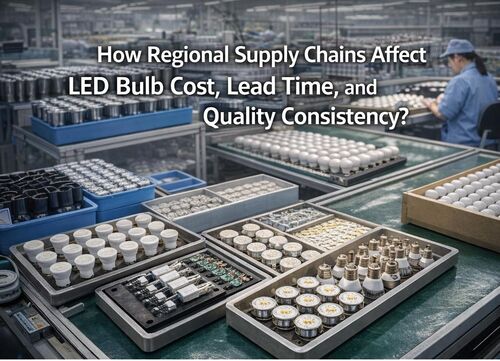
  • How Regional Supply Chains Affect LED Bulb Cost, Lead Time, and Quality Consistency?

    How Regional Supply Chains Affect LED Bulb Cost, Lead Time, and Quality Consistency?

    Many buyers evaluate LED bulbs by unit price alone. Months later, they discover unstable lead times, drifting quality, and rising hidden costs. The issue is rarely the product. It is the regional supply chain behind it.

    Regional supply chains shape how LED bulb costs are built, how reliably orders are delivered, and how consistent quality remains across large volumes.

    Understanding this relationship helps B2B buyers avoid false savings and choose suppliers that support long-term business, not just the first order.
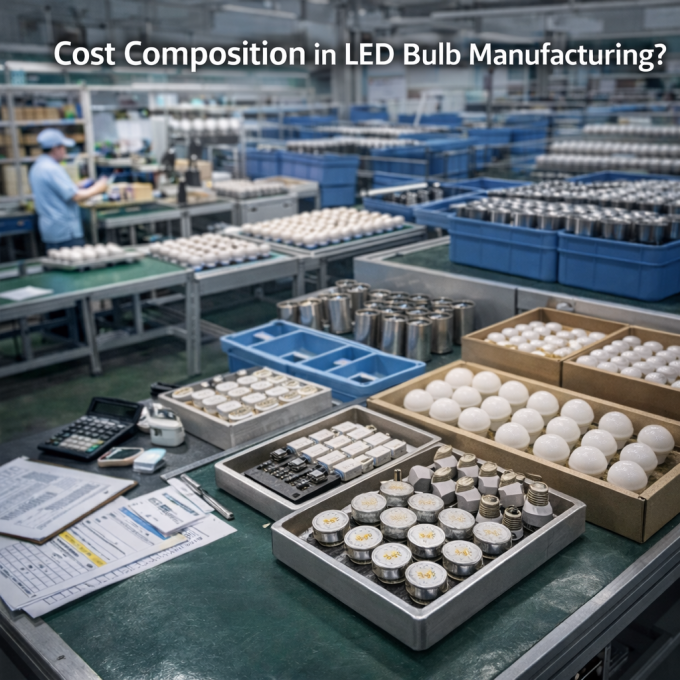
    Cost Composition in LED Bulb Manufacturing?

    How Regional Supply Chains Affect LED Bulb Cost, Lead Time, and Quality Consistency?  0

    LED bulb cost is not one number. It is the outcome of many structural decisions inside the supply chain.

    Regional supply chains influence cost composition by determining how materials, labor, overhead, and risk are distributed.

    What really makes up an LED bulb cost

    A typical LED bulb cost includes:

    Cost Element Description
    LED chips Light source, binning sensitive
    Driver Electrical stability and lifespan
    Housing Thermal and mechanical structure
    Assembly labor Consistency and yield
    Quality control Inspection and testing
    Certification Compliance and maintenance
    Overhead Rent, management, energy
    Risk buffer Defect, rework, returns

    The visible unit price hides how these elements are managed.

    How regional structure changes cost behavior

    In stability-driven regions, cost control focuses on:

    • fixed BOMs

    • long-term supplier contracts

    • yield optimization

    In flexibility-driven regions, cost control often relies on:

    • frequent sourcing adjustments

    • short-term component pricing

    • rapid substitution

    Both approaches can reach similar initial prices. Their long-term behavior is very different.

    Upfront cost vs structural cost

    Lower quotes often come from:

    • reduced QC

    • looser binning

    • minimal aging tests

    • flexible component sourcing

    These savings appear attractive. They introduce risk later.

    More stable supply chains invest more upfront to avoid downstream cost.

    Cost visibility for buyers

    Some supply chains offer:

    • transparent cost explanations

    • predictable pricing behavior

    Others offer:

    • aggressive initial pricing

    • frequent later adjustments

    The difference is cultural, not personal.

    Why buyers misjudge cost

    Buyers often compare:

    • price per unit

    They rarely compare:

    • cost stability over 12–24 months

    • cost of re-certification

    • cost of returns and replacements

    Regional supply chains determine which costs remain hidden until scale exposes them.

    Lead Time and Production Planning Differences?

    How Regional Supply Chains Affect LED Bulb Cost, Lead Time, and Quality Consistency?  1

    Lead time problems are rarely caused by one late shipment. They come from how factories plan production.

    Regional supply chains shape lead time reliability by defining production rhythm, planning discipline, and supplier alignment.

    What drives LED bulb lead time

    Key lead time drivers include:

    • raw material availability

    • driver sourcing

    • housing production

    • assembly capacity

    • QC and aging time

    How these steps are coordinated differs by region.

    Long-run vs short-run production logic

    Some regions favor:

    • long production runs

    • fewer SKUs

    • predictable schedules

    Others favor:

    • mixed SKUs

    • short runs

    • frequent changeovers

    Long-run logic reduces planning noise.
    Short-run logic increases responsiveness but reduces predictability.

    Lead time predictability vs speed

    Fast is not the same as reliable.

    Aspect Stable Supply Chains Flexible Supply Chains
    Quoted lead time Moderate Often short
    Delivery accuracy High Variable
    Schedule changes Rare Common
    Priority shifts Low Frequent

    Buyers often prefer fast quotes.
    Operations prefer reliable delivery.

    Supplier coordination depth

    Stable regions tend to:

    • lock material supply in advance

    • buffer critical components

    • protect committed orders

    Flexible regions tend to:

    • reallocate capacity dynamically

    • shift priority between customers

    • respond quickly to new demand

    This benefits some buyers and hurts others.

    What happens during market disruption

    During events like:

    • LED chip shortages

    • driver price swings

    • logistics disruptions

    Stable supply chains usually:

    • slow intake of new orders

    • protect existing commitments

    Flexible supply chains often:

    • renegotiate lead times

    • reprioritize production

    • shift focus to higher-margin orders

    This difference only becomes visible under pressure.

    Lead time lesson for buyers

    If your business depends on:

    • predictable inventory

    • fixed delivery windows

    lead time stability matters more than quoted speed.

    Regional supply chains determine which you get.

    Quality Consistency Across Large Orders?

    How Regional Supply Chains Affect LED Bulb Cost, Lead Time, and Quality Consistency?  2

    Quality problems rarely show up in the first sample. They appear when orders scale.

    Quality consistency across large LED bulb orders depends on how tightly the supply chain controls variation over time.

    Why LED bulbs expose inconsistency quickly

    LED bulbs are:

    • mass-installed

    • visually comparable side by side

    • electrically sensitive

    Small variation becomes obvious at scale.

    Typical inconsistency symptoms include:

    • color shift between batches

    • uneven dimming behavior

    • thermal-related early failures

    These issues damage brand and trust.

    What creates batch-to-batch variation

    Variation usually comes from:

    • LED bin changes

    • driver substitutions

    • housing thickness variation

    • assembly tolerance drift

    Supply chains differ in how they control these variables.

    Process-driven vs adjustment-driven quality

    Process-driven quality focuses on:

    • fixed work instructions

    • frozen BOMs

    • long-term supplier alignment

    Adjustment-driven quality relies on:

    • inspection after changes

    • correction after problems

    • short-term fixes

    The first prevents problems.
    The second reacts to them.

    Scale amplifies small decisions

    A 0.5% failure rate sounds small.

    At:

    • 1,000 bulbs → 5 failures

    • 50,000 bulbs → 250 failures

    Returns, replacements, and reputation damage follow.

    Regions that prioritize yield and prevention perform better at scale.

    Quality documentation and traceability

    Stable supply chains usually maintain:

    • batch traceability

    • component history

    • aging and test records

    This allows root-cause analysis when issues occur.

    Flexible supply chains may lack:

    • consistent records

    • version control

    Problems become harder to resolve conclusively.

    Buyer involvement level

    Some supply chains expect buyers to:

    • approve every change

    • manage quality actively

    Others manage quality internally and inform buyers only when necessary.

    Buyers without large QC teams benefit more from the second model.

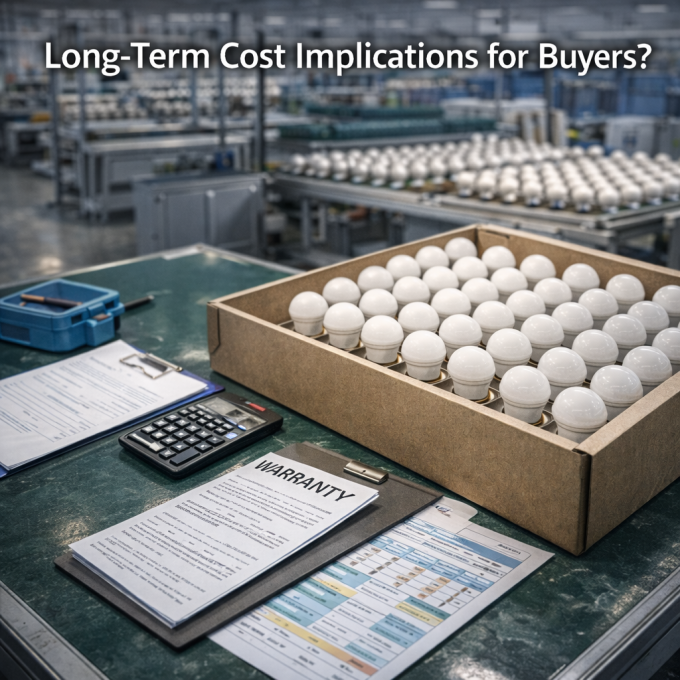
    Long-Term Cost Implications for Buyers?

    How Regional Supply Chains Affect LED Bulb Cost, Lead Time, and Quality Consistency?  3

    The real cost of LED bulbs is revealed over time, not on the invoice.

    Regional supply chains influence long-term cost through stability, risk exposure, and operational friction.

    The hidden costs buyers often miss

    Long-term costs include:

    • re-certification expenses

    • internal QC labor

    • inventory write-offs

    • customer complaints

    • warranty replacements

    These costs rarely appear in unit pricing.

    Cost drift over product life

    In unstable supply chains, buyers often see:

    • silent component changes

    • performance drift

    • unexpected price adjustments

    Each change triggers internal cost:

    • testing

    • documentation updates

    • market explanation

    Stable supply chains reduce these events.

    Brand and reputation cost

    For brand owners and wholesalers:

    • inconsistent bulbs erode trust

    • returns damage distributor relationships

    • complaints affect repeat sales

    Recovering trust costs more than saving cents per unit.

    Inventory and cash flow impact

    Unstable lead times and quality force buyers to:

    • hold more safety stock

    • delay launches

    • freeze cash in inventory

    Predictable supply chains reduce these pressures.

    Total cost comparison over time

    Cost Area Stable Supply Chain Flexible Supply Chain
    Initial unit price Slightly higher Often lower
    Price volatility Low High
    QC workload Lower Higher
    Re-certification Rare Frequent
    Return rate Low Variable
    Operational friction Low High

    For many B2B buyers, total cost favors stability.

    When flexibility still wins

    Flexible supply chains make sense when:

    • products change frequently

    • volumes are small

    • speed outweighs continuity

    But for LED bulbs, continuity usually wins.

    Strategic cost thinking

    Smart buyers evaluate cost as:

    • a 12–36 month curve

    • not a single purchase event

    Regional supply chains define that curve.

    Conclusion

    Regional supply chains shape LED bulb cost, lead time reliability, and quality consistency, with stable regions favoring predictability and long-term value while flexible regions trade consistency for speed.

    Teco supports global B2B buyers sourcing GU10, MR16, and A60 LED bulbs with a focus on long-term cost stability, reliable lead times, and consistent quality.

    Our manufacturing base operates in Zhejiang, where supply chain structure favors:

    • frozen specifications

    • predictable production planning

    • low batch variation

    • compliance-focused export markets

    We help buyers reduce hidden costs by aligning product type with the right regional supply chain.

    Email: [email protected]
    Website: www.tecolite.com

    Tell me your order volume, target market, and growth plan.
    I will help you evaluate not just price, but the supply chain behind it.

  • Human-Centric Lighting with GU10 Bulbs: Design Logic, Applications, and Limits

    Human-Centric Lighting with GU10 Bulbs: Design Logic, Applications, and Limits

    Many projects claim to implement human-centric lighting, yet occupants still report fatigue, night-time overstimulation, or visual discomfort. In most cases, the problem is not intention—it is design logic and inappropriate tool selection.

    Human-centric lighting focuses on how light affects people biologically and psychologically. GU10 bulbs can support this approach when their role is clearly defined and their limits are respected.

    Human-centric lighting is not a product category. It is a design mindset. GU10 bulbs are one tool within that framework. Used correctly, they improve comfort and sleep-related outcomes. Used incorrectly, they add complexity without delivering real benefits.

    Core Design Principles of Human-Centric Lighting

    Human-Centric Lighting with GU10 Bulbs: Design Logic, Applications, and Limits  0

    Human-centric lighting begins with human biology, not luminaires or control systems.

    At its core, human-centric lighting aligns light spectrum, intensity, timing, and predictability with human physiological and behavioral needs.

    Light as a biological signal

    Humans respond to light through more than vision. Light directly affects hormones, alertness, and emotional state.

    Research shows that intrinsically photosensitive retinal ganglion cells (ipRGCs) respond strongly to short-wavelength blue light and transmit signals directly to the brain’s circadian center, bypassing visual perception entirely. A light can appear comfortable while still overstimulating the nervous system.

    This is why visual comfort alone is not a reliable indicator of biological suitability.

    Foundational human-centric principles

    Across residential, hospitality, and wellness-focused environments, several principles consistently apply:

    • Time awareness: Light requirements change throughout the day

    • Spectrum control: Blue-rich light during the day, low-blue or blue-free light at night

    • Intensity restraint: Brightness only where and when it is necessary

    • Visual comfort: Low glare and soft contrast

    • Predictability: No sudden or confusing changes in lighting behavior

    Human-centric lighting prioritizes stress reduction before performance enhancement.

    Vertical exposure matters more than floor brightness

    Biological response depends on light reaching the eyes, not illuminance measured on horizontal surfaces.

    Bright floors with dark walls have limited biological effect. Soft, vertical illumination at eye level is far more influential. This principle directly shapes how GU10 bulbs should be positioned and aimed.

    Less stimulation often delivers better outcomes

    Human-centric lighting is frequently misunderstood as adding features. In practice, it removes unnecessary stimulation:

    • fewer harsh sources

    • fewer bright lights at night

    • fewer competing color temperatures

    GU10 bulbs naturally support this restraint-oriented approach due to their limited output and directional nature.

    The Role of GU10 Bulbs in Human-Centric Lighting

    Human-Centric Lighting with GU10 Bulbs: Design Logic, Applications, and Limits  1

    GU10 bulbs are rarely the primary drivers of human-centric lighting. They function best as controlled, supportive elements.

    GU10 bulbs contribute to human-centric lighting by enabling localized, low-impact, spectrum-specific light where restraint is required.

    Why GU10 aligns with human-centric logic

    GU10 bulbs offer characteristics that fit human-centric design goals:

    • compact form factor

    • directional light distribution

    • easy zoning

    • retrofit compatibility

    These traits allow designers to control where light is present—and just as importantly, where it is absent.

    Human-centric lighting often requires reducing exposure, not increasing it.

    Typical GU10 roles in human-centric projects

    GU10 bulbs are most effective when used for:

    • bedside and reading lights

    • accent lighting

    • night navigation and orientation

    • evening transition lighting

    These applications benefit from precision and low biological impact rather than high output.

    Spectrum roles GU10 handles effectively

    GU10 bulbs perform best when assigned limited, intentional spectral roles:

    Spectrum Human-Centric Function
    2700K warm white Evening comfort and relaxation
    Amber Late-evening calm
    Red Night-time orientation with minimal biological impact

    White GU10 bulbs above 3000K should be avoided late at night, even when dimmed. Blue content remains present and biologically active.

    GU10 as a boundary-setting tool

    Human-centric lighting depends on clear boundaries between activity and rest.

    GU10 bulbs help define:

    • where light stops

    • where darkness begins

    • where activity transitions to recovery

    These boundaries are particularly important in bedrooms, hotel guest rooms, and wellness-oriented environments.

    Psychological comfort still matters

    Beyond hormones, lighting influences emotional perception.

    Warm, localized GU10 lighting improves:

    • perceived safety

    • emotional comfort

    • sense of personal control

    In hospitality and residential settings, these psychological effects are often as important as measurable biological outcomes.

    Design Strategies Using GU10 Bulbs

    Human-Centric Lighting with GU10 Bulbs: Design Logic, Applications, and Limits  2

    GU10 bulbs deliver results only when integrated into structured design strategies.

    Effective human-centric lighting with GU10 relies on layered, time-aware, and placement-sensitive design.

    Strategy 1: Layered lighting hierarchy

    Human-centric spaces rely on multiple lighting layers rather than a single dominant source:

    Layer Purpose GU10 Suitability
    Ambient General visibility Limited
    Task Focused activity Moderate
    Accent Comfort and mood Strong
    Night Orientation only Very strong

    GU10 bulbs should dominate the lower-impact layers, not the ambient layer.

    Strategy 2: Evening transition control

    Evening lighting should gradually reduce cognitive stimulation.

    Effective approaches include:

    • switching from neutral to warm GU10 light

    • gradually reducing brightness

    • shifting light from ceilings toward walls and surfaces

    Dim-to-warm GU10 bulbs support this transition, but only as an intermediate step—not as true night lighting.

    Strategy 3: Night-time protection

    At night, the objective is simple: avoid waking the brain.

    Recommended practice:

    • red GU10 bulbs

    • very low output

    • placement below eye level

    Red light has been shown to have negligible impact on melatonin suppression, making it suitable for night-time navigation in bedrooms, hotel bathrooms, and corridors.

    Strategy 4: Directional and glare control

    Human-centric lighting minimizes direct eye exposure.

    GU10 fixtures should be:

    • shielded

    • aimed away from the eyes

    • directed toward walls, floors, or architectural elements

    Indirect reflection creates softer, more biologically tolerable exposure.

    Strategy 5: Default-safe design

    Human-centric lighting must function correctly even when users behave unpredictably.

    Design systems so that:

    • late-night switches never activate bright white light

    • warm or red GU10 lighting is always accessible

    • operation does not depend on apps or user training

    This principle is critical in hotels, serviced apartments, and rental properties.

    Strategy 6: Retrofit-friendly improvements

    GU10 bulbs enable incremental upgrades.

    Replacing night-time white GU10 lamps with red or amber versions often produces noticeable improvements in sleep comfort with minimal disruption.

    Limitations Designers Must Accept

    Human-Centric Lighting with GU10 Bulbs: Design Logic, Applications, and Limits  3

    Human-centric lighting fails when designers expect GU10 bulbs to perform tasks they were never designed to handle.

    GU10 bulbs have clear biological and technical limits that must be accepted.

    Limited circadian stimulation capability

    GU10 bulbs cannot provide strong circadian activation due to:

    • limited luminous flux

    • narrow beam angles

    • point-source distribution

    Circadian stimulation requires large-area, vertical illumination that GU10 cannot deliver alone.

    Spectrum control constraints

    Most GU10 bulbs use phosphor-converted white LEDs, resulting in:

    • fixed blue peaks

    • limited spectral shaping

    • incomplete melanopic control

    Even tunable GU10 products often change visual appearance more than biological impact.

    Dimming does not resolve biological issues

    Dimming reduces brightness, not wavelength.

    White GU10 light still contains blue energy when dimmed, and research shows melatonin suppression can occur at very low blue-light levels. For night-time use, spectrum selection is more important than dimming.

    Flicker and driver quality risks

    GU10 bulbs integrate compact drivers, and quality varies widely.

    Low-quality drivers introduce:

    • flicker

    • instability at low output

    • spectral drift

    Neurological comfort depends on consistency, not just brightness control.

    Certification and standard limitations

    GU10-based designs rarely meet:

    • WELL circadian credit thresholds

    • healthcare-grade lighting standards

    • research-driven human-centric metrics

    This does not disqualify GU10—it defines its appropriate role.

    The correct mindset

    Successful human-centric design accepts that:

    • GU10 supports comfort more than performance

    • GU10 reduces harm more than it creates benefit

    • GU10 complements systems rather than replacing them

    Honest tools produce reliable outcomes.

    Conclusion

    GU10 bulbs support human-centric lighting when used for localized, low-impact, and time-aware applications. Their value lies in comfort enhancement, night-time protection, and boundary-setting—not in full circadian stimulation or biological optimization.

    Teco designs and manufactures GU10 LED spotlights for human-centric and wellness-aware lighting applications in hospitality and residential projects. We work B2B only, focusing on stable quality, clear technical positioning, and real-world performance.

    Our China-based factory operates four production lines and supports:

    • warm, amber, and red GU10 solutions

    • dim-to-warm GU10 development

    • stable low-level dimming

    • OEM and ODM customization

    • compliance for Europe, the Middle East, and Southeast Asia

    If you are designing a human-centric lighting project and considering GU10 bulbs, tell us your space, users, and constraints.
    We will help you determine where GU10 fits—and where it does not.

  • GU10 Color Temperature Changing Bulbs: How They Work and Where They Fit

    GU10 Color Temperature Changing Bulbs: How They Work and Where They Fit

    Color temperature changing GU10 bulbs are frequently marketed as smart, healthy, or even circadian-ready. In real projects, they sometimes add value. In many others, they quietly fail expectations because the technical mechanism behind the color change is misunderstood.

    GU10 color temperature changing bulbs primarily adjust visual warmth. Their biological and circadian impact depends entirely on how the color change is achieved, not on the label or the CCT range claimed.

    This article explains the actual technical approaches used in GU10 color temperature changing bulbs, how each approach behaves spectrally, where these products are genuinely useful, where they are commonly misapplied, and how they relate—often imperfectly—to circadian lighting strategies. No theory shortcuts. No marketing language.

    Technical Types of Color Temperature Change in GU10 Bulbs

    GU10 Color Temperature Changing Bulbs: How They Work and Where They Fit  0

    Not all GU10 color temperature changing bulbs work in the same way. The internal method used to change color temperature determines whether the result is merely cosmetic or has any biological relevance.

    Understanding the technical category is more important than knowing the advertised CCT range.

    Fixed-Step CCT Switching GU10 Bulbs

    This is the most common and lowest-cost approach.

    The bulb provides two or three preset color temperatures, typically:

    • 2700K

    • 3000K

    • 4000K

    Switching is achieved through:

    • power cycling

    • wall-switch toggling

    • internal DIP switches

    Feature Characteristic
    CCT change Discrete steps
    Spectrum Fixed per step
    Control Manual
    Cost level Low

    Each step activates a separate LED package or phosphor blend. There is no spectral blending and no time-based adaptation.

    This approach offers predictability and low flicker risk. It works well in retrofit projects where installers want flexibility without smart controls. However, it does not respond automatically to time of day and provides no biological logic on its own.

    Tunable White (Dual-Channel) GU10 Bulbs

    Tunable white GU10 bulbs use two LED channels:

    • one warm white

    • one cool white

    The driver blends these channels at varying current ratios to create a continuous CCT range.

    Feature Characteristic
    CCT range Continuous
    Spectrum Mixed
    Control Dimming or smart systems
    Cost level Medium

    Visually, this produces smooth transitions and broad flexibility. Biologically, performance is inconsistent.

    In many designs, the cool channel never fully disengages. Even at warm settings, residual blue energy remains in the spectrum. Without published spectral power distribution (SPD) data, biological performance cannot be assumed.

    Dim-to-Warm GU10 Bulbs

    Dim-to-warm GU10 bulbs are designed to mimic halogen behavior.

    As the lamp is dimmed:

    • light output decreases

    • correlated color temperature shifts warmer

    Feature Characteristic
    Trigger Dimming
    Behavior Automatic
    User effort Minimal
    Cost level Medium

    Dim-to-warm improves evening comfort and reduces alertness. However, it reduces blue content rather than eliminating it.

    This distinction matters. Dim-to-warm supports evening transition but should not be treated as biologically neutral night lighting.

    Smart RGBW / RGBWW GU10 Bulbs

    These products use multiple LED channels, typically:

    • RGB

    • warm white

    • sometimes cool white

    They can produce a wide range of colors and color temperatures.

    Feature Characteristic
    Flexibility Very high
    Control App-based
    Complexity High
    Output consistency Variable

    These bulbs are designed for visual effects and user interaction, not for biological accuracy. Channel calibration, thermal drift, and driver limitations often lead to inconsistent spectral output, especially at low brightness.

    They are suitable for mood lighting. They are unreliable for wellness or circadian objectives.

    Why This Classification Matters

    Two GU10 bulbs labeled “CCT adjustable” may behave completely differently in real environments.

    If the technical method is unclear, biological benefit should be assumed to be limited.

    Internal Mechanisms and Their Practical Limits

    Color temperature change in GU10 bulbs is determined by LED channel architecture and driver behavior. These constraints define what the bulb can and cannot achieve biologically.

    Fixed-Step Mechanisms

    Each CCT step activates a dedicated LED package. Output is stable, predictable, and repeatable.

    Advantages include:

    • low flicker risk

    • stable spectrum per mode

    • simple electrical behavior

    Limitations are equally clear:

    • no smooth transitions

    • no automation

    • no biological timing logic

    Tunable White Blending Behavior

    Dual-channel blending adjusts visual appearance but often fails to remove blue peaks completely.

    This leads to a common project issue: a light that looks warm but still suppresses melatonin.

    Without SPD data, this failure is invisible until users experience sleep disruption.

    Dim-to-Warm Driver Behavior

    Dim-to-warm relies on current-dependent spectral shifts.

    As current drops:

    • blue contribution decreases

    • red and yellow wavelengths dominate

    This improves evening comfort but does not guarantee night-time biological neutrality.

    Dim-to-warm is transition-friendly, not night-safe.

    Smart GU10 Driver Constraints

    Smart GU10 bulbs face hard physical limits:

    • limited driver space

    • thermal instability

    • inconsistent channel calibration

    As a result:

    • spectrum varies between units

    • flicker increases at low output

    • color accuracy drifts over time

    These issues are acceptable in decorative lighting. They introduce risk in wellness-focused projects.

    Driver Quality as the Decisive Factor

    Regardless of category, the driver determines:

    • flicker performance

    • dimming stability

    • spectral consistency

    IEEE Std 1789 confirms that flicker affects neurological comfort even when not consciously visible. Low-quality drivers undermine even well-designed LED packages.

    Appropriate Use Cases and Common Misuse Scenarios

    GU10 Color Temperature Changing Bulbs: How They Work and Where They Fit  1

    Color temperature changing GU10 bulbs are not inherently problematic. Misuse occurs when expectations exceed what the technology can deliver.

    Valid Applications

    Evening flexibility in residential spaces
    Fixed-step and dim-to-warm GU10 bulbs work well in living rooms and dining areas, allowing users to shift from neutral activity lighting to warmer relaxation light.

    Hospitality guest rooms (limited scope)
    Hotels benefit from preset warm evening modes and neutral cleaning modes. Fixed-step GU10 bulbs allow staff-controlled defaults without guest education.

    Retail and display lighting
    CCT adjustment supports visual presentation without biological expectations.

    Common Misuse Patterns

    Night-time bedroom lighting
    Warm white light is often assumed to be safe. It is not always. Even 2700K white light contains blue wavelengths that can suppress melatonin.

    Claiming circadian functionality
    If a bulb cannot eliminate blue light at night, follow time-based logic, or support vertical eye-level exposure, it should not be labeled circadian.

    Over-reliance on apps
    Smart GU10 bulbs assume consistent user behavior. In reality, automation is overridden, schedules drift, and systems revert to white light.

    Misuse Consequences

    Misuse Project Outcome
    Night use of white light Sleep disruption
    Assuming dimming is enough Melatonin suppression
    Trusting CCT labels False wellness claims
    Ignoring driver quality Flicker complaints and instability

    The failure is rarely the bulb itself. It is the expectation.

    Relationship to Circadian Lighting Strategies

    Color temperature change is frequently confused with circadian lighting. They overlap, but they are not equivalent.

    Changing CCT addresses visual comfort. Circadian lighting requires spectrum control, timing, intensity, and exposure geometry.

    What Circadian Lighting Requires

    Factor Importance
    Spectrum High
    Timing High
    Intensity Medium
    Duration Medium
    Vertical exposure High

    CCT change addresses only one variable.

    Where CCT-Changing GU10 Bulbs Fit

    These products can support circadian-aware strategies by:

    • easing evening transitions

    • reducing harsh contrast

    • improving perceived comfort

    They cannot provide:

    • morning circadian stimulation

    • night-time melatonin safety

    • biological entrainment

    Honest Positioning

    A realistic statement is:

    “GU10 color temperature changing bulbs improve visual comfort and support circadian-aware transitions, but they do not replace circadian lighting systems.”

    This framing avoids project disappointment and client conflict.

    Conclusion

    GU10 color temperature changing bulbs adjust visual warmth using different technical mechanisms. They perform best when used for comfort and transitional lighting, not as substitutes for circadian or biologically precise lighting systems.

    Understanding how the color change is achieved is essential to knowing where the product truly fits.

    Teco manufactures GU10 LED spotlights, including fixed-CCT, dim-to-warm, and spectrum-specific solutions designed for practical applications in hospitality and residential projects. We work B2B only, focusing on stable quality, clear technical limits, and honest product positioning.

    Our factory in China operates four production lines and supports:

    • warm, amber, and red GU10 options

    • dim-to-warm GU10 development

    • OEM and ODM customization

    • compliance for Europe, the Middle East, and Southeast Asia

    If you are considering GU10 color temperature changing bulbs for a project:

    Email: [email protected]
    Website: www.tecolite.com

    Tell us your application and expectations.
    We will help you choose what fits—and avoid what does not.

  • Benefits of GU10 Circadian Bulbs in Retrofit Lighting Projects

    Benefits of GU10 Circadian Bulbs in Retrofit Lighting Projects

    Retrofit lighting projects fail when ambition ignores reality. Budgets are fixed, ceilings remain closed, and operational downtime is not negotiable. In this context, circadian intent only survives when solutions respect structural, behavioral, and economic constraints.

    GU10 circadian-capable bulbs deliver practical biological benefits in retrofit projects by reducing night-time disruption, improving evening comfort, and protecting sleep—without requiring structural changes.

    Retrofit lighting is about progress, not perfection. GU10 bulbs are not full circadian systems, but in many retrofit scenarios they provide the highest biological return per unit of change. This article explains why they work in retrofit conditions, where they outperform complex systems in practice, and how to decide when GU10 is the correct retrofit tool.

    Core Benefits of GU10 Circadian Bulbs in Retrofit Projects

    Benefits of GU10 Circadian Bulbs in Retrofit Lighting Projects  0

    Retrofit projects succeed when improvements are simple, predictable, and measurable. GU10 circadian bulbs align naturally with these constraints.

    The primary value of GU10 circadian bulbs in retrofit environments is biological improvement achieved with minimal physical and operational disruption.

    No structural intervention required

    Most retrofit buildings cannot accommodate changes to:

    • ceilings

    • wiring routes

    • control cabinets

    GU10 bulbs operate within existing sockets and circuits. This enables:

    • rapid deployment

    • zero room downtime

    • no permitting or redesign

    • no specialist commissioning

    In hospitality, residential, and senior living retrofits, this factor alone often determines whether a project can proceed.

    Immediate night-time sleep protection

    Night-time lighting is the most common circadian failure point in existing buildings.

    Replacing standard white GU10 bulbs with:

    • amber GU10

    • red GU10

    immediately reduces melatonin suppression by addressing the problem at its source: spectrum.

    Harvard Medical School confirms that blue light in the 460–480 nm range suppresses melatonin, even at low intensity.
    Source: https://health.harvard.edu/staying-healthy/blue-light-has-a-dark-side

    GU10 retrofits remove blue-rich light rather than attempting to manage its effects through dimming or control logic.

    Minimal learning curve for users

    Retrofit users—guests, tenants, residents—resist behavioral change.

    GU10 circadian bulbs:

    • behave like conventional lamps

    • require no training

    • do not depend on user understanding

    People use the lights as they always have. This behavioral neutrality is critical in retrofit success and often makes GU10 solutions more effective in practice than complex systems that are misunderstood or bypassed.

    Localized correction instead of system dependence

    Retrofit projects rarely support centralized circadian control.

    GU10 enables localized biological correction in high-impact zones:

    • bedside lighting

    • bathroom night lighting

    • corridors and night paths

    Local biological problems do not always require system-wide solutions. In many retrofit cases, correcting a few critical zones delivers the majority of benefit.

    Favorable cost-to-impact ratio

    Full circadian or HCL systems incur cost through:

    • new luminaires

    • control infrastructure

    • commissioning

    • long-term maintenance

    GU10 circadian bulbs shift investment to the lamp level. This allows:

    • phased upgrades

    • pilot testing

    • outcome validation before scaling

    For retrofit buyers, this reduces both financial and operational risk.

    GU10 Circadian Bulbs Compared with Full HCL Systems in Retrofit Contexts

    Benefits of GU10 Circadian Bulbs in Retrofit Lighting Projects  1

    A common question is whether GU10 circadian bulbs can replace Human Centric Lighting (HCL) systems. They cannot—but this comparison often misses the real retrofit question.

    In retrofit projects, GU10 circadian bulbs compete on reliability and feasibility, not on biological completeness.

    Structural feasibility comparison

    Aspect GU10 Retrofit Full HCL System
    Ceiling modification None Required
    Rewiring No Yes
    Control infrastructure No Yes
    Installation timeline Hours Weeks
    Operational disruption Minimal Significant

    Most retrofit environments cannot tolerate the structural and operational demands of HCL systems.

    Biological performance focus

    Biological Objective GU10 Retrofit Full HCL
    Night melatonin protection Strong Strong
    Evening relaxation Moderate Strong
    Daytime alertness Limited Strong
    Full circadian entrainment Not achievable Achievable

    GU10 solutions focus on harm reduction, particularly at night.
    HCL systems focus on biological optimization across the full day.

    Retrofit projects almost always prioritize harm reduction first.

    Different failure modes

    Understanding how systems fail is critical in retrofit decision-making.

    • HCL systems often fail due to:

    programming drift

    • sensor errors

    • user overrides

    • maintenance complexity

    GU10 circadian retrofits typically fail due to:

    unrealistic expectations

    • continued use of white light at night

    • poor lamp placement

    In retrofit conditions, simple systems fail less often.

    Operational and maintenance reality

    Facilities teams generally prefer:

    • replaceable components

    • predictable behavior

    • minimal software dependence

    GU10 bulbs align with this operational mindset. Many HCL systems fail not technically, but operationally.

    Cost and risk balance

    Factor GU10 HCL
    Initial investment Low High
    Risk exposure Low Medium–High
    Payback horizon Short Long
    User acceptance High Variable

    In retrofit economics, lower risk frequently outweighs theoretical performance.

    Retrofit Project Types Where GU10 Performs Best

    GU10 circadian bulbs do not suit every retrofit scenario. They suit specific ones very well.

    GU10 circadian retrofits are most effective where night-time comfort, sleep protection, and ease of implementation are primary goals.

    Hospitality retrofits

    Hotels rarely close rooms for lighting upgrades.

    GU10 retrofits allow:

    • room-by-room implementation

    • zero guest displacement

    • immediate guest feedback

    Typical applications include:

    Area GU10 Circadian Role
    Bedside Warm or amber lighting
    Bathroom night mode Red GU10
    Corridors Warm, low-glare
    Accent lighting Warm, indirect

    These interventions target guest sleep quality, which directly affects reviews and repeat bookings.

    Serviced apartments and rental properties

    These properties face:

    • frequent tenant turnover

    • limited capital budgets

    • low tolerance for complexity

    GU10 circadian bulbs improve night-time comfort without altering infrastructure. Tenants experience the benefit even if they cannot articulate why.

    Residential retrofit upgrades

    Homeowners typically want better sleep, not lighting systems.

    GU10 allows:

    • DIY-friendly upgrades

    • incremental changes

    • low commitment

    Replacing night-time GU10 bulbs with red or amber versions often produces the most immediate perceived improvement.

    Senior living and assisted housing

    Sleep disruption and night-time falls increase with age.

    Red GU10 night lighting:

    • protects melatonin

    • preserves night vision

    • improves safety

    In these environments, night-time protection often matters more than daytime circadian stimulation.

    Offices with limited wellness objectives

    Offices pursuing basic wellness improvements can use GU10 to:

    • soften after-hours cleaning light

    • reduce biological stress during late occupancy

    GU10 is not suitable for full daytime circadian stimulation but can reduce harm outside working hours.

    Retrofit scenarios where GU10 is insufficient

    Avoid GU10-only retrofit strategies when the objective is:

    • full circadian entrainment

    • healthcare-grade biological lighting

    • productivity-focused daytime stimulation

    • certification-driven compliance

    These goals require system-level solutions.

    A Practical Decision Framework for GU10 Circadian Retrofits

    Retrofit success depends on correct early decisions.

    A simple decision framework helps determine whether GU10 circadian bulbs are an appropriate retrofit solution.

    Step 1: Define the biological problem

    Identify the primary issue being addressed.

    Problem GU10 Suitable
    Poor sleep quality Yes
    Night-time disruption Yes
    Guest complaints Yes
    Low daytime alertness No
    Certification compliance No

    GU10 addresses night-time problems more effectively than daytime ones.

    Step 2: Confirm structural constraints

    If the project cannot:

    • open ceilings

    • add control wiring

    • replace luminaires

    GU10 becomes one of the few viable options.

    Step 3: Identify time-of-day focus

    GU10 performs best when the focus is:

    • evening transition

    • night-time protection

    If morning stimulation is the priority, GU10 is secondary at best.

    Step 4: Evaluate user behavior

    If users are likely to:

    • ignore controls

    • override settings

    • resist learning

    Simple GU10-based solutions often outperform complex systems in practice.

    Step 5: Assess budget and risk tolerance

    Project Type More Suitable
    Pilot or trial GU10
    Phased upgrade GU10
    Full renovation HCL
    Certification-driven project HCL

    Step 6: Combine solutions when appropriate

    Effective retrofits often mix approaches:

    • GU10 for night-time protection

    • existing daylight for daytime stimulation

    • no full HCL system

    Circadian improvement does not require purity. It requires effectiveness.

    Final reality check

    GU10 circadian bulbs will not transform an aging building into a circadian showcase. They will:

    • reduce biological harm

    • improve sleep quality

    • increase comfort

    • lower user complaints

    In retrofit logic, that outcome defines success.

    Conclusion

    GU10 circadian bulbs offer a low-risk, high-impact approach to improving sleep and comfort in retrofit lighting projects where full circadian systems are impractical.

    They succeed not by doing everything, but by doing the right things under real constraints.

    Teco manufactures GU10 circadian-capable LED spotlights designed specifically for retrofit lighting projects in hospitality, residential, and senior living environments.
    We work B2B only, supporting buyers who need realistic application guidance, verified certification, and stable delivery.

    Our China-based factory operates four production lines and supports:

    • warm, amber, and red GU10 solutions

    • stable low-level dimming for night use

    • OEM and ODM customization

    • compliance for Europe, Middle East, and Southeast Asia

    If you are planning a retrofit lighting upgrade and considering GU10 circadian bulbs:

    Email: [email protected]
    Website: www.tecolite.com

    Tell us your building type and constraints.
    We will help you determine whether GU10 is the right retrofit choice—or whether it is not.