Huizhou Henhui Electronics Technology Co., Ltd.

作者: tecolux

  • GU10 Bulbs in Wellness Lighting: Practical Applications and Limits

    GU10 Bulbs in Wellness Lighting: Practical Applications and Limits

    Wellness lighting is often presented as a universal upgrade, yet many projects fail because the selected light format cannot support biological goals. GU10 bulbs are frequently involved in these failures—not because they are poor products, but because their limits are misunderstood.

    GU10 bulbs can support wellness lighting in specific, controlled scenarios, but they cannot function as primary biological lighting systems.
    Respecting these limits is essential for achieving real wellness outcomes.

    Wellness lighting is not about atmosphere alone. It is about how light interacts with hormones, sleep regulation, alertness, and long-term neurological comfort. GU10 bulbs can play a role, but only when used with correct expectations and disciplined design logic.

    Fundamental Principles of Wellness Lighting

    Wellness lighting is often described emotionally. In practice, it is physiological.

    Wellness lighting aims to reduce biological stress and support natural rhythms by controlling spectrum, timing, intensity, and stability of light exposure.

    What wellness lighting actually targets

    Wellness lighting focuses primarily on non-visual outcomes.

    Target Area Why It Matters
    Sleep quality Physical recovery and immune health
    Alertness regulation Cognitive performance and focus
    Stress modulation Hormonal balance
    Visual comfort Eye strain reduction
    Neurological calm Long-term wellbeing

    These outcomes are driven by light spectrum, exposure timing, intensity, and consistency, not aesthetics.

    Light as a biological signal

    The human body processes light as biological information.

    Research confirms that intrinsically photosensitive retinal ganglion cells (ipRGCs) respond strongly to short-wavelength blue light and transmit signals directly to the brain’s circadian center, bypassing visual perception.

    Source: Berson DM, 2002
    https://www.ncbi.nlm.nih.gov/pmc/articles/PMC1573567/

    As a result, a light source may appear comfortable while still disrupting sleep or hormonal balance.

    Core rules that define wellness lighting

    Across residential, hospitality, and healthcare-adjacent environments, several principles remain consistent:

    • Blue-rich light supports alertness, not rest

    • Warm or blue-free light supports relaxation

    • Night-time lighting should minimize biological stimulation

    • Flicker and instability increase neurological stress

    Wellness lighting prioritizes harm reduction first, before attempting performance enhancement.

    Why product selection matters

    Control systems cannot correct inappropriate spectra.

    If a bulb emits biologically disruptive wavelengths, dimming or scheduling only reduces the degree of harm—it does not eliminate it.
    This is why GU10 selection must begin with wellness principles, not convenience or familiarity.

    How GU10 Bulbs Can Contribute to Wellness Lighting
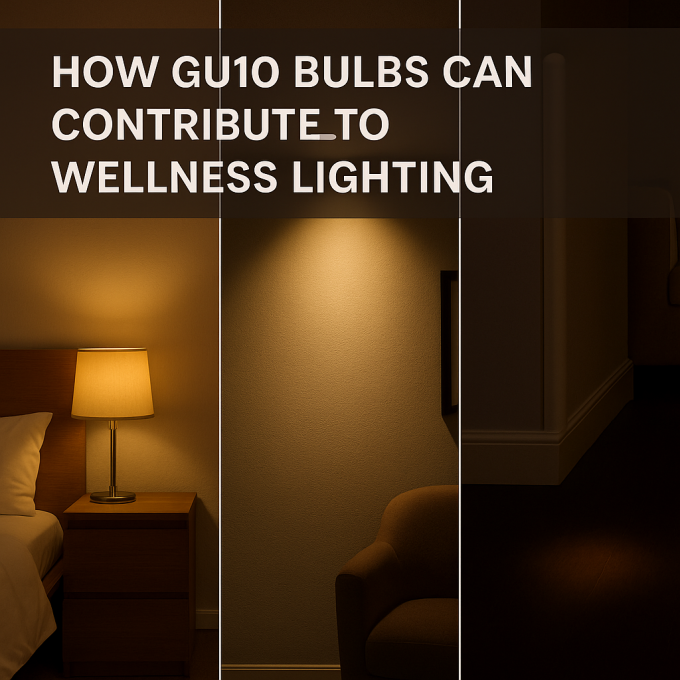
    GU10 Bulbs in Wellness Lighting: Practical Applications and Limits  0

    GU10 bulbs are rarely ideal, but they are widely used. Their value lies in limited, well-defined contributions, not comprehensive control.

    GU10 bulbs support wellness lighting by enabling localized, low-intensity, spectrum-specific illumination.

    Practical strengths of GU10

    GU10 bulbs offer several advantages that align with restrained wellness applications:

    • easy retrofit

    • low installation cost

    • compact form factor

    • directional control

    These characteristics are useful where biological exposure must be controlled rather than amplified.

    Localized biological impact

    Wellness lighting does not always require room-wide biological stimulation.

    GU10 performs well when light should:

    • remain outside direct eye paths

    • stay below circadian activation thresholds

    • support orientation rather than activity

    Typical examples include:

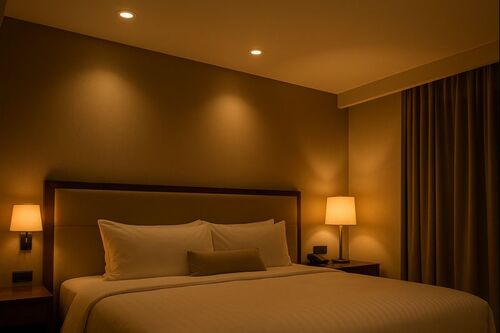
    • bedside lighting

    • accent lighting

    • floor-level navigation

    Circadian response depends largely on vertical illuminance at eye level, not floor brightness.

    Source: WELL Building Standard v2
    https://standard.wellcertified.com/light

    Directional GU10 placement helps limit unwanted eye exposure.

    Appropriate spectrum use for GU10

    GU10 bulbs are most effective when restricted to specific spectral roles.

    Spectrum Wellness Function
    2700K warm white Evening transition
    Amber Late-evening relaxation
    Red Night-time navigation

    White GU10 lamps above 3000K should not be used at night in wellness-oriented environments.

    Dimming as a supporting tool, not a solution

    Dimming improves comfort only when the spectrum is already biologically appropriate.

    A dimmed white GU10 lamp still emits blue wavelengths and can still suppress melatonin.
    Harvard Medical School confirms that blue light suppresses melatonin even at low exposure levels.

    Source: https://health.harvard.edu/staying-healthy/blue-light-has-a-dark-side

    GU10 contributes to wellness when dimming supports safe spectra—not when dimming attempts to compensate for unsafe ones.

    Psychological comfort as a secondary benefit

    Wellness is not purely hormonal. Emotional perception matters.

    Warm GU10 accent lighting can improve:

    • perceived comfort

    • relaxation

    • sense of safety

    These effects support wellness indirectly, particularly in hospitality environments.

    Technical and Biological Limits of GU10 Bulbs
    GU10 Bulbs in Wellness Lighting: Practical Applications and Limits  1

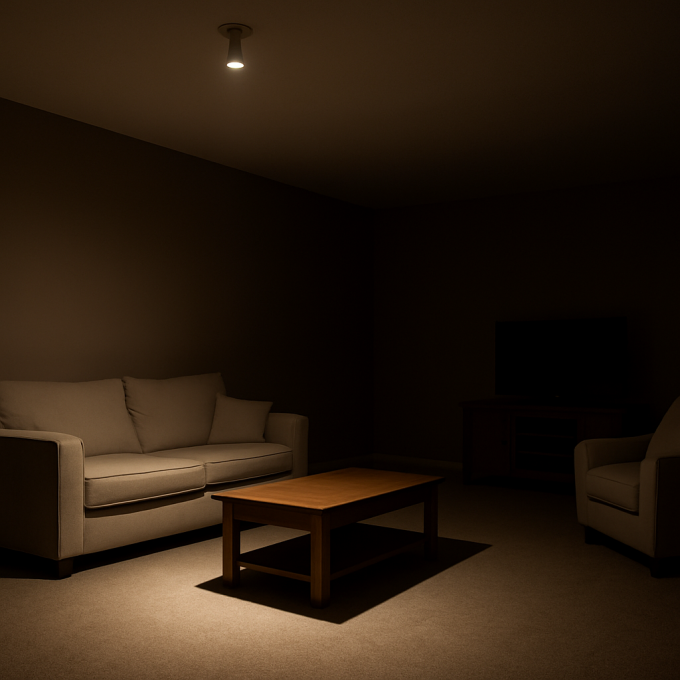
    Many wellness projects fail because GU10 bulbs are used beyond their functional boundaries.

    GU10 bulbs are not suitable for primary circadian stimulation, large-area wellness lighting, or precision-controlled biological systems.

    Output and coverage limitations

    Wellness lighting often requires uniform vertical illuminance at eye level.

    GU10 bulbs are:

    • point light sources

    • limited in luminous flux

    • narrow in beam distribution

    This makes it difficult to deliver consistent biological signals across a space.

    Large-area wellness lighting requires:

    • diffuse emission

    • indirect distribution

    • broad coverage

    GU10 cannot achieve this independently.

    Spectrum control constraints

    Most GU10 bulbs rely on phosphor-converted white LEDs, which results in:

    • fixed blue spectral peaks

    • limited melanopic control

    • weak biological tuning

    Even tunable GU10 products often adjust visual appearance without meaningfully reducing melanopic impact.

    A visually warmer light may still disrupt sleep.

    Misconceptions about low brightness

    Low brightness does not equal low biological impact.

    Research shows that melatonin suppression can occur at very low blue-light exposure, even below 10 lux.

    Source: Journal of Clinical Endocrinology & Metabolism
    https://academic.oup.com/jcem/article/100/6/2209/2836073

    White GU10 lighting is therefore unsuitable for night-time wellness use, regardless of dimming level.

    Flicker and driver variability

    GU10 bulbs integrate drivers within compact housings, leading to wide quality variation.

    Lower-quality drivers often introduce:

    • flicker

    • instability at low output

    • spectral shifts over time

    IEEE Std 1789 confirms that flicker negatively affects neurological comfort.

    Source: https://ieeexplore.ieee.org/document/6575776

    Wellness lighting demands consistency, which GU10 products do not always guarantee.

    Certification and system-level limitations

    GU10-based solutions rarely meet:

    • WELL circadian performance targets

    • healthcare lighting standards

    • research-grade biological metrics

    This does not make GU10 unsuitable—it makes it context-limited.

    Appropriate Use Cases for GU10 in Wellness Lighting
    GU10 Bulbs in Wellness Lighting: Practical Applications and Limits  2

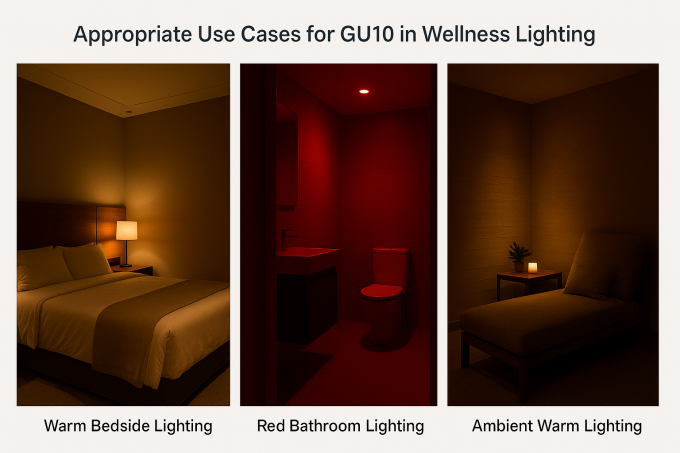
    GU10 bulbs perform best when assigned clear, supportive roles within a broader wellness strategy.

    Successful projects treat GU10 as a secondary wellness element, not a core biological driver.

    Hospitality guest rooms

    Small interventions often deliver measurable results.

    Effective GU10 deployment includes:

    Area GU10 Role
    Bedside Warm or amber light
    Night navigation Red light
    Bathroom night mode Red GU10
    Accent lighting Warm, indirect

    These changes improve sleep quality without system complexity.

    Better sleep correlates with improved guest satisfaction and repeat bookings.

    Residential bedrooms

    Homes allow greater tolerance for manual behavior.

    GU10 works well when:

    • ceiling lights are avoided at night

    • red night lighting is available

    • warm light dominates evening use

    Simple setups often outperform complex smart systems that users disable.

    Wellness hotels and spas

    Spas prioritize calm over stimulation.

    GU10 is effective for:

    • ambient warmth

    • visual comfort

    • psychological relaxation

    It should not be used for circadian entrainment or daylight simulation.

    Retrofit wellness upgrades

    Existing buildings often lack infrastructure flexibility.

    GU10 enables:

    • low-cost wellness improvements

    • minimal disruption

    • fast implementation

    Replacing a limited number of bulbs can significantly improve night-time comfort.

    Where GU10 should not be used

    GU10 is not appropriate as the primary solution in:

    • healthcare facilities

    • senior living circadian programs

    • office environments focused on alertness

    • research-driven wellness installations

    These applications require precision GU10 cannot provide.

    Conclusion

    GU10 bulbs can support wellness lighting when used for localized, low-impact, spectrum-aware applications.
    They are not substitutes for architectural circadian systems and should not be treated as such.

    Wellness lighting succeeds when biological limits are respected and product roles are clearly defined.
    GU10 works best when restraint—not ambition—guides its use.

    Teco manufactures GU10 LED spotlights designed for wellness-aware applications, particularly in hospitality and residential retrofit projects.
    We work B2B only, focusing on stable quality, verified performance, and realistic application guidance.

    Our China-based factory operates four production lines and supports:

    • warm, amber, and red GU10 solutions

    • stable low-level dimming

    • OEM and ODM customization

    • compliance for Europe, Middle East, and Southeast Asia

    If you are planning a wellness lighting project and considering GU10 bulbs:

    Email: [email protected]
    Website: www.tecolite.com

    Tell us your space and biological goal.
    We will tell you honestly where GU10 works—and where it does not.
  • Benefits of GU10 Circadian Bulbs in Retrofit Lighting Projects

    Benefits of GU10 Circadian Bulbs in Retrofit Lighting Projects

    Retrofit lighting projects fail when ambition ignores reality. Budgets are fixed, ceilings remain closed, and operational downtime is not negotiable. In this context, circadian intent only survives when solutions respect structural, behavioral, and economic constraints.

    GU10 circadian-capable bulbs deliver practical biological benefits in retrofit projects by reducing night-time disruption, improving evening comfort, and protecting sleep—without requiring structural changes.

    Retrofit lighting is about progress, not perfection. GU10 bulbs are not full circadian systems, but in many retrofit scenarios they provide the highest biological return per unit of change. This article explains why they work in retrofit conditions, where they outperform complex systems in practice, and how to decide when GU10 is the correct retrofit tool.

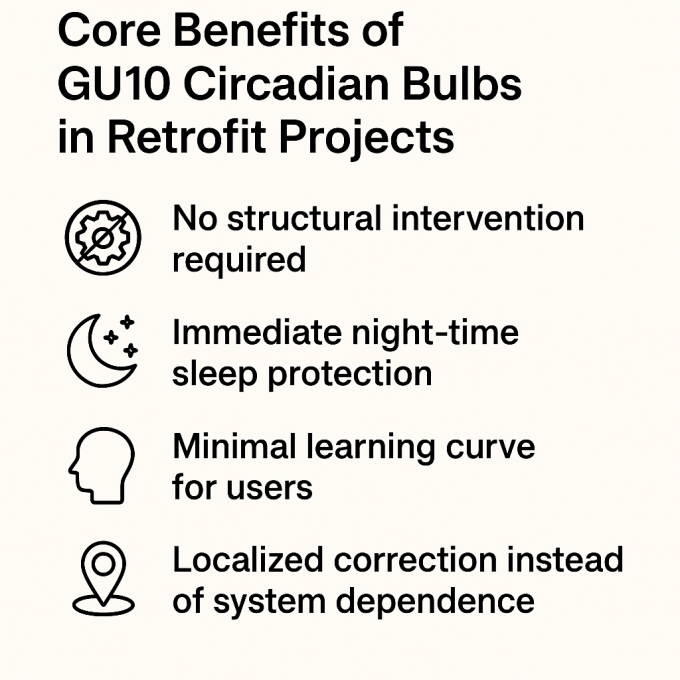
    Core Benefits of GU10 Circadian Bulbs in Retrofit Projects

    Benefits of GU10 Circadian Bulbs in Retrofit Lighting Projects  0

    Retrofit projects succeed when improvements are simple, predictable, and measurable. GU10 circadian bulbs align naturally with these constraints.

    The primary value of GU10 circadian bulbs in retrofit environments is biological improvement achieved with minimal physical and operational disruption.

    No structural intervention required

    Most retrofit buildings cannot accommodate changes to:

    • ceilings

    • wiring routes

    • control cabinets

    GU10 bulbs operate within existing sockets and circuits. This enables:

    • rapid deployment

    • zero room downtime

    • no permitting or redesign

    • no specialist commissioning

    In hospitality, residential, and senior living retrofits, this factor alone often determines whether a project can proceed.

    Immediate night-time sleep protection

    Night-time lighting is the most common circadian failure point in existing buildings.

    Replacing standard white GU10 bulbs with:

    • amber GU10

    • red GU10

    immediately reduces melatonin suppression by addressing the problem at its source: spectrum.

    Harvard Medical School confirms that blue light in the 460–480 nm range suppresses melatonin, even at low intensity.
    Source: https://health.harvard.edu/staying-healthy/blue-light-has-a-dark-side

    GU10 retrofits remove blue-rich light rather than attempting to manage its effects through dimming or control logic.

    Minimal learning curve for users

    Retrofit users—guests, tenants, residents—resist behavioral change.

    GU10 circadian bulbs:

    • behave like conventional lamps

    • require no training

    • do not depend on user understanding

    People use the lights as they always have. This behavioral neutrality is critical in retrofit success and often makes GU10 solutions more effective in practice than complex systems that are misunderstood or bypassed.

    Localized correction instead of system dependence

    Retrofit projects rarely support centralized circadian control.

    GU10 enables localized biological correction in high-impact zones:

    • bedside lighting

    • bathroom night lighting

    • corridors and night paths

    Local biological problems do not always require system-wide solutions. In many retrofit cases, correcting a few critical zones delivers the majority of benefit.

    Favorable cost-to-impact ratio

    Full circadian or HCL systems incur cost through:

    • new luminaires

    • control infrastructure

    • commissioning

    • long-term maintenance

    GU10 circadian bulbs shift investment to the lamp level. This allows:

    • phased upgrades

    • pilot testing

    • outcome validation before scaling

    For retrofit buyers, this reduces both financial and operational risk.

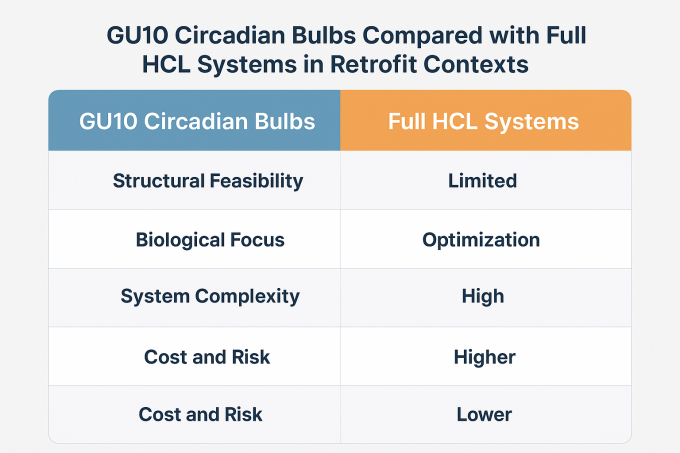
    GU10 Circadian Bulbs Compared with Full HCL Systems in Retrofit Contexts

    Benefits of GU10 Circadian Bulbs in Retrofit Lighting Projects  1

    A common question is whether GU10 circadian bulbs can replace Human Centric Lighting (HCL) systems. They cannot—but this comparison often misses the real retrofit question.

    In retrofit projects, GU10 circadian bulbs compete on reliability and feasibility, not on biological completeness.

    Structural feasibility comparison

    Aspect GU10 Retrofit Full HCL System
    Ceiling modification None Required
    Rewiring No Yes
    Control infrastructure No Yes
    Installation timeline Hours Weeks
    Operational disruption Minimal Significant

    Most retrofit environments cannot tolerate the structural and operational demands of HCL systems.

    Biological performance focus

    Biological Objective GU10 Retrofit Full HCL
    Night melatonin protection Strong Strong
    Evening relaxation Moderate Strong
    Daytime alertness Limited Strong
    Full circadian entrainment Not achievable Achievable

    GU10 solutions focus on harm reduction, particularly at night.
    HCL systems focus on biological optimization across the full day.

    Retrofit projects almost always prioritize harm reduction first.

    Different failure modes

    Understanding how systems fail is critical in retrofit decision-making.

    • HCL systems often fail due to:

    programming drift

    • sensor errors

    • user overrides

    • maintenance complexity

    GU10 circadian retrofits typically fail due to:

    unrealistic expectations

    • continued use of white light at night

    • poor lamp placement

    In retrofit conditions, simple systems fail less often.

    Operational and maintenance reality

    Facilities teams generally prefer:

    • replaceable components

    • predictable behavior

    • minimal software dependence

    GU10 bulbs align with this operational mindset. Many HCL systems fail not technically, but operationally.

    Cost and risk balance

    Factor GU10 HCL
    Initial investment Low High
    Risk exposure Low Medium–High
    Payback horizon Short Long
    User acceptance High Variable

    In retrofit economics, lower risk frequently outweighs theoretical performance.

    Retrofit Project Types Where GU10 Performs Best

    GU10 circadian bulbs do not suit every retrofit scenario. They suit specific ones very well.

    GU10 circadian retrofits are most effective where night-time comfort, sleep protection, and ease of implementation are primary goals.

    Hospitality retrofits

    Hotels rarely close rooms for lighting upgrades.

    GU10 retrofits allow:

    • room-by-room implementation

    • zero guest displacement

    • immediate guest feedback

    Typical applications include:

    Area GU10 Circadian Role
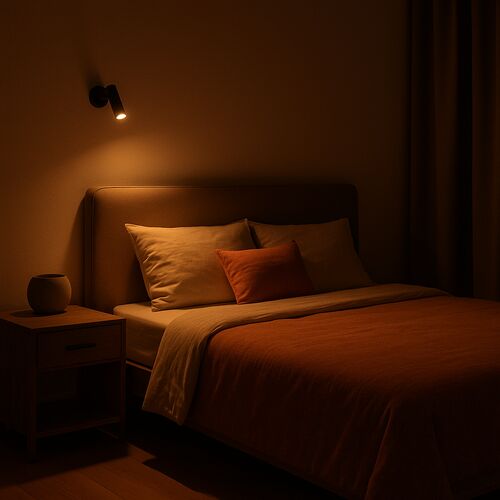
    Bedside Warm or amber lighting
    Bathroom night mode Red GU10
    Corridors Warm, low-glare
    Accent lighting Warm, indirect

    These interventions target guest sleep quality, which directly affects reviews and repeat bookings.

    Serviced apartments and rental properties

    These properties face:

    • frequent tenant turnover

    • limited capital budgets

    • low tolerance for complexity

    GU10 circadian bulbs improve night-time comfort without altering infrastructure. Tenants experience the benefit even if they cannot articulate why.

    Residential retrofit upgrades

    Homeowners typically want better sleep, not lighting systems.

    GU10 allows:

    • DIY-friendly upgrades

    • incremental changes

    • low commitment

    Replacing night-time GU10 bulbs with red or amber versions often produces the most immediate perceived improvement.

    Senior living and assisted housing

    Sleep disruption and night-time falls increase with age.

    Red GU10 night lighting:

    • protects melatonin

    • preserves night vision

    • improves safety

    In these environments, night-time protection often matters more than daytime circadian stimulation.

    Offices with limited wellness objectives

    Offices pursuing basic wellness improvements can use GU10 to:

    • soften after-hours cleaning light

    • reduce biological stress during late occupancy

    GU10 is not suitable for full daytime circadian stimulation but can reduce harm outside working hours.

    Retrofit scenarios where GU10 is insufficient

    Avoid GU10-only retrofit strategies when the objective is:

    • full circadian entrainment

    • healthcare-grade biological lighting

    • productivity-focused daytime stimulation

    • certification-driven compliance

    These goals require system-level solutions.

    A Practical Decision Framework for GU10 Circadian Retrofits

    Retrofit success depends on correct early decisions.

    A simple decision framework helps determine whether GU10 circadian bulbs are an appropriate retrofit solution.

    Step 1: Define the biological problem

    Identify the primary issue being addressed.

    Problem GU10 Suitable
    Poor sleep quality Yes
    Night-time disruption Yes
    Guest complaints Yes
    Low daytime alertness No
    Certification compliance No

    GU10 addresses night-time problems more effectively than daytime ones.

    Step 2: Confirm structural constraints

    If the project cannot:

    • open ceilings

    • add control wiring

    • replace luminaires

    GU10 becomes one of the few viable options.

    Step 3: Identify time-of-day focus

    GU10 performs best when the focus is:

    • evening transition

    • night-time protection

    If morning stimulation is the priority, GU10 is secondary at best.

    Step 4: Evaluate user behavior

    If users are likely to:

    • ignore controls

    • override settings

    • resist learning

    Simple GU10-based solutions often outperform complex systems in practice.

    Step 5: Assess budget and risk tolerance

    Project Type More Suitable
    Pilot or trial GU10
    Phased upgrade GU10
    Full renovation HCL
    Certification-driven project HCL

    Step 6: Combine solutions when appropriate

    Effective retrofits often mix approaches:

    • GU10 for night-time protection

    • existing daylight for daytime stimulation

    • no full HCL system

    Circadian improvement does not require purity. It requires effectiveness.

    Final reality check

    GU10 circadian bulbs will not transform an aging building into a circadian showcase. They will:

    • reduce biological harm

    • improve sleep quality

    • increase comfort

    • lower user complaints

    In retrofit logic, that outcome defines success.

    Conclusion

    GU10 circadian bulbs offer a low-risk, high-impact approach to improving sleep and comfort in retrofit lighting projects where full circadian systems are impractical.

    They succeed not by doing everything, but by doing the right things under real constraints.

    Teco manufactures GU10 circadian-capable LED spotlights designed specifically for retrofit lighting projects in hospitality, residential, and senior living environments.
    We work B2B only, supporting buyers who need realistic application guidance, verified certification, and stable delivery.

    Our China-based factory operates four production lines and supports:

    • warm, amber, and red GU10 solutions

    • stable low-level dimming for night use

    • OEM and ODM customization

    • compliance for Europe, Middle East, and Southeast Asia

    If you are planning a retrofit lighting upgrade and considering GU10 circadian bulbs:

    Email: [email protected]
    Website: www.tecolite.com

    Tell us your building type and constraints.
    We will help you determine whether GU10 is the right retrofit choice—or whether it is not.

  • GU10 Color Temperature Changing Bulbs: How They Work and Where They Fit

    GU10 Color Temperature Changing Bulbs: How They Work and Where They Fit

    Color temperature changing GU10 bulbs are frequently marketed as smart, healthy, or even circadian-ready. In real projects, they sometimes add value. In many others, they quietly fail expectations because the technical mechanism behind the color change is misunderstood.

    GU10 color temperature changing bulbs primarily adjust visual warmth. Their biological and circadian impact depends entirely on how the color change is achieved, not on the label or the CCT range claimed.

    This article explains the actual technical approaches used in GU10 color temperature changing bulbs, how each approach behaves spectrally, where these products are genuinely useful, where they are commonly misapplied, and how they relate—often imperfectly—to circadian lighting strategies. No theory shortcuts. No marketing language.

    Technical Types of Color Temperature Change in GU10 Bulbs

    GU10 Color Temperature Changing Bulbs: How They Work and Where They Fit  0

    Not all GU10 color temperature changing bulbs work in the same way. The internal method used to change color temperature determines whether the result is merely cosmetic or has any biological relevance.

    Understanding the technical category is more important than knowing the advertised CCT range.

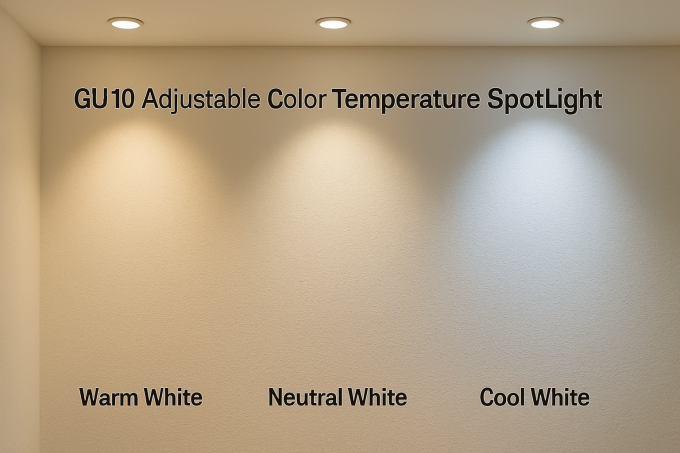
    Fixed-Step CCT Switching GU10 Bulbs

    This is the most common and lowest-cost approach.

    The bulb provides two or three preset color temperatures, typically:

    • 2700K

    • 3000K

    • 4000K

    Switching is achieved through:

    • power cycling

    • wall-switch toggling

    • internal DIP switches

    Feature Characteristic
    CCT change Discrete steps
    Spectrum Fixed per step
    Control Manual
    Cost level Low

    Each step activates a separate LED package or phosphor blend. There is no spectral blending and no time-based adaptation.

    This approach offers predictability and low flicker risk. It works well in retrofit projects where installers want flexibility without smart controls. However, it does not respond automatically to time of day and provides no biological logic on its own.

    Tunable White (Dual-Channel) GU10 Bulbs

    Tunable white GU10 bulbs use two LED channels:

    • one warm white

    • one cool white

    The driver blends these channels at varying current ratios to create a continuous CCT range.

    Feature Characteristic
    CCT range Continuous
    Spectrum Mixed
    Control Dimming or smart systems
    Cost level Medium

    Visually, this produces smooth transitions and broad flexibility. Biologically, performance is inconsistent.

    In many designs, the cool channel never fully disengages. Even at warm settings, residual blue energy remains in the spectrum. Without published spectral power distribution (SPD) data, biological performance cannot be assumed.

    Dim-to-Warm GU10 Bulbs

    Dim-to-warm GU10 bulbs are designed to mimic halogen behavior.

    As the lamp is dimmed:

    • light output decreases

    • correlated color temperature shifts warmer

    Feature Characteristic
    Trigger Dimming
    Behavior Automatic
    User effort Minimal
    Cost level Medium

    Dim-to-warm improves evening comfort and reduces alertness. However, it reduces blue content rather than eliminating it.

    This distinction matters. Dim-to-warm supports evening transition but should not be treated as biologically neutral night lighting.

    Smart RGBW / RGBWW GU10 Bulbs

    These products use multiple LED channels, typically:

    • RGB

    • warm white

    • sometimes cool white

    They can produce a wide range of colors and color temperatures.

    Feature Characteristic
    Flexibility Very high
    Control App-based
    Complexity High
    Output consistency Variable

    These bulbs are designed for visual effects and user interaction, not for biological accuracy. Channel calibration, thermal drift, and driver limitations often lead to inconsistent spectral output, especially at low brightness.

    They are suitable for mood lighting. They are unreliable for wellness or circadian objectives.

    Why This Classification Matters

    Two GU10 bulbs labeled “CCT adjustable” may behave completely differently in real environments.

    If the technical method is unclear, biological benefit should be assumed to be limited.

    Internal Mechanisms and Their Practical Limits

    Color temperature change in GU10 bulbs is determined by LED channel architecture and driver behavior. These constraints define what the bulb can and cannot achieve biologically.

    Fixed-Step Mechanisms

    Each CCT step activates a dedicated LED package. Output is stable, predictable, and repeatable.

    Advantages include:

    • low flicker risk

    • stable spectrum per mode

    • simple electrical behavior

    Limitations are equally clear:

    • no smooth transitions

    • no automation

    • no biological timing logic

    Tunable White Blending Behavior

    Dual-channel blending adjusts visual appearance but often fails to remove blue peaks completely.

    This leads to a common project issue: a light that looks warm but still suppresses melatonin.

    Without SPD data, this failure is invisible until users experience sleep disruption.

    Dim-to-Warm Driver Behavior

    Dim-to-warm relies on current-dependent spectral shifts.

    As current drops:

    • blue contribution decreases

    • red and yellow wavelengths dominate

    This improves evening comfort but does not guarantee night-time biological neutrality.

    Dim-to-warm is transition-friendly, not night-safe.

    Smart GU10 Driver Constraints

    Smart GU10 bulbs face hard physical limits:

    • limited driver space

    • thermal instability

    • inconsistent channel calibration

    As a result:

    • spectrum varies between units

    • flicker increases at low output

    • color accuracy drifts over time

    These issues are acceptable in decorative lighting. They introduce risk in wellness-focused projects.

    Driver Quality as the Decisive Factor

    Regardless of category, the driver determines:

    • flicker performance

    • dimming stability

    • spectral consistency

    IEEE Std 1789 confirms that flicker affects neurological comfort even when not consciously visible. Low-quality drivers undermine even well-designed LED packages.

    Appropriate Use Cases and Common Misuse Scenarios

    GU10 Color Temperature Changing Bulbs: How They Work and Where They Fit  1

    Color temperature changing GU10 bulbs are not inherently problematic. Misuse occurs when expectations exceed what the technology can deliver.

    Valid Applications

    Evening flexibility in residential spaces
    Fixed-step and dim-to-warm GU10 bulbs work well in living rooms and dining areas, allowing users to shift from neutral activity lighting to warmer relaxation light.

    Hospitality guest rooms (limited scope)
    Hotels benefit from preset warm evening modes and neutral cleaning modes. Fixed-step GU10 bulbs allow staff-controlled defaults without guest education.

    Retail and display lighting
    CCT adjustment supports visual presentation without biological expectations.

    Common Misuse Patterns

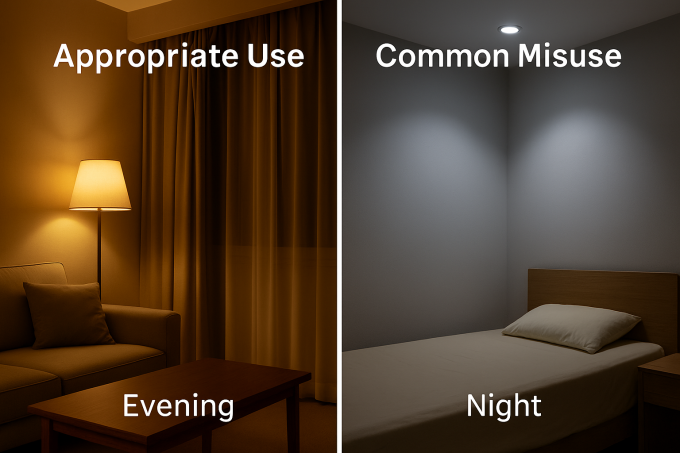
    Night-time bedroom lighting
    Warm white light is often assumed to be safe. It is not always. Even 2700K white light contains blue wavelengths that can suppress melatonin.

    Claiming circadian functionality
    If a bulb cannot eliminate blue light at night, follow time-based logic, or support vertical eye-level exposure, it should not be labeled circadian.

    Over-reliance on apps
    Smart GU10 bulbs assume consistent user behavior. In reality, automation is overridden, schedules drift, and systems revert to white light.

    Misuse Consequences

    Misuse Project Outcome
    Night use of white light Sleep disruption
    Assuming dimming is enough Melatonin suppression
    Trusting CCT labels False wellness claims
    Ignoring driver quality Flicker complaints and instability

    The failure is rarely the bulb itself. It is the expectation.

    Relationship to Circadian Lighting Strategies

    Color temperature change is frequently confused with circadian lighting. They overlap, but they are not equivalent.

    Changing CCT addresses visual comfort. Circadian lighting requires spectrum control, timing, intensity, and exposure geometry.

    What Circadian Lighting Requires

    Factor Importance
    Spectrum High
    Timing High
    Intensity Medium
    Duration Medium
    Vertical exposure High

    CCT change addresses only one variable.

    Where CCT-Changing GU10 Bulbs Fit

    These products can support circadian-aware strategies by:

    • easing evening transitions

    • reducing harsh contrast

    • improving perceived comfort

    They cannot provide:

    • morning circadian stimulation

    • night-time melatonin safety

    • biological entrainment

    Honest Positioning

    A realistic statement is:

    “GU10 color temperature changing bulbs improve visual comfort and support circadian-aware transitions, but they do not replace circadian lighting systems.”

    This framing avoids project disappointment and client conflict.

    Conclusion

    GU10 color temperature changing bulbs adjust visual warmth using different technical mechanisms. They perform best when used for comfort and transitional lighting, not as substitutes for circadian or biologically precise lighting systems.

    Understanding how the color change is achieved is essential to knowing where the product truly fits.

    Teco manufactures GU10 LED spotlights, including fixed-CCT, dim-to-warm, and spectrum-specific solutions designed for practical applications in hospitality and residential projects. We work B2B only, focusing on stable quality, clear technical limits, and honest product positioning.

    Our factory in China operates four production lines and supports:

    • warm, amber, and red GU10 options

    • dim-to-warm GU10 development

    • OEM and ODM customization

    • compliance for Europe, the Middle East, and Southeast Asia

    If you are considering GU10 color temperature changing bulbs for a project:

    Email: [email protected]
    Website: www.tecolite.com

    Tell us your application and expectations.
    We will help you choose what fits—and avoid what does not.

  • Human-Centric Lighting with GU10 Bulbs: Design Logic, Applications, and Limits

    Human-Centric Lighting with GU10 Bulbs: Design Logic, Applications, and Limits

    Many projects claim to implement human-centric lighting, yet occupants still report fatigue, night-time overstimulation, or visual discomfort. In most cases, the problem is not intention—it is design logic and inappropriate tool selection.

    Human-centric lighting focuses on how light affects people biologically and psychologically. GU10 bulbs can support this approach when their role is clearly defined and their limits are respected.

    Human-centric lighting is not a product category. It is a design mindset. GU10 bulbs are one tool within that framework. Used correctly, they improve comfort and sleep-related outcomes. Used incorrectly, they add complexity without delivering real benefits.

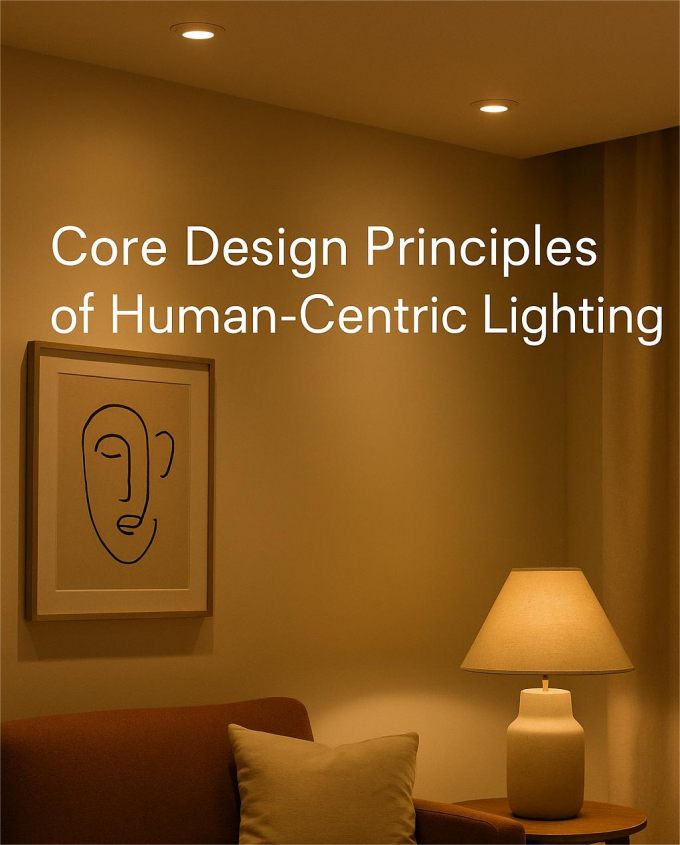
    Core Design Principles of Human-Centric Lighting

    Human-Centric Lighting with GU10 Bulbs: Design Logic, Applications, and Limits  0

    Human-centric lighting begins with human biology, not luminaires or control systems.

    At its core, human-centric lighting aligns light spectrum, intensity, timing, and predictability with human physiological and behavioral needs.

    Light as a biological signal

    Humans respond to light through more than vision. Light directly affects hormones, alertness, and emotional state.

    Research shows that intrinsically photosensitive retinal ganglion cells (ipRGCs) respond strongly to short-wavelength blue light and transmit signals directly to the brain’s circadian center, bypassing visual perception entirely. A light can appear comfortable while still overstimulating the nervous system.

    This is why visual comfort alone is not a reliable indicator of biological suitability.

    Foundational human-centric principles

    Across residential, hospitality, and wellness-focused environments, several principles consistently apply:

    • Time awareness: Light requirements change throughout the day

    • Spectrum control: Blue-rich light during the day, low-blue or blue-free light at night

    • Intensity restraint: Brightness only where and when it is necessary

    • Visual comfort: Low glare and soft contrast

    • Predictability: No sudden or confusing changes in lighting behavior

    Human-centric lighting prioritizes stress reduction before performance enhancement.

    Vertical exposure matters more than floor brightness

    Biological response depends on light reaching the eyes, not illuminance measured on horizontal surfaces.

    Bright floors with dark walls have limited biological effect. Soft, vertical illumination at eye level is far more influential. This principle directly shapes how GU10 bulbs should be positioned and aimed.

    Less stimulation often delivers better outcomes

    Human-centric lighting is frequently misunderstood as adding features. In practice, it removes unnecessary stimulation:

    • fewer harsh sources

    • fewer bright lights at night

    • fewer competing color temperatures

    GU10 bulbs naturally support this restraint-oriented approach due to their limited output and directional nature.

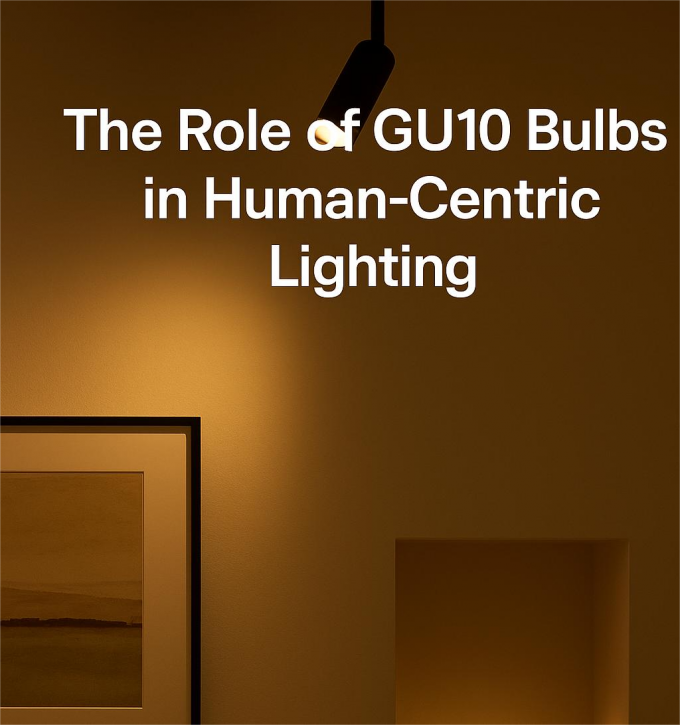
    The Role of GU10 Bulbs in Human-Centric Lighting

    Human-Centric Lighting with GU10 Bulbs: Design Logic, Applications, and Limits  1

    GU10 bulbs are rarely the primary drivers of human-centric lighting. They function best as controlled, supportive elements.

    GU10 bulbs contribute to human-centric lighting by enabling localized, low-impact, spectrum-specific light where restraint is required.

    Why GU10 aligns with human-centric logic

    GU10 bulbs offer characteristics that fit human-centric design goals:

    • compact form factor

    • directional light distribution

    • easy zoning

    • retrofit compatibility

    These traits allow designers to control where light is present—and just as importantly, where it is absent.

    Human-centric lighting often requires reducing exposure, not increasing it.

    Typical GU10 roles in human-centric projects

    GU10 bulbs are most effective when used for:

    • bedside and reading lights

    • accent lighting

    • night navigation and orientation

    • evening transition lighting

    These applications benefit from precision and low biological impact rather than high output.

    Spectrum roles GU10 handles effectively

    GU10 bulbs perform best when assigned limited, intentional spectral roles:

    Spectrum Human-Centric Function
    2700K warm white Evening comfort and relaxation
    Amber Late-evening calm
    Red Night-time orientation with minimal biological impact

    White GU10 bulbs above 3000K should be avoided late at night, even when dimmed. Blue content remains present and biologically active.

    GU10 as a boundary-setting tool

    Human-centric lighting depends on clear boundaries between activity and rest.

    GU10 bulbs help define:

    • where light stops

    • where darkness begins

    • where activity transitions to recovery

    These boundaries are particularly important in bedrooms, hotel guest rooms, and wellness-oriented environments.

    Psychological comfort still matters

    Beyond hormones, lighting influences emotional perception.

    Warm, localized GU10 lighting improves:

    • perceived safety

    • emotional comfort

    • sense of personal control

    In hospitality and residential settings, these psychological effects are often as important as measurable biological outcomes.

    Design Strategies Using GU10 Bulbs

    Human-Centric Lighting with GU10 Bulbs: Design Logic, Applications, and Limits  2

    GU10 bulbs deliver results only when integrated into structured design strategies.

    Effective human-centric lighting with GU10 relies on layered, time-aware, and placement-sensitive design.

    Strategy 1: Layered lighting hierarchy

    Human-centric spaces rely on multiple lighting layers rather than a single dominant source:

    Layer Purpose GU10 Suitability
    Ambient General visibility Limited
    Task Focused activity Moderate
    Accent Comfort and mood Strong
    Night Orientation only Very strong

    GU10 bulbs should dominate the lower-impact layers, not the ambient layer.

    Strategy 2: Evening transition control

    Evening lighting should gradually reduce cognitive stimulation.

    Effective approaches include:

    • switching from neutral to warm GU10 light

    • gradually reducing brightness

    • shifting light from ceilings toward walls and surfaces

    Dim-to-warm GU10 bulbs support this transition, but only as an intermediate step—not as true night lighting.

    Strategy 3: Night-time protection

    At night, the objective is simple: avoid waking the brain.

    Recommended practice:

    • red GU10 bulbs

    • very low output

    • placement below eye level

    Red light has been shown to have negligible impact on melatonin suppression, making it suitable for night-time navigation in bedrooms, hotel bathrooms, and corridors.

    Strategy 4: Directional and glare control

    Human-centric lighting minimizes direct eye exposure.

    GU10 fixtures should be:

    • shielded

    • aimed away from the eyes

    • directed toward walls, floors, or architectural elements

    Indirect reflection creates softer, more biologically tolerable exposure.

    Strategy 5: Default-safe design

    Human-centric lighting must function correctly even when users behave unpredictably.

    Design systems so that:

    • late-night switches never activate bright white light

    • warm or red GU10 lighting is always accessible

    • operation does not depend on apps or user training

    This principle is critical in hotels, serviced apartments, and rental properties.

    Strategy 6: Retrofit-friendly improvements

    GU10 bulbs enable incremental upgrades.

    Replacing night-time white GU10 lamps with red or amber versions often produces noticeable improvements in sleep comfort with minimal disruption.

    Limitations Designers Must Accept

    Human-Centric Lighting with GU10 Bulbs: Design Logic, Applications, and Limits  3

    Human-centric lighting fails when designers expect GU10 bulbs to perform tasks they were never designed to handle.

    GU10 bulbs have clear biological and technical limits that must be accepted.

    Limited circadian stimulation capability

    GU10 bulbs cannot provide strong circadian activation due to:

    • limited luminous flux

    • narrow beam angles

    • point-source distribution

    Circadian stimulation requires large-area, vertical illumination that GU10 cannot deliver alone.

    Spectrum control constraints

    Most GU10 bulbs use phosphor-converted white LEDs, resulting in:

    • fixed blue peaks

    • limited spectral shaping

    • incomplete melanopic control

    Even tunable GU10 products often change visual appearance more than biological impact.

    Dimming does not resolve biological issues

    Dimming reduces brightness, not wavelength.

    White GU10 light still contains blue energy when dimmed, and research shows melatonin suppression can occur at very low blue-light levels. For night-time use, spectrum selection is more important than dimming.

    Flicker and driver quality risks

    GU10 bulbs integrate compact drivers, and quality varies widely.

    Low-quality drivers introduce:

    • flicker

    • instability at low output

    • spectral drift

    Neurological comfort depends on consistency, not just brightness control.

    Certification and standard limitations

    GU10-based designs rarely meet:

    • WELL circadian credit thresholds

    • healthcare-grade lighting standards

    • research-driven human-centric metrics

    This does not disqualify GU10—it defines its appropriate role.

    The correct mindset

    Successful human-centric design accepts that:

    • GU10 supports comfort more than performance

    • GU10 reduces harm more than it creates benefit

    • GU10 complements systems rather than replacing them

    Honest tools produce reliable outcomes.

    Conclusion

    GU10 bulbs support human-centric lighting when used for localized, low-impact, and time-aware applications. Their value lies in comfort enhancement, night-time protection, and boundary-setting—not in full circadian stimulation or biological optimization.

    Teco designs and manufactures GU10 LED spotlights for human-centric and wellness-aware lighting applications in hospitality and residential projects. We work B2B only, focusing on stable quality, clear technical positioning, and real-world performance.

    Our China-based factory operates four production lines and supports:

    • warm, amber, and red GU10 solutions

    • dim-to-warm GU10 development

    • stable low-level dimming

    • OEM and ODM customization

    • compliance for Europe, the Middle East, and Southeast Asia

    If you are designing a human-centric lighting project and considering GU10 bulbs, tell us your space, users, and constraints.
    We will help you determine where GU10 fits—and where it does not.
  • GU10-Compatible Circadian Lighting Systems: What Works and What Doesn’t

    GU10-Compatible Circadian Lighting Systems: What Works and What Doesn’t

    Many lighting projects attempt to implement circadian lighting using GU10 lamps and end up underwhelmed. The concept is often correct, but the execution overlooks fundamental biological and technical constraints.

    GU10 lamps can support circadian lighting strategies in specific, well-defined scenarios. They cannot replace full-spectrum architectural circadian systems. Understanding this distinction is essential.

    Circadian lighting is not a product category. It is a system logic defined by biological response, control capability, and spatial delivery. GU10 sits within that logic with clear strengths—and equally clear boundaries. This article explains both, without marketing shortcuts.

    What Defines a Circadian Lighting System

    GU10-Compatible Circadian Lighting Systems: What Works and What Doesn’t  0

    Circadian lighting is frequently simplified as “changing color temperature.” This is a technical misunderstanding. Visual warmth does not equal biological effectiveness.

    A circadian lighting system is defined by how accurately it controls spectrum, timing, intensity, and duration in alignment with human circadian biology.

    Core elements of a circadian lighting system

    A functional circadian system must address four parameters simultaneously:

    Parameter Why It Matters
    Spectrum Determines biological response
    Intensity Sets circadian signal strength
    Timing Aligns with circadian phase
    Duration Sustains biological effect

    If any one of these variables is missing or uncontrolled, the system becomes incomplete.

    Many so-called circadian solutions focus solely on correlated color temperature (CCT). This produces visual change but often fails to produce meaningful biological impact.

    Biological metrics over visual labels

    Modern circadian lighting design relies on non-visual metrics rather than appearance-based descriptions.

    Metric What It Measures Reference
    Melanopic EDI Biological light effectiveness CIE S 026
    ipRGC response Circadian activation pathway Berson et al.
    CS (Circadian Stimulus) Sleep–wake influence Rea et al.

    Source: CIE S 026/E:2018
    https://cie.co.at/publications/cie-system-metrology-optical-radiation-response-light-non-visual-effects

    If a lighting system cannot meaningfully influence these metrics, it should be described as circadian-aware, not circadian-complete.

    Where GU10 fits within this definition

    GU10 lamps are:

    • compact

    • retrofit-friendly

    • limited in luminous output

    • limited in spectral control

    They can participate in circadian strategies, but they cannot independently define circadian outcomes.

    Circadian System Types That Can Work with GU10

    GU10-Compatible Circadian Lighting Systems: What Works and What Doesn’t  1

    GU10 is not designed for full circadian control. However, it can function within certain circadian system architectures when expectations are realistic.

    GU10-compatible circadian strategies rely on discrete spectral stages rather than continuous spectral modulation.

    Time-based spectrum staging

    This is the most robust and widely applicable approach.

    Different GU10 spectra are assigned to specific time periods:

    Time of Day GU10 Spectrum Purpose
    Morning 4000K–5000K Support alertness
    Evening 2700K–3000K Reduce stimulation
    Night Red or amber GU10 Protect melatonin

    This method does not attempt to replicate daylight curves. Instead, it respects known biological thresholds—particularly the presence or absence of blue light.

    Circadian response is not linear. The human system reacts strongly to spectral boundaries, not smooth transitions.

    Dimmable GU10 with controlled scheduling

    Dimming can reduce circadian impact, but only under strict conditions:

    • trailing-edge–compatible dimming

    • stable driver behavior at low current

    • no spectral shift toward blue at low output

    This approach is most suitable for evening transition phases rather than daytime entrainment.

    GU10 as a secondary circadian layer

    In well-designed circadian environments, GU10 rarely acts as the primary biological driver.

    Instead, it supports:

    • accent lighting

    • wall washing

    • localized task illumination

    Primary circadian stimulus is typically delivered through:

    • indirect ceiling systems

    • linear luminaires

    • large-area diffuse sources

    GU10 complements these systems. It does not replace them.

    Manual circadian zoning

    Some residential and hospitality projects deliberately avoid automation.

    Typical zoning logic includes:

    • primary ceiling lighting disabled at night

    • red GU10 lamps for night navigation

    • warm GU10 for evening ambience

    • daylight GU10 restricted to morning use

    This approach is simple, predictable, and aligned with natural human behavior patterns.

    Where GU10 Compatibility Reaches Its Limits

    GU10-Compatible Circadian Lighting Systems: What Works and What Doesn’t  2

    GU10 has non-negotiable constraints. Ignoring them leads to ineffective circadian outcomes and user dissatisfaction.

    GU10 fails when continuous spectral tuning, high melanopic output, or full-room biological control is required.

    Output and spatial coverage limits

    Circadian stimulation depends on spatial exposure, not point brightness.

    A typical GU10 provides:

    • limited luminous flux

    • narrow beam distribution

    • localized illumination

    Circadian response is driven primarily by vertical illuminance at eye level, not horizontal lux values.

    Source: WELL Building Standard v2
    https://standard.wellcertified.com/light

    GU10 cannot deliver uniform vertical exposure across a space.

    Spectral control limitations

    Most GU10 lamps:

    • rely on phosphor-converted white LEDs

    • have fixed spectral power distributions

    • cannot fully remove short-wavelength peaks

    Even tunable GU10 lamps often adjust CCT visually rather than melanopically. Visual warmth may improve while biological impact remains largely unchanged.

    Why dimming alone is insufficient

    A persistent misconception is that dimming white light eliminates circadian disruption.

    It does not.
    Even low-intensity white light contains blue wavelengths. Research shows that melatonin suppression can occur at very low blue-light exposure levels, including below 10 lux.

    Source: Journal of Clinical Endocrinology & Metabolism (2015)
    https://academic.oup.com/jcem/article/100/6/2209/2836073

    This makes white GU10 unsuitable for true night-time circadian protection.

    Control system limitations

    GU10-based systems often rely on:

    • phase dimming

    • wall-mounted controls

    • limited smart logic

    They typically lack:

    • precise timing control

    • spectral awareness

    • biological feedback mechanisms

    At scale, this limits reliability for circadian-critical applications.

    Expectation boundaries

    GU10 cannot:

    • replicate outdoor daylight exposure

    • deliver circadian entrainment alone

    • meet healthcare-grade circadian requirements

    • satisfy WELL circadian targets independently

    This is not a product failure. It is a design boundary.

    Best Use Cases for GU10 in Circadian Strategies

    GU10-Compatible Circadian Lighting Systems: What Works and What Doesn’t  3

    GU10 performs best when applied deliberately rather than aggressively.

    Its strength lies in localized, time-specific, and low-risk circadian support.
    Hospitality guest rooms

    Hotels benefit significantly from GU10 when applied correctly.
    Area GU10 Function
    Bedside Warm or red night light
    Bathroom night mode Red GU10
    Evening ambience 2700K, dimmed
    Morning task Limited 4000K

    This approach improves sleep quality without introducing user complexity.

    Residential bedrooms

    Homes tolerate simpler circadian strategies.

    GU10 works well when:

    • warm light is the default

    • red light is available at night

    • white light is minimized after evening hours

    Simplicity often outperforms sophistication.

    Retrofit projects

    GU10 is particularly valuable in retrofit scenarios:

    • no ceiling reconstruction

    • no rewiring

    • minimal disruption

    This enables circadian improvement without architectural intervention.

    Accent and psychological comfort lighting

    Circadian benefit is not purely hormonal.

    Warm accent lighting contributes to:

    • perceived comfort

    • relaxation

    • emotional safety

    These factors indirectly support recovery and sleep quality.

    Where GU10 should not be used

    Avoid positioning GU10 as:

    • the primary circadian driver

    • healthcare lighting core

    • office alertness system

    • daylight simulation source

    Correct placement matters more than capability claims.

    Conclusion

    GU10 lamps can support circadian lighting strategies when applied in time-based, localized, and spectrum-aware roles. They cannot replace full circadian lighting systems.

    Used correctly, GU10 enhances comfort, reinforces circadian cues, and enables meaningful improvement—particularly in hospitality, residential, and retrofit-focused projects. Used incorrectly, it creates false expectations and inconsistent outcomes.

    Circadian lighting is a system decision. GU10 is one component within that system—not the system itself.

    Teco designs and manufactures GU10-compatible dimmable LED spotlights for hospitality, residential, and retrofit-oriented projects, with a focus on stable drivers, controlled spectra, and predictable long-term performance.

    We work with B2B partners on:

    • circadian-aware GU10 product lines

    • warm, amber, and red spectrum solutions

    • OEM and ODM development

    • compliance for Europe, the Middle East, and Southeast Asia

    If you are evaluating whether GU10 is appropriate for a circadian-focused application—or determining where it should not be used—technical clarification at the planning stage can prevent costly misalignment later.

    Email: [[email protected]]
    Website: [https://www.tecolite.com]

    Describe your application goals and constraints.
    We will explain what works, what doesn’t, and why.

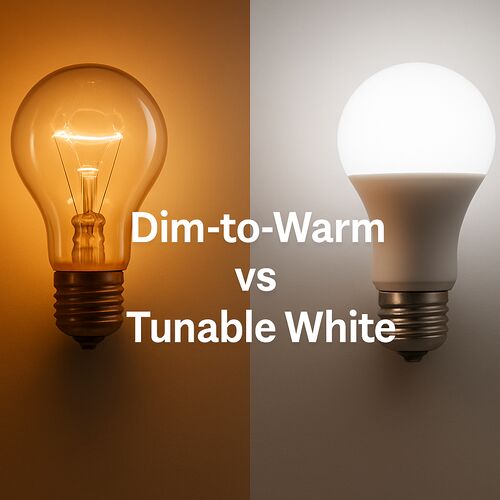
  • Dim-to-Warm vs Tunable White: What’s the Difference and Which One Should You Choose?

    Dim-to-Warm vs Tunable White: What’s the Difference and Which One Should You Choose?

    Lighting has evolved from a fixed-output utility into a controllable system that influences visual comfort, mood, circadian function, and brand experience.
    Two technologies dominate the conversation: Dim-to-Warm and Tunable White.

    They sound similar—both change color temperature—but they solve very different problems and deliver very different user experiences.

    This article explains how each system works, what applications they are suited for, what engineering trade-offs they carry, and how specifiers should make decisions based on human perception, economics, and operational priorities.

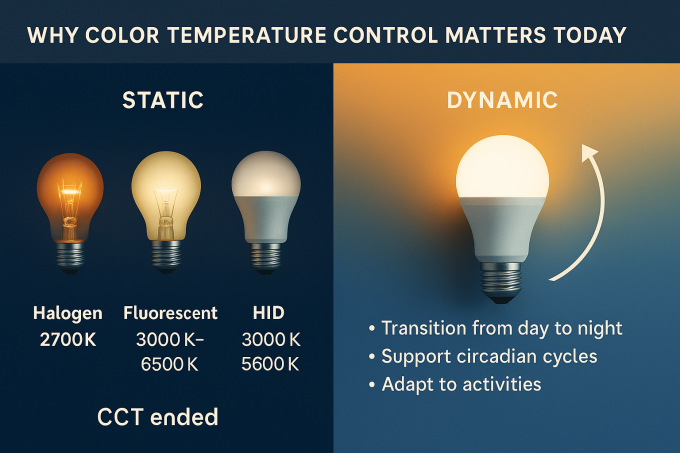
    1. Why Color Temperature Control Matters Today

    Dim-to-Warm vs Tunable White: What’s the Difference and Which One Should You Choose?  0

    Historically, light sources had a fixed CCT:

    • Halogen: 2700–3000K

    • Fluorescent: 3000–6500K

    • HID: 3000–5600K

    LED disrupted this by enabling digital control of spectral output.

    The shift wasn’t just aesthetic. It reflected three real industry demands:

    • Better visual comfort

    • Better mood and experience

    • Better control over operational costs and energy

    Today, hospitality, residential, retail, and workplaces expect lighting to:

    • Transition from day to night

    • Support circadian cycles

    • Deliver comfortable dimming

    • Adapt to activities or brand identity

    Static CCT cannot do this.
    Dynamic CCT can.

    But dynamic CCT is not one technology.
    There are two fundamentally different approaches.

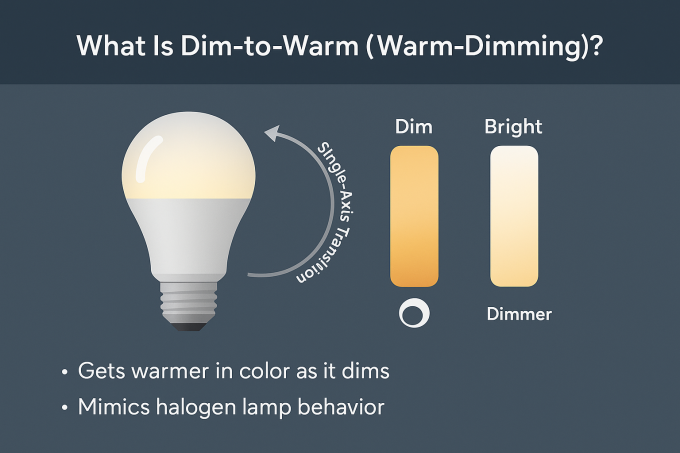
    2. What Is Dim-to-Warm (Warm-Dimming)?

    Dim-to-Warm vs Tunable White: What’s the Difference and Which One Should You Choose?  1

    Dim-to-Warm mimics the behavior of halogen lamps:
    as you dim the light, the color temperature gets warmer.

    Typical range:

    • Bright: 2700–3000K

    • Dim: 1800–2200K

    Some premium systems go as low as 1600K.

    This is a single-axis transition that follows a predefined curve.
    Users do not control CCT directly—only brightness.
    Color temperature changes automatically.

    2.1 How Dim-to-Warm Works

    A dim-to-warm LED uses two phosphor or diode channels:

    • Cool/neutral channel

    • Warm/amber channel

    As the driver reduces output, it shifts the balance toward the warm channel.

    The user sees:

    • Bright = neutral

    • Dim = warm and cozy

    It creates a natural, intuitive dimming experience without control complexity.

    2.2 What Dim-to-Warm Feels Like

    The experience is closer to analog incandescent lighting:

    • Softer

    • Calmer

    • Lower contrast

    • Low blue content

    Humans perceive dim-to-warm as comfortable and emotional, not “technical”.

    This is why it fits living spaces, restaurants, hotels, and hospitality.

    2.3 Technical Advantages

    Benefit Value
    Intuitive control No CCT settings, just dimming
    Emotional experience Similar to firelight/halogen
    Reliable driver behavior Fewer channel conflicts
    Low blue light at low output Better evening comfort
    Lower cost than tunable white Simpler architecture

    2.4 Limitations

    Limitation Impact
    Single preset curve No customization
    Limited CCT range Not suitable for high-CCT daylight scenes
    Cannot support circadian protocols No automated CCT control
    No “cool” output Not suitable for workspaces

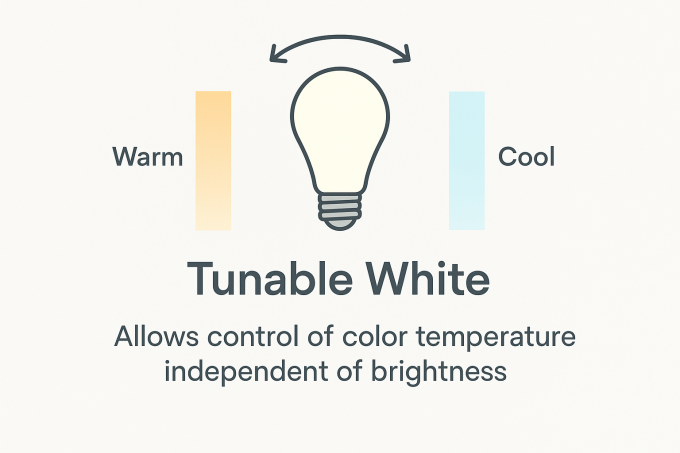
    3. What Is Tunable White?

    Dim-to-Warm vs Tunable White: What’s the Difference and Which One Should You Choose?  2

    Tunable White (TW) allows independent control of color temperature regardless of brightness.

    Typical range:

    • 1800K–6500K (Premium)

    • 2700K–5000K (Standard commercial)

    Users can adjust:

    • Brightness

    • Color temperature

    • (In advanced systems) spectral content

    Tunable white requires:

    • Two or more LED channels

    • A controller

    • An algorithm or control protocol

    This makes it a more powerful but more complex system.

    3.1 What Tunable White Is Designed For

    Tunable white enables lighting to adapt to:

    • Circadian schedules

    • Task requirements

    • Aesthetic scenes

    • Architectural events

    • Brand experience

    It is a dynamic visual tool, not just a mood tool.

    Example use cases

    • Day: 4000K for productivity

    • Evening: 3000K for relaxation

    • Presentation: 5000K for clarity

    • Dining: 2700K for ambience

    Dim-to-warm cannot do this.

    3.2 Technical Advantages

    Benefit Value
    Wide CCT range Supports human-centric lighting
    Independent control Flexible programming
    Dynamic scenes Retail, office, museum
    True circadian lighting Morning cool, evening warm
    Architectural adaptability Design differentiation

    3.3 Limitations

    Limitation Impact
    Higher cost Multi-channel + controls
    More complex commissioning System design required
    Risk of visual mismatch Poor mixing or calibration
    User confusion Too many controls without UX design
    Control compatibility issues Many dimmers incompatible

    4. Why People Confuse the Two

    To people unfamiliar with lighting, both technologies look like:

    “LEDs that change color temperature”

    But the mechanisms and outcomes are fundamentally different.

    Feature Dim-to-Warm Tunable White
    CCT control Automatic Manual / programmable
    Dim effect Warmer Same or warmer
    Range Limited Wide
    Complexity Low High
    Purpose Comfort Function + experience
    Biology Partially supportive Fully supportive

    Dim-to-warm is a behavior.
    Tunable white is a system.

    5. Which One Looks More “Natural”?

    Dim-to-warm almost always looks more natural because:

    • Spectral shift follows a smooth, curved decay

    • Lower blue content aligns with night perception

    • People associate warmth with comfort and relaxation

    Tunable white looks technical, unless well-designed.

    In high-end hospitality, designers often want lights to feel invisible:

    Light should not call attention to itself.

    Dim-to-warm achieves this elegantly.

    6. Biological Impact: Which One Supports Circadian Health?

    6.1 Dim-to-Warm

    • Low blue at night

    • Good for relaxation

    • Helps sleep hygiene

    • Not controllable for morning stimulation

    Supports evening biology, but not 24-hour health.

    6.2 Tunable White

    • High CCT and blue peaks for alertness

    • Low CCT for melatonin support

    • Programmable cycles

    • Day-night alignment possible

    Supports research-backed circadian strategies, including:

    • Office productivity

    • Sleep environments

    • Healthcare recovery

    Summary

    Feature Dim-to-Warm Tunable White
    Evening relaxation Excellent Good
    Daytime stimulation Weak Excellent
    Circadian alignment Partial Full
    Human health strategy Limited Strong

    7. Energy and Driver Behavior

    7.1 Dim-to-Warm

    • Typically uses triac or phase-cut dimmers

    • Stable performance with legacy hardware

    • Minimal flicker if engineered well

    7.2 Tunable White

    • Requires digital or 0–10V / DALI DT8 controls

    • Higher risk of flicker or misconfiguration

    • Higher commissioning cost

    Operationally, dim-to-warm is simpler and more deployable.

    8. Economic Considerations

    8.1 Capex (Upfront Cost)

    System Cost
    Dim-to-Warm Low–Medium
    Tunable White Medium–High

    8.2 Opex (Operational Cost)

    System Complexity
    Dim-to-Warm Low
    Tunable White Medium–High

    9. Best Applications for Each

    9.1 Best for Dim-to-Warm

    • Restaurants

    • Bars

    • Hotels

    • Lounge spaces

    • Residential

    • Cinemas

    • Spas

    • Retail dressing rooms

    Design philosophy:

    “Comfort, mood, and visual softness matter most.”

    9.2 Best for Tunable White

    • Offices

    • Schools

    • Hospitals

    • Museums

    • Galleries

    • Conference rooms

    • Retail chains

    • Experience centers

    Design philosophy:

    “Lighting must adapt to activity, time, or branding.”

    10. Common Mistakes in Specification

    10.1 Mistake 1 — Using Tunable White for Simple Projects

    Results:

    • Overcost

    • Underutilized features

    • Confused users

    10.2 Mistake 2 — Using Dim-to-Warm in Workspaces

    Results:

    • Sleepiness

    • Low visibility

    • Poor task performance

    10.3 Mistake 3 — Ignoring Beam and Optics

    People obsess over CCT and forget optics.

    Optics shape experience more than color.

    11. How to Choose the Right Technology

    11.1 Choose Dim-to-Warm if:

    • You want emotional lighting

    • You want halogen-like dimming

    • You want low blue in evenings

    • You want low complexity

    • You want lower cost

    11.2 Choose Tunable White if:

    • Lighting must adapt

    • You need circadian support

    • You want programmable scenes

    • You design for commercial spaces

    • You want performance outcomes

    12. Future Trends

    • Dual-engine spectrally optimized LEDs

    • Circadian standards (WELL, UL, DIN)

    • Low-blue workplace lighting

    • Adaptive hospitality environments

    The industry is moving toward biologically meaningful control, not just visual preference.

    Conclusion

    Dim-to-warm and tunable white are both powerful technologies—but they are designed for different outcomes.

    • Dim-to-warm delivers emotional, warm, halogen-like ambiance, ideal for hospitality and residential environments that prioritize comfort.

    • Tunable white delivers dynamic, programmable, performance-focused lighting, ideal for commercial spaces that need adaptability, productivity, and wellness support.

    They are not substitutes.
    They are tools for different problems.

    The correct choice depends on purpose, people, and place, not just CCT ranges on a datasheet.

    If you’re planning a project and need dim-to-warm or tunable white solutions with reliable drivers, high CRI, and OEM/ODM capability, Teco can help.

    We support:

    • Hospitality lighting

    • Premium residential

    • Retail and commercial environments

    • Custom spectrum and optical design

    Contact: [email protected]
    Website: tecolite.com

    Share your application requirements or spec sheet—
    we’ll help you select technology that fits human behavior, not just hardware specs.

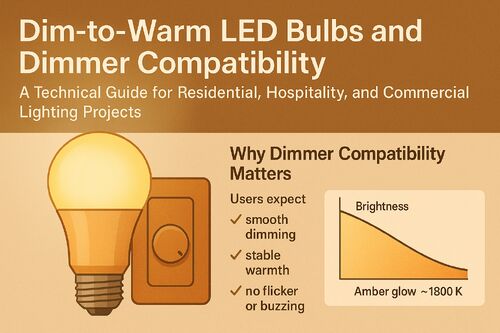
  • Dim-to-Warm LED Bulbs and Dimmer Compatibility: A Technical Guide for Residential, Hospitality, and Commercial Lighting

    Dim-to-Warm LED Bulbs and Dimmer Compatibility: A Technical Guide for Residential, Hospitality, and Commercial Lighting

    Dim-to-warm LED bulbs are increasingly used in homes, hotels, restaurants, and premium retail spaces because they deliver a warmer amber tone as brightness decreases—similar to halogen behavior but with dramatically lower energy use.

    For designers, integrators, wholesalers, and buyers, the first assumption is simple:

    If a bulb dims, it should work with any dimmer.

    In reality, dim-to-warm LEDs do not behave like halogen lamps, and dimming performance varies widely depending on driver architecture, load stability, dimming topology, and installation conditions.

    This guide explains how dim-to-warm LEDs work, why compatibility issues occur, how to select dimmers that support stable warm-dimming, and what installers should verify before commissioning.

    It also includes references from the U.S. Department of Energy (DOE), the Lighting Research Center (LRC), and NEMA dimming standards, ensuring the content supports decision-making with credible sources.

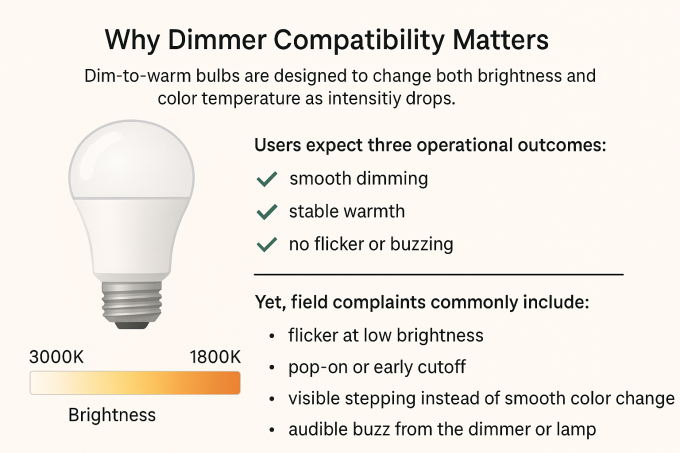
    1. Why Dimmer Compatibility Matters

    Dim-to-Warm LED Bulbs and Dimmer Compatibility: A Technical Guide for Residential, Hospitality, and Commercial Lighting   0

    Dim-to-warm bulbs are designed to change both brightness and color temperature as intensity drops. A typical profile shifts from 3000K at full output to ~1800K or below at low dimming levels.

    Users expect three operational outcomes:

    ✔ smooth dimming
    ✔ stable warmth
    ✔ no flicker or buzzing

    Yet, field complaints commonly include:

    • flicker at low brightness

    • pop-on or early cutoff

    • visible stepping instead of smooth color change

    • audible buzz from the dimmer or lamp

    The DOE notes that poor dimmer–driver interaction is a major cause of LED flicker and user dissatisfaction (source: https://www.energy.gov/energysaver/led-lighting).

    Compatibility is therefore not optional—it determines usability, perceived quality, and service cost.

    2. How Dim-to-Warm LEDs Work 

    Dim-to-warm LEDs are built around multi-channel packages containing:

    • high-CCT LEDs

    • warm amber/red LEDs

    A driver dynamically adjusts their current balance.

    What Happens During Dimming

    Brightness Cool LED Channel Warm LED Channel Visual Effect
    100% High Low Neutral / 3000K
    50% Reduced Increasing Warm tone begins
    20% Minimal High Amber glow / ~1800K

    This dual-channel behavior produces incandescent-like warmth, which is valued for ambience.

    Biological Impact at Low Light Levels

    The Lighting Research Center (LRC) shows that lower blue content helps support evening melatonin production and relaxation (https://www.lrc.rpi.edu/) — a factor increasingly used in hospitality design, sleep-enhanced environments, and premium residential lighting.

    However, this capability depends on driver precision—which is directly impacted by dimmer compatibility.

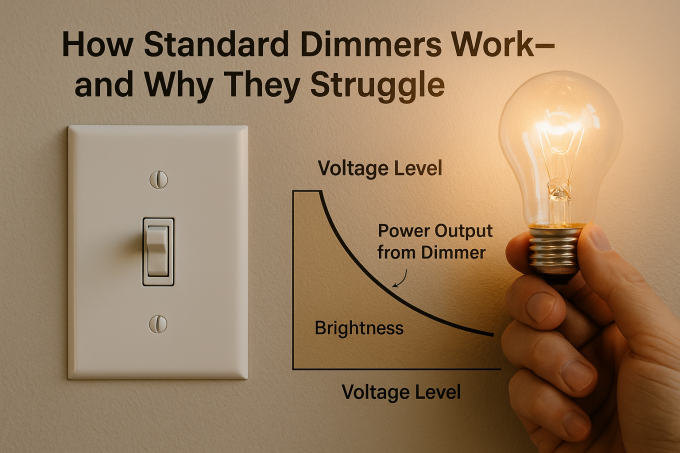
    3. How Standard Dimmers Work—and Why They Struggle

    Dim-to-Warm LED Bulbs and Dimmer Compatibility: A Technical Guide for Residential, Hospitality, and Commercial Lighting   1

    Most homes still use triac leading-edge dimmers, designed for incandescent loads.

    These dimmers:

    • chop AC waveform

    • expect resistive loads

    • require minimum wattage to regulate

    Why LEDs behave differently

    LEDs use switch-mode drivers that require:

    • stable current

    • rectified input

    • low dropout operation

    When the waveform becomes irregular, LED drivers struggle to regulate, causing:

    ✔ flicker
    ✔ noise
    ✔ uneven warmth

    The DOE warns that “legacy dimmers are generally incompatible with electronic drivers unless specifically designed for them.” (source: doi.gov LED technical guidance)

    Quick Comparison

    Property Incandescent LED
    Load Type Resistive Electronic driver
    Minimum Load Easy to meet Hard to reach
    Dimming Behavior Smooth Depends on driver quality
    Color Change None Curve dependent

    4. Why Some Dim-to-Warm Bulbs Work and Some Do Not

    Compatibility depends on:

    • Driver design

    • Dimmer topology (leading-edge vs trailing-edge)

    • Minimum load handling

    • Wiring condition

    • Neutral connection availability

    • Number of fixtures on the circuit

    Hotels and premium residences manage this well because commercial lighting systems often use dimmers designed for LED loads.

    Residential upgrades often fail because old wall dimmers were never intended for 6–10W electronic loads.

    5. Common Problems and Their Engineering Causes

    Symptom Likely Cause
    Flicker at low brightness Load too small / ripple instability
    Sudden shutoff Driver dropout threshold
    Constant buzzing Harmonic distortion
    Visible stepping warmth Poor dimming resolution
    Bulb turns orange too soon Driver color curve miscalibration
    One bulb behaves differently Wiring variation / load imbalance

    Users often blame the bulb when the dimmer is the real incompatibility point.

    6. Leading-Edge vs Trailing-Edge Dimmer Behavior

    Leading-Edge Dimmer (Triac / SCR)

    ✔ Widely installed
    ✘ Poor waveform stability with LED drivers

    Trailing-Edge Dimmer (ELV / MOSFET)

    ✔ Smoother waveform
    ✔ Lower electrical noise
    ✔ Better for multi-channel LEDs

    Manufacturers increasingly recommend trailing-edge dimmers for dim-to-warm applications because LED loads behave better under controlled cutoff profiles.

    NEMA SSL-7A provides design guidelines for LED dimming compatibility—many driver manufacturers reference this document when shaping performance curves.

    7. Installation Practices That Affect Stability

    Dim-to-Warm LED Bulbs and Dimmer Compatibility: A Technical Guide for Residential, Hospitality, and Commercial Lighting   2

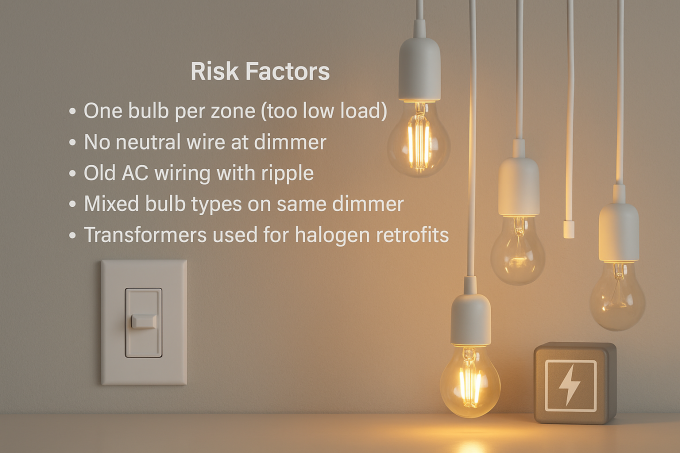
    A well-designed bulb can still perform poorly if installation conditions degrade stability.

    Risk factors:

    • One bulb per zone (too low load)

    • No neutral wire at dimmer

    • Old AC wiring with ripple

    • Mixed bulb types on same dimmer

    • Transformers used for halogen retrofits

    Why more bulbs equal more stability

    A dimmer that expects 50–150W load will regulate better with multiple 8W bulbs than with one solitary lamp.

    8. How to Select a Compatible Dimmer

    Professionally verified dimmers have:

    ✔ LED compatibility
    ✔ trailing-edge control
    ✔ minimum load adjustment (trim)
    ✔ stability feedback

    Manufacturers publish tested dimmer lists—these are valuable references but should be validated onsite.

    9. Field Testing: What Installers Should Check

    Dim-to-Warm LED Bulbs and Dimmer Compatibility: A Technical Guide for Residential, Hospitality, and Commercial Lighting   3

    A practical test protocol:

    Step 1: Low-End Trim

    • Check if light remains stable below 10–15%

    • Adjust trim if available

    Step 2: Color Shift Smoothness

    • Observe transition from neutral to amber

    • Ensure no sudden jumps

    Step 3: No Audible Noise

    • Test silent operation at all levels

    Step 4: Multi-Fixture Consistency

    • Compare bulbs under same dimmer load

    Step 5: Pop-On Behavior

    • Dim to 0%, increase slowly—light should rise smoothly

    These checks reveal 95% of performance issues before installation is finalized.

    10. Warm-Dimming Driver Design and Why It Matters

    Engineers design dim-to-warm drivers around:

    • current shaping

    • low dropout regulators

    • channel balancing algorithms

    • perceptual dimming curves

    A stable dimmer greatly impacts how the driver transitions between warm and cool channels.

    A poorly matched dimmer can force:

    ⚠ abrupt color shifts
    ⚠ premature warming
    ⚠ flicker induced by regulation loss

    Well-designed drivers mitigate this, but compatibility still relies on the dimmer waveform.

    11. Why Dim-to-Warm Matters for Human Experience

    Lighting affects perception and physiology.

    The LRC notes that warm light with reduced blue content helps align with evening biological processes that induce sleep readiness—an attribute valued across:

    • hospitality suites

    • senior living

    • wellness environments

    • premium residences

    A poor dimming experience undermines these benefits because flicker and instability trigger discomfort and cognitive stress.

    Users describe results in emotional terms:
    “too harsh,” “strange,” “not cozy.”

    These subjective reactions originate from real physiological triggers.

    12. Pricing, Market Outlook, and Technology Trend

    Dim-to-warm bulbs cost more than basic LEDs because they include:

    • multi-channel emitters

    • more advanced drivers

    • dimming curve calibration

    Although overall LED prices have fallen 90% in the last decade (DOE Solid-State Lighting report),
    specialty warm-dimming lamps remain premium due to lower production volume.

    Growth is particularly strong in:

    • boutique hospitality

    • residential wellness lighting

    • restaurant interior projects

    • luxury renovations

    Future cost reductions will depend on wider adoption and driver integration.

    13. Final Recommendations for Designers & Buyers

    ✔ Select LED-rated trailing-edge dimmers

    ✔ Avoid mixing bulb types on the same circuit

    ✔ Test low-end trim and color shift onsite

    ✔ Consider loads above the dimmer minimum requirement

    ✔ Use manufacturer compatibility lists

    Lighting behavior should be verified in real rooms, not assumed from datasheets.

    Conclusion

    Dim-to-warm LED bulbs can work with standard dimmer switches, but performance depends heavily on dimmer type, installation quality, and driver architecture.

    A stable system results in warm, comfortable light that enhances mood, hospitality experience, and visual appeal.
    A mismatched system creates flicker, audible noise, abrupt color jumps, and premature bulb failure.

    Designers and technical buyers should treat dimming compatibility as a specification—not an assumption—and validate performance through controlled testing.

    If you need dim-to-warm LEDs engineered for stable performance with leading-edge or trailing-edge dimmers, we provide:

    • photometry files

    • dimmer compatibility test results

    • OEM/ODM engineering support

    • high-CRI and specialty spectrum options

    Share your project type, socket requirement, and dimming system—we can recommend suitable SKUs and driver arrangements for reliable, human-centric lighting.

  • Circular Lighting Design: How LED Manufacturers Can Enable Recycling and Reuse

    Circular Lighting Design: How LED Manufacturers Can Enable Recycling and Reuse

    .gtr-container-x7y2z9w4 {
    font-family: Verdana, Helvetica, “Times New Roman”, Arial, sans-serif;
    color: #333;
    line-height: 1.6;
    padding: 20px;
    max-width: 100%;
    box-sizing: border-box;
    }

    .gtr-container-x7y2z9w4__main-title {
        font-size: 18px;
        font-weight: bold;
        margin-bottom: 20px;
        color: #0056b3;
        text-align: left;
    }
    
    .gtr-container-x7y2z9w4__section-title {
        font-size: 16px;
        font-weight: bold;
        margin-top: 30px;
        margin-bottom: 15px;
        color: #0056b3;
        text-align: left;
    }
    
    .gtr-container-x7y2z9w4__subsection-title {
        font-size: 14px;
        font-weight: bold;
        margin-top: 20px;
        margin-bottom: 10px;
        color: #333;
        text-align: left;
    }
    
    .gtr-container-x7y2z9w4 p {
        font-size: 14px;
        margin-bottom: 15px;
        text-align: left !important;
        word-break: normal;
        overflow-wrap: normal;
    }
    
    .gtr-container-x7y2z9w4__separator {
        border: none;
        border-top: 1px solid #eee;
        margin: 40px 0;
    }
    
    .gtr-container-x7y2z9w4 ul {
        list-style: none !important;
        padding-left: 0;
        margin-bottom: 15px;
    }
    
    .gtr-container-x7y2z9w4 ul li {
        position: relative;
        padding-left: 20px;
        margin-bottom: 8px;
        font-size: 14px;
        text-align: left !important;
        list-style: none !important;
    }
    
    .gtr-container-x7y2z9w4 ul li::before {
        content: "•" !important;
        position: absolute !important;
        left: 0 !important;
        color: #007bff;
        font-size: 16px;
        line-height: 1;
    }
    
    @media (min-width: 768px) {
        .gtr-container-x7y2z9w4 {
            padding: 40px;
            max-width: 960px;
            margin: 0 auto;
        }
    }
    

    Circular Lighting Design: How LED Manufacturers Can Enable Recycling and Reuse

    In the lighting-industry transition toward sustainability, circular design is increasingly becoming not only a moral imperative, but a commercial differentiator. For LED manufacturers, wholesalers and specifiers, moving beyond the “linear” model of make–use–dispose to one of design–use–reuse/recycle can unlock material savings, regulatory compliance benefits, brand advantage and lower downstream waste or disposal cost.

    This article outlines how LED lighting manufacturers can implement circular lighting design—covering principles, material flows, recycling and reuse strategies, business models and practical steps.

    1. Why Circular Lighting Matters for LED Manufacturers

    Circular Lighting Design: How LED Manufacturers Can Enable Recycling and Reuse  0

    LED technology has already transformed lighting energy use: according to the International Energy Agency (IEA), LED lamps offer 80-90% energy savings compared to incandescent, and 50-60% compared to fluorescent alternatives. ([IEA][1]) While energy efficiency is critical, material flows and end-of-life (EoL) impacts are the next frontier.

    In a circular economy model, the goal shifts from simply using less energy to designing systems where luminaires and modules remain in use longer, materials are recovered, re-used or recycled, and waste generation is minimized. As one literature overview notes: lighting products can adopt the 10-R strategy (R0 refuse, R1 rethink, R2 reduce, R3 reuse, R4 repair, R5 refurbish, R6 remanufacture, R7 repurpose, R8 recycle, R9 recover). ([ResearchGate][2]) For manufacturers, this means integrating circularity into design, sourcing, manufacturing, service, and end-of-life strategy.

    1. Principles of Circular Design for LED Lighting

    Circular Lighting Design: How LED Manufacturers Can Enable Recycling and Reuse  1

    Circular design in the LED lighting context can be broken down into a set of key principles:

    2.1 Design for longevity and modularity

    Products designed to last longer (e.g., extendable driver life, replaceable modules) reduce waste. Modular designs facilitate repair or upgrade rather than full replacement.

    2.2 Design for disassembly

    Using screws instead of permanent adhesives; applying standardized connectors; making modules easily separated enables reuse and recycling of individual components.

    2.3 Design for reuse and remanufacture

    Design choices should facilitate reuse of either the luminaire body, the driver, the optics or retrofit modules. Remanufacture may involve replacing key components but keeping mechanical housing.

    2.4 Design for material recovery and recycling

    Choosing materials that are easily separated and recycled (e.g., aluminium heat-sink, standard PCBs, plastics labelled for recycling) supports closed-loop material flows. For example, LED lamps already show > 90% glass recyclability in conventional lamp recycling processes. ([LED专业][3])

    2.5 Business model innovation

    In a circular approach, manufacturers may offer “Lighting-as-a-Service”, leasing models, take-back schemes, or refurbishment services, rather than simply selling units. Such models incentivize longer life and reuse of assets.

    2.6 Transparency and measurement

    Manufacturers need to track material flows, component origin, lifetime performance and reuse volumes. Life Cycle Assessment (LCA) becomes a tool to quantify benefits of circular design. ([ResearchGate][4])

    1. Material Flows, Recycling and Reuse in LED Lighting
      3.1 End-of-life streams

    LED luminaires will reach end-of-life due to failure, obsolescence, or refurbishment. Instead of sending complete units to landfill, manufacturers should plan for removal, collection, sorting, refurbishing and material recovery.

    3.2 Recycling rates and opportunities

    Although much of the focus has been on lamp and discharge-tube recycling, LED-specific recycling is gaining attention. One article reports longtime lamp recycling rates above 90% for glass in certain lamp types. ([LED专业][3]) While that applies to older lamp types, similar approaches are being adapted to LED modules.

    Another literature overview highlights that lighting products can participate in circular economy by applying reuse, repair, refurbishment and recycling. ([ResearchGate][2])

    3.3 Example: Life-Cycle Assessment insights

    An LCA of an outdoor LED luminaire found significant benefits when component reuse and material recovery are accounted for. ([ResearchGate][4]) In general, designing a product with circularity in mind can reduce embodied carbon, lower raw-material extraction impacts and reduce waste.

    3.4 Reintegration of materials

    For an LED manufacturer, the goal is to establish a closed loop: recover aluminium, plastics, optics, PCBs and drivers; separate and sort; reintroduce recovered materials into new product manufacture, or refurbish units for secondary markets.

    1. Business Models for LED Circular Lighting

    Circular Lighting Design: How LED Manufacturers Can Enable Recycling and Reuse  2

    4.1 Take-back and refurbishment

    Manufacturers provide a scheme whereby at the end of their first installation life, luminaires are returned to the producer or an authorised refurbisher, cleaned, refurbished, re-certified, and redeployed in secondary installations.

    4.2 Leasing / Lighting-as-a-Service (LaaS)

    Instead of selling a luminaire, the manufacturer retains ownership and charges for “lighting service” – e.g., a fixed cost per lux-hour delivered. In this model, incentives align for durability, maintenance optimisation, reuse, and end-of-life recovery.

    4.3 Design for upgrade and reuse

    Manufacturers design modular driver boards and LED modules so that when performance requirements change (CCT, output, form factor), the older modules can be swapped and the mechanical housing reused.

    4.4 Material buy-back or recycled-content pledge

    Manufacturers commit to using a percentage of recycled aluminium, plastics or optics in new units; or they accept return of units and guarantee recovery of materials, thereby encouraging recycling.

    4.5 Digital tracking and lifecycle services

    Manufacturers can use IoT/monitoring to track product performance, remote diagnostics, predictive maintenance and data that feeds into refurbishment workflows and end-of-life recycling decisions.

    1. Practical Steps for Manufacturers to Enable Recycling & Reuse
      5.1 Early-stage design
    • Specify modules rather than integrated non-serviceable units.

    • Use standardised mechanical formats (e.g., screw mount, plug-in modules).

    • Label components and use single-material or easily separable designs.

    • Use fasteners and connectors for disassembly.

    5.2 Material selection

    • Use compliant plastics with known recycling streams.

    • Avoid coatings or adhesives that hinder separation of materials.

    • Choose aluminium and steel components for easy recycling.

    • Document material composition for recycling facilities.

    5.3 Module replaceability

    • Drivers, LEDs and optics should be user-serviceable or easy to replace/refurbish.

    • Provide firmware update paths and spare modules for refurbishment markets.

    5.4 Service and monitoring

    • Provide lifetime monitoring data and maintenance history.

    • Offer refurbishment programs after first life, communicate clearly to specifiers.

    5.5 Collection and reverse logistics

    • Provide instructions for end-of-life collection.

    • Partner with certified recyclers or refurbishers.

    • Implement take-back programs for used luminaires.

    5.6 Communication and disclosure

    • Publish Environmental Product Declarations (EPDs) or Life Cycle Assessments.

    • Provide specifiers with percentage recycled content, recyclability rate, refurbishment pathways.

    • Explain circular business model value (reuse, maintenance, service life extension).

    5.7 Regulatory alignment

    • Monitor Extended Producer Responsibility (EPR) regulations in target markets.

    • Ensure compliance with WEEE (Waste Electrical and Electronic Equipment) directives or equivalent.

    • Design for compliance with eco-design, reparability and recyclability metrics.

    1. Commercial and Sustainability Benefits

    Circular Lighting Design: How LED Manufacturers Can Enable Recycling and Reuse  3

    6.1 Cost savings through material reuse

    By recovering metals such as aluminium and copper, and plastics, manufacturers can reduce raw-material cost volatility and dependency on virgin materials.

    6.2 Differentiation and market leadership

    Offering “circular” luminaires or service models provides a stronger value proposition for specification in high-end commercial projects where sustainability matters.

    6.3 Risk mitigation

    By designing for reuse and recyclability, manufacturers reduce risks associated with product obsolescence, regulatory change, material scarcity and waste-management cost.

    6.4 Lower embodied carbon

    Circular design reduces the embodied carbon of products. Prioritising reuse and refurbishment can reduce carbon per luminaire over its lifecycle.

    6.5 Regulatory and procurement alignment

    Many corporate and public procurement frameworks now favour products with measurable circular credentials (reuse rate, recyclability, take-back services). Manufacturers who adopt these early gain advantage.

    1. Key Metrics and Indicators to Track

    Manufacturers should track the following key performance indicators (KPIs):

    • Reused modules (% of units serviced & redeployed)

    • Recycled material content (% of new units containing recycled aluminium/plastics)

    • Take-back rate (% of units returned at end-of-first-life)

    • Recyclability rate (% of mass of luminaires technically recyclable)

    • Lifetime extension (% increase in service life compared with baseline)

    • Embodied carbon reduction (% vs. linear baseline)

    For example, the UK-based Recolight lighting-industry scheme reports that lamp recycling rates grew from 19% in 2008 to 43.1% in 2020 and 68% in 2023. ([Recolight][5]) Though this references lamps, it demonstrates what is possible in lighting waste management.

    1. Barriers and How to Overcome Them
      8.1 Business-model inertia

    Many lighting manufacturers still operate on linear sales models. Transitioning to service or reuse models requires internal change.

    Solution: Pilot projects, partner with refurbishment firms, communicate value to customers clearly.

    8.2 Technical complexity of modules

    Integrated luminaires with non-removable LED modules hinder reuse and retrofit.

    Solution: Shift to modular design; design with disassembly in mind; avoid hidden adhesives or proprietary formats.

    8.3 Cost of take-back and logistics

    Collection, sorting, refurbishment cost money and must be financed.

    Solution: Build cost into product lifecycle pricing; partner with recycling schemes; promote resale/refurbish value.

    8.4 Unclear regulatory incentives

    Recycling targets, standards for repairability or recyclability may vary by region.

    Solution: Monitor legislative change; engage with standard-bodies; build credentials in advance.

    8.5 Market expectation mismatch

    End-users expect ultra-low cost; refurbishment or service models may seem premium.

    Solution: Educate specifiers on total-cost-of-ownership (TCO), embodied carbon savings, long–term value.

    1. Case Study: Illumination Manufacturer Adopts Circular Approach

    A major lighting company has launched a “Lighting for Circularity” programme indicating three pillars: products, services, systems. ([Signify EN NZ][6]) Their approach includes offering luminaires designed for reuse, modular drivers for upgrade, take-back services for end-of-life, and smart controls to extend service life.

    In one outdoor luminaire case, use of recycled aluminium and design for driver interchangeability enabled a materials-reduction benefit of ~60% in manufacturing impact versus a conventional product. ([Lumenloop][7])

    Although precise figures vary by product type, the direction is clear: circular design is no longer optional.

    1. Conclusion

    For LED manufacturers, embracing circular lighting design is both a sustainability imperative and a strategic business opportunity. By focusing on longevity, modularity, refurbishment, reuse, material recovery and transparent metrics, manufacturers can reduce cost risk, increase market differentiation, align with procurement demands, and contribute to true resource-efficiency.

    In short: moving from a linear “take–make–dispose” model to a circular “design–use–return–reuse/recycle” model defines the next generation of LED lighting manufacturing.

    As standards, regulations and procurement frameworks increasingly favour circular credentials, manufacturers who enable recycling and reuse now will be better positioned for tomorrow’s market.

  • Sustainable Packaging in LED Manufacturing: How Small Design Changes Deliver Big Environmental Impact

    Sustainable Packaging in LED Manufacturing: How Small Design Changes Deliver Big Environmental Impact

    .gtr-container-x7y2z9 {
    font-family: Verdana, Helvetica, “Times New Roman”, Arial, sans-serif;
    color: #333;
    line-height: 1.6;
    padding: 15px;
    box-sizing: border-box;
    overflow-wrap: break-word;
    }

    .gtr-container-x7y2z9 p {
      font-size: 14px;
      margin-bottom: 1em;
      text-align: left !important;
    }
    
    .gtr-container-x7y2z9 a {
      color: #007bff;
      text-decoration: underline;
    }
    
    .gtr-container-x7y2z9 strong {
      font-weight: bold;
    }
    
    .gtr-container-x7y2z9 .gtr-title {
      font-size: 18px;
      font-weight: bold;
      margin-bottom: 1.5em;
      text-align: left;
    }
    
    .gtr-container-x7y2z9 .gtr-section-title {
      font-size: 18px;
      font-weight: bold;
      margin-top: 2em;
      margin-bottom: 1em;
      text-align: left;
    }
    
    .gtr-container-x7y2z9 .gtr-subsection-title {
      font-size: 16px;
      font-weight: bold;
      margin-top: 1.5em;
      margin-bottom: 0.8em;
      text-align: left;
    }
    
    .gtr-container-x7y2z9 .gtr-sub-subsection-title {
      font-size: 14px;
      font-weight: bold;
      margin-top: 1.2em;
      margin-bottom: 0.6em;
      text-align: left;
    }
    
    .gtr-container-x7y2z9 .gtr-separator {
      border-top: 1px solid #ddd;
      margin: 2em 0;
    }
    
    .gtr-container-x7y2z9 ul {
      list-style: none !important;
      padding-left: 0;
      margin-bottom: 1em;
    }
    
    .gtr-container-x7y2z9 ul li {
      list-style: none !important;
      position: relative;
      padding-left: 1.5em;
      margin-bottom: 0.5em;
      font-size: 14px;
      text-align: left;
    }
    
    .gtr-container-x7y2z9 ul li::before {
      content: "•" !important;
      position: absolute !important;
      left: 0 !important;
      color: #007bff;
      font-size: 1em;
      line-height: 1.6;
    }
    
    .gtr-container-x7y2z9 ol {
      list-style: none !important;
      padding-left: 0;
      margin-bottom: 1em;
      counter-reset: list-item;
    }
    
    .gtr-container-x7y2z9 ol li {
      list-style: none !important;
      position: relative;
      padding-left: 2em;
      margin-bottom: 0.5em;
      font-size: 14px;
      text-align: left;
      counter-increment: none;
    }
    
    .gtr-container-x7y2z9 ol li::before {
      content: counter(list-item) "." !important;
      position: absolute !important;
      left: 0 !important;
      color: #007bff;
      font-weight: bold;
      width: 1.5em;
      text-align: right;
      line-height: 1.6;
    }
    
    @media (min-width: 768px) {
      .gtr-container-x7y2z9 {
        max-width: 800px;
        margin: 0 auto;
        padding: 20px;
      }
    
      .gtr-container-x7y2z9 .gtr-title {
        font-size: 24px;
      }
    
      .gtr-container-x7y2z9 .gtr-section-title {
        font-size: 20px;
      }
    
      .gtr-container-x7y2z9 .gtr-subsection-title {
        font-size: 18px;
      }
    }
    

    Sustainable Packaging in LED Manufacturing: How Small Design Changes Deliver Big Environmental Impact

    Sustainability used to be a marketing slogan in the lighting world. Today, it is a business requirement. Regulations are tighter, customers are more informed, and wholesalers are expected to offer products that do more than just perform well—they must also carry a smaller environmental footprint. Packaging has become one of the simplest, fastest, and most cost-effective ways for LED manufacturers to reduce waste without changing the core product.

    In LED manufacturing, small packaging adjustments—changing materials, optimizing structure, or reducing ink—can create a surprisingly large environmental impact. For companies that sell millions of units annually, these changes are not minor; they reshape the way products travel, store, and reach end users.

    This article breaks down how sustainable packaging works in LED factories, why it matters for the global supply chain, and what benefits wholesalers and commercial buyers gain by supporting the shift.

    Why Sustainable Packaging Has Become a Priority

    Sustainable Packaging in LED Manufacturing: How Small Design Changes Deliver Big Environmental Impact  0

    The lighting industry faces rising pressure from three directions:

    • Stricter government regulations

    • Increased expectations from corporate buyers

    • Growing logistics and raw material costs

    Environmental regulations, especially in Europe, often set the pace for global standards. For instance:

    These numbers explain why LED manufacturers are rethinking packaging—not only for compliance but also for cost efficiency and brand value.

    For B2B buyers, the shift is equally important. Many retailers, electrical wholesalers, and engineering companies now submit sustainability reports or ESG disclosures. Choosing LED suppliers with eco-friendly packaging directly supports these initiatives.

    How LED Manufacturers Reduce Packaging Waste Through Material Choices

    Sustainable Packaging in LED Manufacturing: How Small Design Changes Deliver Big Environmental Impact  1

    The fastest path to greener packaging starts with the materials themselves. LED manufacturers are now replacing old components with sustainable alternatives that still protect products during shipping.

    1. Recycled cardboard instead of virgin pulp

    Most modern LED factories now use packaging with 70–90% recycled fiber. The advantage is substantial—producing recycled cardboard requires:

    • 70% less energy

    • 90% less water

    • significantly fewer chemicals
      (Source: U.S. EPA — https://www.epa.gov)

    Recycled cardboard also performs well in drop tests, making it suitable for GU10, MR16, and A-series LED bulbs.

    1. Switching from plastic trays to molded pulp

    Molded pulp trays, made from waste fiber, replace traditional PET or PVC trays. They are:

    • biodegradable

    • shock-absorbent

    • cost-competitive

    A study published by the Sustainable Packaging Coalition shows molded pulp reduces carbon emissions by up to 70% compared to plastic. (Source: https://sustainablepackaging.org)

    1. Eliminating unnecessary plastic film

    Many LED boxes once contained inner plastic bags or shrink wrap. Manufacturers now rely on:

    • friction-fit structures

    • die-cut stabilizers

    • fiber-based cushioning

    These remove more than 20–30 tons of plastic waste annually for mid-size factories.

    1. Soy-based inks instead of petroleum inks

    Soy ink reduces VOC emissions and improves recyclability. The American Soybean Association notes that soy ink cuts petroleum-based ink usage by 40–80%. (Source: https://soyink.com)

    These material shifts may look simple, but when multiplied across millions of units, the environmental savings become enormous.

    Structural Packaging Improvements That Reduce Volume and Carbon Footprint

    Sustainable Packaging in LED Manufacturing: How Small Design Changes Deliver Big Environmental Impact  2

    Material substitution is just one part of the story. Structural redesign often produces even bigger benefits for LED companies and wholesalers.

    1. Slimmer packaging saves container space

    When engineers reduce box width by even 2–3 mm, the gains are significant. For a factory exporting 200,000 GU10 bulbs monthly, downsizing packaging can:

    • add 3,000–5,000 extra units per container

    • reduce shipping cost per unit

    • lower CO₂ emissions through fewer shipments

    The World Shipping Council estimates that optimizing container space can reduce transportation emissions by 10–15%. (Source: https://worldshipping.org)

    1. Eliminating dead space inside boxes

    Historically, LED bulbs came in oversized boxes to “look premium.” Now, manufacturers follow strict volume control standards. Proper alignment of the bulb, driver, and optics allows for much tighter packaging without compromising impact resistance.

    1. Fold-flat outer cartons

    Factories increasingly use cartons designed to fold flat before filling, cutting warehouse storage needs by around 30–40%. This benefits distributors that stock thousands of items.

    1. One-piece box designs

    A single-piece box reduces glue usage and speeds up automated packing, lowering energy consumption in production lines.

    Automation and Smart Packaging Techniques in LED Factories

    Sustainable Packaging in LED Manufacturing: How Small Design Changes Deliver Big Environmental Impact  3

    Many LED factories—including highly optimized plants in China—now use automated packaging lines. These systems are more precise and produce less waste.

    Key technologies include:
    1. High-precision die-cutting

    Computer-controlled machines cut packaging board with less than 0.5 mm tolerance, reducing trim waste by 15–25%.

    1. Automated folding and gluing

    Automated lines ensure consistent folding, allowing manufacturers to use thinner cardboard without risking deformation.

    1. Digital printing for small batches

    Digital printing reduces ink waste and eliminates plate-making chemicals. It also supports small-batch customization—valuable for private-label wholesalers.

    1. QR-based information instead of large manuals

    More LED manufacturers now use QR codes linking to digital instructions, meeting EU digital product requirements and cutting paper usage by up to 80%.

    The European Paper Recycling Council reports that digital documentation significantly reduces lifecycle carbon emissions for high-volume retail products. (Source: https://www.paperforrecycling.eu)

    How Sustainable Packaging Reduces Cost for Wholesalers and Importers

    Sustainable Packaging in LED Manufacturing: How Small Design Changes Deliver Big Environmental Impact  4

    A misconception in the market is that eco-friendly packaging costs more. In reality, sustainable packaging often reduces total cost of ownership for distributors and large buyers.

    Here’s how:

    1. Lower shipping costs

    Smaller packaging → more units per pallet → fewer pallets per shipment.

    This reduces:

    • freight cost

    • warehouse cost

    • CO₂ emissions

    1. Lower damage rates

    Molded pulp or reinforced cardboard provides better shock resistance than plastic trays, reducing breakage during shipping.

    1. Easier pallet stacking

    Uniform, slim packaging improves stacking efficiency, which helps wholesalers who store thousands of SKUs.

    1. Higher retail acceptance

    Many retailers and electrical chains now demand sustainable packaging as part of their ESG commitments. Using eco-friendly packaging ensures compliance with:

    This avoids penalties or rejection during product listing.

    How Small Packaging Changes Reduce Environmental Impact Across the Supply Chain

    Sustainable Packaging in LED Manufacturing: How Small Design Changes Deliver Big Environmental Impact  5

    To understand the environmental value of sustainable packaging, it helps to see how LED products move across the global supply chain:

    • Factory

    • Container loading

    • Cross-border transport

    • Warehousing

    • Distributor sorting

    • Final delivery

    Small packaging improvements affect each stage:

    At the factory

    • Less waste generated

    • Lower energy use

    • Faster packing throughput

    In shipping

    • Reduced container space

    • Improved pallet efficiency

    • Lower emissions due to fewer shipments

    In warehousing

    • Higher storage density

    • Fewer damaged goods

    • Faster picking times

    For customers

    • Less packaging to dispose

    • Easier recycling

    • Lower environmental footprint

    The result is a full supply-chain improvement, not just a cosmetic upgrade.

    Real-World Examples of High-Impact Packaging Changes
    1. Reducing GU10 LED box height by 4 mm

    Small change → production gains:

    • +4,200 units per 40HC container

    • -12% cardboard usage

    • -7% total freight emissions

    1. Switching to recycled molded pulp inserts

    Benefits:

    • 70% lower carbon footprint

    • 100% plastic elimination

    • improved drop test performance

    1. Using soy-based ink on outer cartons

    Outcome:

    • 50–80% less petrochemical ink

    • higher recyclability

    • better print clarity

    1. Adding QR code instead of 12-page manuals

    Impact:

    • 80% less paper

    • fewer printing chemicals

    • easier multilingual access

    For factories producing millions of units, these numbers scale dramatically.

    Why Sustainable Packaging Strengthens Brand Value

    Lighting is a competitive market. Small details like packaging help brands stand out. LED buyers—especially in Europe, Singapore, and the UAE—care about environmental performance as part of overall product value.

    Sustainable packaging builds:

    • Better brand perception

    • Compliance with retailer requirements

    • Alignment with corporate ESG goals

    • Consumer trust

    • Differentiation from low-cost competitors

    In many cases, wholesalers using sustainable packaging also highlight it in product catalogs, increasing the perceived value of their private-label brands.

    What Wholesalers Should Look for When Choosing LED Suppliers

    When evaluating LED factories for sustainable packaging, wholesalers should ask:

    • Do you use recycled cardboard or molded pulp?

    • Can you reduce box dimensions for container optimization?

    • Do you support plastic-free packaging?

    • What is the average packaging waste reduction per unit?

    • Can you print QR codes instead of multi-language manuals?

    • Can you provide certifications or test reports for packaging materials?

    • Do you offer sustainable packaging customization for private-label orders?

    These questions help buyers filter suppliers that deliver genuine sustainability—rather than marketing claims.

    Final Thoughts: Small Adjustments, Major Impact

    Sustainable packaging is no longer a trend—it is becoming a new standard in LED manufacturing. The beauty of packaging innovation is that small design decisions produce large environmental benefits without increasing product cost. For manufacturers, the changes reduce waste. For wholesalers, they improve efficiency and profitability. And for the environment, they reduce long-term impact.

    In the lighting world where millions of units move every month, even a 2-millimeter reduction in packaging size can save tons of paper, thousands of dollars, and a meaningful amount of carbon emissions.

    Ready to Switch to Sustainable Packaging for Your LED Products?

    If you are seeking a supplier that can support:
    ✔ sustainable packaging
    ✔ bulk production
    ✔ customized private-label solutions
    ✔ improved container efficiency
    ✔ stable, long-term supply

    I can help.

    Contact me directly:
    www.tecolite.com

    Let’s build a cleaner, smarter lighting supply chain—one small improvement at a time.

  • How LED Manufacturers Achieve High CRI and Color Consistency: Inside the Production Process

    How LED Manufacturers Achieve High CRI and Color Consistency: Inside the Production Process

    .gtr-container-p9q0r1 {
    font-family: Verdana, Helvetica, “Times New Roman”, Arial, sans-serif;
    color: #333;
    line-height: 1.6;
    max-width: 100%;
    padding: 15px;
    box-sizing: border-box;
    }

    .gtr-container-p9q0r1 p {
        font-size: 14px;
        margin-bottom: 1em;
        text-align: left;
    }
    
    .gtr-container-p9q0r1 strong {
        font-weight: bold;
    }
    
    .gtr-container-p9q0r1 a {
        color: #007bff;
        text-decoration: none;
    }
    
    .gtr-container-p9q0r1 a:hover {
        text-decoration: underline;
    }
    
    .gtr-container-p9q0r1 .gtr-title {
        font-size: 24px;
        font-weight: bold;
        margin-bottom: 1.5em;
        color: #1a1a1a;
        text-align: left;
    }
    
    .gtr-container-p9q0r1 .gtr-section-title {
        font-size: 20px;
        font-weight: bold;
        margin-top: 2em;
        margin-bottom: 1em;
        color: #1a1a1a;
        text-align: left;
    }
    
    .gtr-container-p9q0r1 .gtr-subsection-title {
        font-size: 16px;
        font-weight: bold;
        margin-top: 1.5em;
        margin-bottom: 0.8em;
        color: #1a1a1a;
        text-align: left;
    }
    
    .gtr-container-p9q0r1 ul,
    .gtr-container-p9q0r1 ol {
        list-style: none !important;
        padding-left: 25px !important;
        margin-bottom: 1em;
    }
    
    .gtr-container-p9q0r1 ul li {
    position: relative;
        margin-bottom: 0.5em;
        font-size: 14px;
        text-align: left;
        padding-left: 15px;
    list-style: none !important;
    

    }

    .gtr-container-p9q0r1 ul li::before {
        content: "•" !important;
        position: absolute !important;
        left: 0 !important;
        color: #007bff;
        font-weight: bold;
        font-size: 16px;
        line-height: 1;
    }
    
    .gtr-container-p9q0r1 ol {
        counter-reset: list-item;
    }
    
    .gtr-container-p9q0r1 ol li {
    position: relative;
        margin-bottom: 0.5em;
        font-size: 14px;
        text-align: left;
        padding-left: 25px;
    list-style: none !important;
    

    }

    .gtr-container-p9q0r1 ol li::before {
        content: counter(list-item) "." !important;
        position: absolute !important;
        left: 0 !important;
        color: #007bff;
        font-weight: bold;
        font-size: 14px;
        width: 20px;
        text-align: right;
        line-height: 1;
    }
    
    .gtr-container-p9q0r1 .gtr-separator {
        border-top: 1px solid #eee;
        margin: 2em 0;
    }
    
    .gtr-container-p9q0r1 .gtr-contact-info {
        margin-top: 3em;
        padding-top: 1.5em;
        border-top: 1px solid #eee;
        text-align: center;
        font-size: 14px;
        color: #555;
    }
    
    .gtr-container-p9q0r1 .gtr-contact-info p {
        margin-bottom: 0.5em;
    }
    
    .gtr-container-p9q0r1 .gtr-contact-info strong {
        color: #1a1a1a;
    }
    
    @media (min-width: 768px) {
        .gtr-container-p9q0r1 {
            max-width: 800px;
            margin: 0 auto;
            padding: 30px;
        }
    
        .gtr-container-p9q0r1 .gtr-title {
            font-size: 28px;
        }
    
        .gtr-container-p9q0r1 .gtr-section-title {
            font-size: 22px;
        }
    
        .gtr-container-p9q0r1 .gtr-subsection-title {
            font-size: 18px;
        }
    }
    

    How LED Manufacturers Achieve High CRI and Color Consistency: Inside the Production Process

    When people talk about LED quality, they usually focus on efficiency, lifespan, or thermal design. But for manufacturers working inside an LED factory, there is another metric that often matters even more—color rendering. High CRI is what tells you whether a bulb will make a retail store’s products look accurate, a hotel lobby appear warm and inviting, or a medical room meet professional lighting standards.

    To wholesale buyers and lighting brands, CRI is not a number printed on a box. It represents reliability, supplier competence, and production discipline. Achieving high CRI at scale is not simple. It requires a chain of tightly controlled processes—from LED chip selection to phosphor formulation, driver stability, optical engineering, and final calibration.

    Working inside an LED factory gives you a very different understanding of how difficult this balance is. Color rendering is affected by dozens of micro-variables, many of which are invisible to outsiders. Consistency across tens of thousands of units is even harder.

    This article opens the door to that internal world. It explains, from a manufacturer’s perspective, how factories achieve high CRI and keep large production batches stable for commercial buyers across Europe, the Middle East, Southeast Asia, and the U.S.

    Understanding CRI the Way Manufacturers Use It

    How LED Manufacturers Achieve High CRI and Color Consistency: Inside the Production Process  0

    Outside the factory, CRI is often oversimplified. In reality, manufacturers work with far more precise and technical metrics.

    CRI, or Color Rendering Index, is based on standardized test color samples defined by the International Commission on Illumination (CIE).
    Reference: https://cie.co.at

    The common Ra value (0–100 scale) is calculated using eight pastel colors. But manufacturers often monitor additional values such as:

    • R9 (strong red rendering)—critical for retail and hospitality

    • R13 (skin tones)—important for hotels, offices, and residential lighting

    • R12 (blue tones)—affects clarity in industrial and medical environments

    R9 is particularly difficult to stabilize. Many low-cost suppliers avoid mentioning it, because achieving high R9 requires higher-quality phosphors and stricter LED binning.

    For technical validation, manufacturers follow guidelines from:

    These standards shape how factories control color rendering.

    Step 1: LED Chip Binning—The Foundation of CRI Stability

    How LED Manufacturers Achieve High CRI and Color Consistency: Inside the Production Process  1

    The moment you walk into a chip storage room in any serious LED factory, you will see boxes labeled with extremely detailed codes. These codes represent bins, which categorize chips by:

    • Color temperature

    • Forward voltage

    • Luminous flux

    • Chromaticity coordinates (x, y)

    The tighter the binning, the more stable the CRI and color consistency.

    Major chip brands such as Nichia, Cree, and Samsung usually provide the best bin uniformity. But even then, manufacturers must perform internal verification because chip performance can shift slightly during transport and storage.

    Why binning matters for CRI:
    Even a tiny variation in x/y coordinates can affect how phosphor converts blue light into full-spectrum light, which directly affects R9 and overall CRI.

    Factories typically reject bins that fall outside a very narrow range. This internal restriction increases cost but protects consistency—something wholesalers appreciate when they require uniformity across thousands of SKUs.

    Step 2: Phosphor Formulation and Coating Precision

    If the LED chip is the engine, the phosphor is the fuel. High CRI requires phosphor blends that convert more of the blue light into full-spectrum wavelengths.

    Factories collaborate with specialized phosphor suppliers, often from Japan or South Korea, because their formulations show better spectral uniformity. The challenge comes during production, when phosphor coating is applied to the chip.

    Why coating precision creates CRI stability:

    • Too thick → warmer color, lower flux

    • Too thin → cooler color, weaker red rendering

    • Uneven coating → shifting chromaticity and CRI variation

    High-end factories use automated dispensing equipment and spectrometers to measure multiple points on each LED package. Manual coating—used by low-end suppliers—often causes inconsistent color.

    For reference, phosphor research is often guided by:

    Step 3: Thermal Design and Heat Stability

    CRI is temperature-sensitive. Even the best LEDs will shift color when overheated. That’s why inside a manufacturing facility, a huge portion of engineering effort goes into thermal stability.

    Manufacturers control this through:

    1. PCB Thermal Conductivity

    Aluminum PCBs with higher thermal conductivity (1–2 W/mK or more) keep junction temperature stable, preventing color drift.

    1. Driver Heat Output

    Low-quality drivers run hotter and accelerate CRI decay. Reputable factories source stable ICs and high-temperature capacitors to keep driver heat minimal.
    DOE research on LED thermal stability: https://www.energy.gov/eere/ssl

    1. Lamp Body and Heat Sink Design

    For GU10 and MR16 bulbs, compact space makes thermal management difficult. Precision-molded aluminum shells or composite heat sinks help regulate temperature during operation.

    If thermal management is weak, color uniformity decreases long before the product reaches its rated lifespan.

    Step 4: Optical Design—How Lenses and Reflectors Impact CRI

    Most buyers don’t realize how much optics affect perceived color. Inside the factory, engineers must ensure that:

    • the lens material does not distort the spectrum

    • diffusion layers do not filter out red peaks

    • reflectors maintain equal distribution

    Optical maps are generated using equipment similar to goniophotometers, following IES LM-79 measurement methods.
    LM-79 reference: https://www.ies.org/standards/ies-lm-79-19/

    A poorly chosen diffuser can reduce R9 significantly, even if the LED chip itself has excellent CRI.

    Step 5: Driver Stability and Its Role in Color Consistency

    The driver is the unsung hero of color performance. A stable driver ensures:

    • consistent current

    • accurate voltage

    • minimal flicker

    • low harmonic distortion

    Why this matters:
    Fluctuating current alters the LED junction temperature, thereby altering spectral balance. This leads to visible color shift over time.

    Factories running high-volume production lines often use IC-based constant-current drivers with tight tolerances. LED bulbs built on low-cost drivers may look fine at first but drift after 100–200 hours.

    ENERGY STAR requires color maintenance testing to validate CRI long-term stability:
    https://www.energystar.gov

    Step 6: Color Calibration and Batch Matching

    This is where factory experience matters most. Before shipment, reputable manufacturers test:

    • color temperature

    • CRI (Ra, R9)

    • spectral distribution

    • lumen output

    • chromaticity shift

    Color calibration equipment includes:

    • Integrating spheres (for spectral testing)

    • High-resolution spectroradiometers (for CRI, flux)

    • Aging racks (to measure stabilized color, usually after 2–3 hours)

    Factories create production “recipes” linking chip bins, driver specs, phosphor type, and PCBs. Once a formula is approved, it is locked for consistent mass production.

    Good suppliers also maintain color history records for each client, ensuring future batches match previous shipments—essential for wholesalers who reorder frequently.

    Step 7: Ageing Tests—Where Real Stability Is Proven

    How LED Manufacturers Achieve High CRI and Color Consistency: Inside the Production Process  2

    Even when all components are perfect, LED bulbs still need to be aged before shipping. This process reveals early failures and color drift.

    Typical ageing conditions include:

    • 2–4 hours at 100% load (standard)

    • 12–24 hours for premium batches

    • accelerated ageing at higher temperature

    During this test, technicians carefully monitor:

    • stabilization of chromaticity coordinates

    • lumen maintenance

    • CRI stability

    • temperature distribution

    Any units with visible drift are rejected before packaging.

    This discipline is what separates factory-grade production from low-cost “assembly” suppliers.

    Step 8: Maintaining Consistency Across Large Production Batches

    How LED Manufacturers Achieve High CRI and Color Consistency: Inside the Production Process  3

    Wholesalers and lighting brands often require thousands or tens of thousands of identical units. Factories follow strict guidelines to achieve batch consistency:

    • fixed supplier lists for chips and drivers

    • identical SMT settings across lines

    • locked phosphor models

    • barcode tracking for traceability

    • periodic revalidation of spectral curves

    • continuous random sampling during production

    Consistency is the hallmark of a factory that understands B2B buyers. Brands cannot afford color mismatch between shelves, and contractors cannot accept variations in hotel or office projects.

    Why High CRI and Color Consistency Matter to B2B Buyers

    From a factory perspective, achieving high CRI and consistency is not just a technical goal—it directly supports the needs of:

    Wholesalers

    • fewer complaints

    • lower product return rates

    • stable reordering cycles

    • higher perceived product value

    Lighting Brands

    • consistent color across product families

    • stronger differentiation

    • ability to meet retailer standards

    Engineering Contractors

    • uniform light across entire projects

    • compliance with lighting design plans

    • improved customer satisfaction

    High CRI also improves end-user experience in sectors like hospitality, retail, healthcare, and corporate workspaces.

    Conclusion

    Behind every stable, high-CRI LED bulb is a long chain of manufacturing decisions—chip binning, phosphor chemistry, thermal engineering, driver stability, optical design, calibration, and disciplined quality control. These steps are not visible to end users, but they determine whether lighting brands and wholesalers can trust their suppliers.

    Factories that understand CRI deeply deliver products that look the same today, next year, and across multiple production runs. That reliability is what B2B customers truly pay for.

    If your business depends on stable color performance and consistent batch quality, I would be glad to support you.
    Our factory specializes in high-CRI, tightly binned LED spotlights for wholesale and commercial projects.

    Contact:
    [[email protected]]
    www.tecolite.com

    Let’s build lighting that your customers trust—every production run, every shipment, every time.