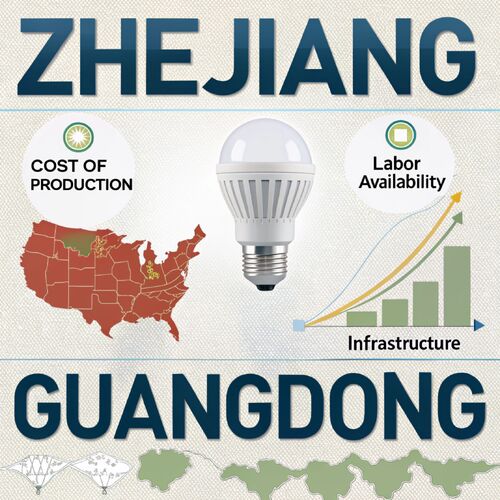
Many global buyers assume Guangdong should dominate all LED lighting manufacturing because it is fast, innovative, and highly visible. That assumption often holds true for fixtures, projects, and smart lighting systems. However, when it comes to standardized LED bulbs—GU10, MR16, A60, and similar lamp formats—the center of gravity sits firmly in Zhejiang.
LED bulb manufacturing concentrates in Zhejiang because bulbs demand structural discipline, process stability, and long-term consistency, not the flexibility and rapid iteration that define Guangdong’s supply chain.
This distinction matters most for B2B buyers sourcing GU10, MR16, and A60 LED bulbs for export and long-term programs. Misunderstanding it frequently leads to quality drift, unstable pricing, repeated requalification, and avoidable sourcing risk.
This difference is not accidental.
It is structural.
Structural Requirements of LED Bulb Manufacturing
LED bulbs look simple. Manufacturing them well is not.
LED bulb manufacturing rewards precision, repeatability, and thermal discipline far more than speed or feature innovation.
What makes LED bulbs structurally demanding
An LED bulb is a closed system. Once sealed, problems cannot be corrected.
Key structural requirements include:
- stable thermal paths
-
consistent driver behavior
-
tight mechanical tolerances
-
predictable LED binning
-
long-term lumen and color stability
Small deviations appear quickly in real-world use.
A minor driver change can cause:
- flicker complaints
-
dimming instability
-
premature failure
A slight housing variation can reduce heat dissipation and shorten product lifetime.
Why bulbs punish inconsistency
Unlike fixtures, bulbs are:
This means any defect scales rapidly.
If a project installs 10,000 GU10 bulbs, a 1% defect rate is not marginal.
It becomes visible, costly, and reputational.
Certification pressure amplifies risk
Bulbs face strict and ongoing compliance requirements:
- CE and CB safety
-
EMC stability
-
thermal limits
-
consistent labeling
Frequent component changes trigger:
- re-testing
-
re-certification
-
customs and audit risk
This structural reality favors factories that resist change, not those that embrace it.
Why this creates regional concentration
Supply chains evolve to fit product behavior.
Bulbs punish flexibility.
They reward discipline.
This is the first reason LED bulb manufacturing concentrates in Zhejiang.
Standardization vs. Customization
The core difference between Zhejiang and Guangdong is not quality.
It is philosophy.
Zhejiang is built for standardization. Guangdong is built for customization. LED bulbs belong to the first category.
Bulbs are standardized by nature
LED bulbs compete on:
- reliability
-
price stability
-
consistency over time
Buyers expect:
These expectations shape how factories must operate.
Why customization conflicts with bulb logic
Customization introduces:
- BOM variation
-
assembly deviation
-
documentation complexity
These factors increase risk in bulb production.
Guangdong thrives on customization because:
This logic works well for fixtures.
It works poorly for bulbs.
Standardization favors process-driven regions
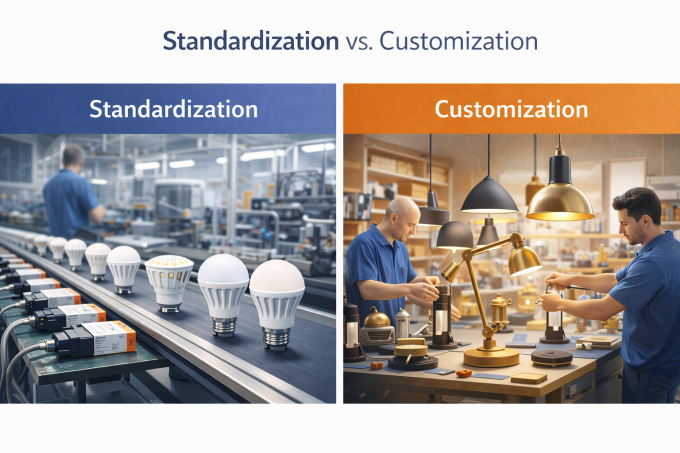
Regions that excel in bulb manufacturing typically feature:
Zhejiang’s industrial culture evolved around exactly this model.
Why buyers often misjudge the difference
Many buyers hear:
“Guangdong is more advanced.”
They interpret this as:
“Guangdong must be better for everything.”
In reality, advanced customization and advanced standardization are opposite skill sets.
Bulb manufacturing requires the latter.
Zhejiang’s Structural Advantages for Bulbs
Zhejiang did not accidentally become the center of LED bulb manufacturing.
Its advantages align directly with bulb requirements.
Zhejiang’s supply chain supports LED bulb manufacturing through mechanical consistency, conservative engineering, and long-term process control.
Mechanical manufacturing heritage
Before LEDs, Zhejiang specialized in:
- electrical hardware
-
metal components
-
die-cast aluminum
-
sockets and connectors
These industries share essential traits with LED bulbs:
- tolerance control
-
repetitive assembly
-
low defect tolerance
When LEDs emerged, Zhejiang factories already understood how to build products that must not change.
Thermal-first engineering mindset
Bulb reliability depends heavily on heat management.
Zhejiang manufacturers emphasize:
Thermal design is treated as fixed infrastructure, not a negotiable variable.
This improves:
- lumen maintenance
-
color stability
-
driver lifespan
Conservative engineering behavior
Zhejiang engineering teams tend to:
A GU10 or MR16 model may remain unchanged for years.
This frustrates novelty-driven buyers.
It benefits reliability-driven buyers.
Supplier relationship stability
Zhejiang bulb factories typically maintain:
Supplier changes require internal justification, not opportunistic price decisions.
This reduces:
- silent substitutions
-
performance drift
-
certification risk
Production rhythm and yield focus
Zhejiang factories favor:
- fewer SKUs
-
longer production runs
-
higher yield targets
This stabilizes:
- pricing
-
delivery schedules
-
quality outcomes
For B2B buyers, predictability often outweighs speed.
Export discipline built into operations
Zhejiang’s LED bulb industry grew alongside export markets.
Factories are accustomed to:
This creates a risk-averse production culture well suited to bulbs.
Limitations of Guangdong for Standard Bulb Production
Guangdong is not weak.
It is optimized for a different job.
Guangdong’s strengths—flexibility, electronics integration, and rapid iteration—become liabilities in standardized bulb manufacturing.
Electronics-first vs. structure-first approach
Guangdong factories often begin with electronics:
- driver innovation
-
control integration
-
feature expansion
For bulbs, this leads to:
Bulbs require stability first, features second.
High SKU churn environment
Guangdong factories commonly manage:
This increases the risk of:
Subcontractor dependency
Guangdong supply chains often rely on:
- multiple subcontractors
-
flexible sourcing
-
rapid vendor switching
This supports speed.
It reduces traceability.
Bulb manufacturing benefits from tightly controlled, long-term supplier relationships.
Cost volatility over time
Initial pricing in Guangdong can be attractive.
Over time, buyers often encounter:
Zhejiang factories are more likely to absorb volatility internally.
Project mindset vs. program mindset
Guangdong excels at:
- project-based orders
-
one-off customization
-
short delivery cycles
Bulb programs require:
- multi-year continuity
-
stable specifications
-
predictable reorders
This mismatch explains why Guangdong dominates fixtures but not bulbs.
What This Means for B2B Buyers
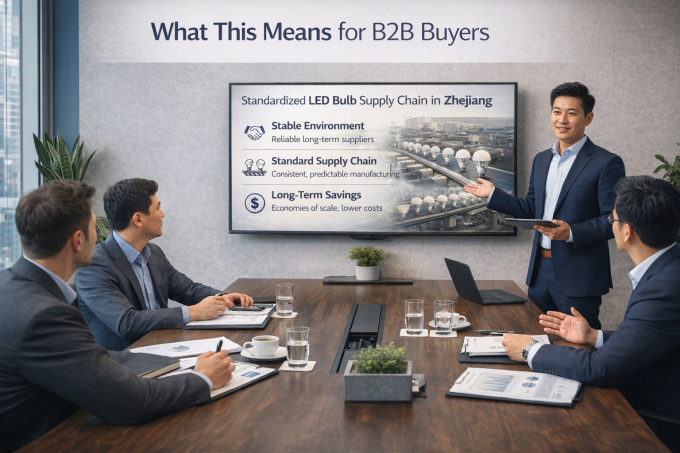
This regional distinction directly affects sourcing outcomes.
B2B buyers who align bulb sourcing with Zhejiang’s strengths reduce risk, stabilize margins, and improve long-term supply reliability.
For GU10, MR16, and A60 sourcing
Zhejiang is usually the better foundation when you require:
For brand owners
Brand risk comes from inconsistency.
Zhejiang suppliers are more likely to:
For wholesalers and distributors
Operational efficiency depends on:
- low return rates
-
minimal QC disputes
-
stable documentation
Zhejiang’s approach reduces operational friction.
For regulated markets
Markets such as:
penalize inconsistency heavily.
Zhejiang factories are structured to survive audits and long certification cycles.
When Guangdong still makes sense
Guangdong is often the correct choice when:
The mistake is not choosing Guangdong.
The mistake is choosing Guangdong for the wrong product type.
A realistic sourcing strategy
Many experienced buyers adopt a split approach:
This mirrors how China’s supply chains are actually organized.
Conclusion
LED bulb manufacturing concentrates in Zhejiang because standardized lamps require process stability, conservative engineering, and long-term consistency—conditions that Zhejiang’s supply chain delivers more reliably than Guangdong’s flexibility-driven model.
Teco manufactures GU10, MR16, and A60 LED bulbs in Zhejiang, focusing on stable B2B supply rather than short-term product cycles.
We work exclusively with global buyers who value consistency, compliance, and predictable delivery.
Our factory operates four production lines and serves markets across:
- Europe
-
Saudi Arabia and UAE
-
USA
-
Singapore
-
Vietnam and Taiwan
If you are evaluating Zhejiang vs. Guangdong for LED bulb sourcing:
Email: [email protected]
Website: www.tecolite.com
Describe your product type and target market.
We help buyers choose the supply chain that actually fits their business—before problems appear.


 Your message must be between 20-3,000 characters!