.gtr-container-ledfootprint789 {
font-family: Verdana, Helvetica, “Times New Roman”, Arial, sans-serif;
color: #333;
line-height: 1.6;
padding: 15px;
box-sizing: border-box;
max-width: 100%;
overflow-x: hidden;
}
.gtr-container-ledfootprint789 p {
    font-size: 14px;
    margin-bottom: 1em;
    text-align: left !important;
}

.gtr-container-ledfootprint789 strong {
    font-weight: bold;
    color: #0056b3;
}

.gtr-container-ledfootprint789 .gtr-main-title {
    font-size: 18px;
    font-weight: bold;
    margin-bottom: 1.5em;
    color: #003366;
    text-align: left;
}

.gtr-container-ledfootprint789 .gtr-section-title {
    font-size: 18px;
    font-weight: bold;
    margin-top: 2em;
    margin-bottom: 1em;
    color: #0056b3;
    text-align: left;
}

.gtr-container-ledfootprint789 .gtr-subsection-title {
    font-size: 16px;
    font-weight: bold;
    margin-top: 1.5em;
    margin-bottom: 0.8em;
    color: #007bff;
    text-align: left;
}

.gtr-container-ledfootprint789 ul {
    list-style: none !important;
    padding-left: 20px !important;
    margin-bottom: 1em;
}

.gtr-container-ledfootprint789 ul li {
position: relative;
    padding-left: 20px;
    margin-bottom: 0.5em;
    font-size: 14px;
    text-align: left;
list-style: none !important;
}
.gtr-container-ledfootprint789 ul li::before {
content: "â¢" !important;
position: absolute !important;
left: 0 !important;
color: #007bff;
font-size: 1.2em;
line-height: 1.6;
}
.gtr-container-ledfootprint789 ol {
list-style: none !important;
padding-left: 25px !important;
margin-bottom: 1em;
counter-reset: list-item;
}
.gtr-container-ledfootprint789 ol li {
position: relative;
padding-left: 25px;
margin-bottom: 0.5em;
font-size: 14px;
text-align: left;
counter-increment: none;
list-style: none !important;
}
.gtr-container-ledfootprint789 ol li::before {
    content: counter(list-item) "." !important;
    position: absolute !important;
    left: 0 !important;
    color: #007bff;
    font-weight: bold;
    width: 20px;
    text-align: right;
    line-height: 1.6;
}

.gtr-container-ledfootprint789 .gtr-table-wrapper {
    width: 100%;
    overflow-x: auto;
    margin-bottom: 1.5em;
}

.gtr-container-ledfootprint789 table {
    width: 100%;
    border-collapse: collapse !important;
    border-spacing: 0 !important;
    margin-bottom: 0;
    min-width: 600px;
}

.gtr-container-ledfootprint789 table,
.gtr-container-ledfootprint789 th,
.gtr-container-ledfootprint789 td {
    border: 1px solid #ccc !important;
    padding: 10px !important;
    text-align: left !important;
    vertical-align: top !important;
    font-size: 14px;
    word-break: normal;
    overflow-wrap: normal;
}

.gtr-container-ledfootprint789 th {
    font-weight: bold;
    color: #003366;
    background-color: transparent !important;
}

@media (min-width: 768px) {
    .gtr-container-ledfootprint789 {
        padding: 30px 50px;
        max-width: 960px;
        margin: 0 auto;
    }

    .gtr-container-ledfootprint789 .gtr-main-title {
        font-size: 24px;
    }

    .gtr-container-ledfootprint789 .gtr-section-title {
        font-size: 20px;
    }

    .gtr-container-ledfootprint789 .gtr-subsection-title {
        font-size: 18px;
    }

    .gtr-container-ledfootprint789 table {
        min-width: auto;
    }
}
The Carbon Footprint of LED Lighting: Understanding Impact and How to Reduce It
For over a decade, LED technology has been promoted as the most energy-efficient lighting option available. And while this remains true, the conversation in the lighting industry is shifting. Buyers—especially in commercial, industrial, and public-sector projects—are no longer satisfied with “energy savings” alone. They now want to understand the total carbon footprint of LED lighting across its entire lifecycle.
From manufacturing and transportation to daily electricity use and end-of-life processing, LEDs produce far less carbon emissions than halogen, CFL, or fluorescent lighting. But “less” does not mean “none.” Understanding where emissions occur helps businesses make responsible procurement decisions, improve ESG reporting, reduce Scope 2 emissions, and build more sustainable lighting portfolios.
This guide breaks down the full carbon impact of LED lighting and provides actionable strategies for distributors, wholesalers, OEM/ODM buyers, and project designers who want to reduce environmental footprint while maintaining performance and cost efficiency.
What Does “Carbon Footprint” Mean for LED Lighting?
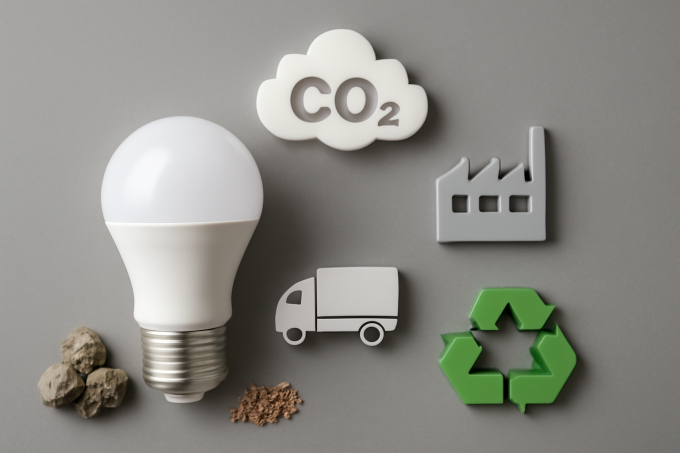
The carbon footprint of a lighting product refers to the total greenhouse gas emissions generated across every stage of its life. For LEDs, this usually includes:
1.1 Raw Material Extraction
These steps require mining, refining, and processing—activities with significant energy consumption.
1.2 Manufacturing & Assembly
LED chips and drivers require precision semiconductor fabrication, PCB production, SMT reflow, and quality testing. These processes generate emissions through electricity usage and factory operations.
1.3 Transportation & Logistics
Shipping LED products—often from Asia to global markets—contributes to carbon impact through fuel consumption.
1.4 Operation During Lifetime
This is where LEDs outperform every other lighting technology.
Lower wattage = lower electricity demand = lower carbon emissions from power plants.
1.5 End-of-Life Processing
LEDs contain electronic components requiring proper recycling under WEEE and related frameworks.
Key insight:
More than 80–90% of the carbon footprint of traditional lighting comes from usage (electricity).
For LEDs, that operational percentage drops significantly, so manufacturing-stage emissions matter more compared with legacy lamps.
How LEDs Compare to Halogen, Fluorescent, and CFL in Carbon Impact
Commercial buyers often ask: “How much lower is the LED footprint compared to other lighting?”
Here’s a simplified comparison based on lifecycle assessments (LCAs) from recognized agencies (e.g., European Commission, DOE Lighting Program):
| Lighting Type |
Typical Lifetime |
Energy Use (per 1,000 hours) |
Relative COâ Impact |
Key Notes |
| Halogen |
1,000 h |
Very high |
Highest |
Short life + high wattage |
| Incandescent |
1,000 h |
Extremely high |
Extremely high |
Considered obsolete |
| CFL |
6,000–10,000 h |
Medium |
Medium |
Contains mercury |
| Fluorescent (T8/T5) |
15,000–30,000 h |
Medium-low |
Medium-low |
Requires ballast |
| LED |
25,000–50,000 h |
Very low |
Lowest |
High efficacy + long life |
A well-designed LED can reduce carbon emissions by up to 80–90% vs halogen and 40–60% vs fluorescent lighting.
This massive reduction is driven by:
- Higher lumens per watt
-
Dramatically longer lifetime
-
Reduced maintenance and replacements
-
Compatibility with smart lighting controls
Understanding the LED Lifecycle Carbon Contributions
To optimize carbon reduction, businesses need to know where emissions come from.
3.1 Manufacturing (20–40% of total impact)
Modern LED production is increasingly efficient, but carbon sources include:
Energy mix in the manufacturing region heavily influences this, making sourcing transparency important for ESG reporting.
3.2 Operational Energy Use (50–70% of total impact)
For most commercial users—hotels, offices, retail, warehouses—daily use hours are high.
Even small wattage differences compound significantly across large installations.
Example:
Replacing 1,000 halogen GU10 (50W) with 1,000 LED GU10 (5W):
- Total wattage drop: 50,000W → 5,000W
-
Annual runtime: 10 hours/day
-
Annual electricity saved: ~164,250 kWh
-
COâ saved (global average grid): ~100 metric tons per year
For corporate buyers, this directly impacts Scope 2 reduction initiatives.
3.3 Transport (5–10%)
Reducing shipment frequency, consolidating orders, and localizing final assembly can reduce transport-related emissions.
3.4 End-of-Life (1–3%)
LEDs do not contain mercury, making them safer than CFLs.
However, drivers and electronics require responsible recycling.
- Major Factors Influencing LED Carbon Footprint in Real Projects
Even the same wattage LED bulb can produce different carbon footprints depending on design and performance quality.
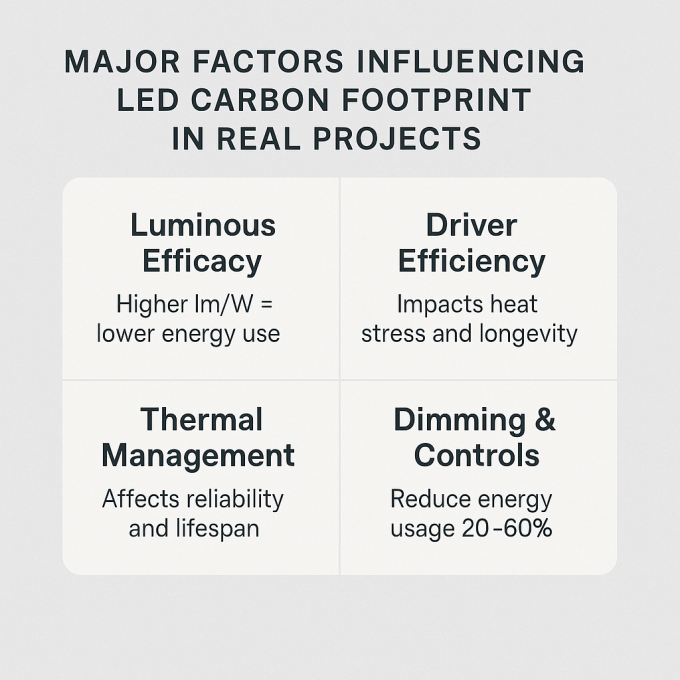
4.1 Luminous Efficacy (lm/W)
Higher efficiency means lower energy consumption.
Top modern LEDs achieve:
For B2B buyers, efficacy is the most important spec driving carbon reduction.
4.2 Driver Efficiency
High-quality drivers waste less energy as heat.
Driver efficiency range:
- Poor quality: 75–80%
-
Mid-range: 85%
-
High quality: 90–95%
An efficient driver reduces heat stress and improves longevity (fewer replacements → lower carbon).
4.3 Thermal Management
Poor thermal design leads to faster lumen depreciation and premature failure.
Better heat sinks reduce:
- Early color shift
-
Driver overheating
-
Warranty claims
-
Replacement emissions
4.4 Dimming & Controls
Smart controls lower energy usage by 20–60% via:
- Occupancy sensors
-
Daylight harvesting
-
Scheduling
-
Adaptive dimming
4.5 Lifetime & Real-World Reliability
Rated lifetime is irrelevant if products fail prematurely.
Poor QC increases carbon waste due to:
- Replacements
-
Additional shipments
-
Extra manufacturing volume
-
Inconsistent CCT leading to replacement
-
Excess maintenance travel miles
-
Higher scrap rates in production
High-reliability LEDs maintain carbon reductions for their entire lifecycle.
How Businesses Can Reduce the Carbon Footprint of LED Lighting
Here are practical steps for distributors, OEM/ODM buyers, and project planners to cut carbon impact while maintaining profitability.
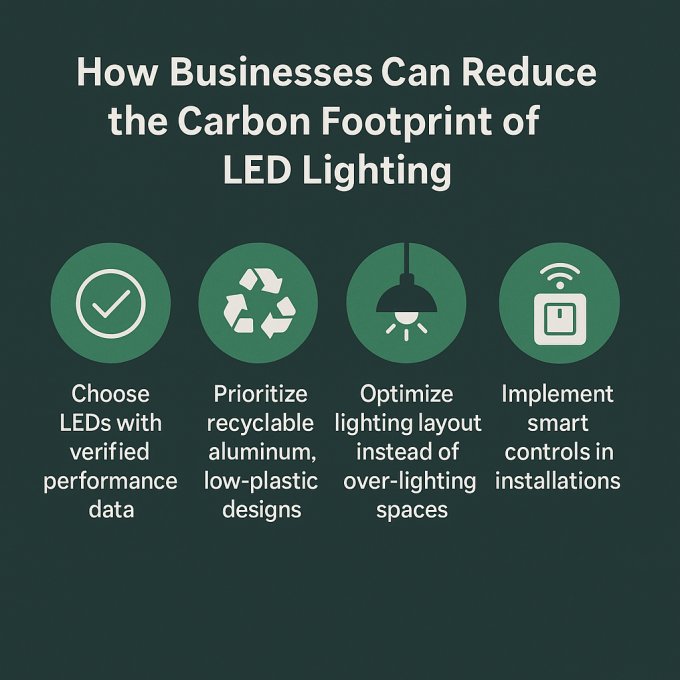
5.1 Choose LEDs with Verified Performance Data
Look for products with:
- LM-79 photometric reports
-
LM-80 + TM-21 lifetime projections
-
Flicker evaluation (Pst LM, SVM)
-
Power factor ≥ 0.9
-
High driver efficiency
-
Clear warranty transparency
Cheap LEDs often have inflated specs or missing test data, masking hidden carbon costs.
5.2 Prioritize Luminaires with Recyclable Aluminum and Low-Plastic Designs
Aluminum heat-sinks are fully recyclable, while plastics contribute more to embodied carbon.
Request:
Modular repairable designs drastically reduce e-waste.
5.3 Optimize Lighting Layout Instead of Over-Lighting Spaces
The biggest carbon waste in commercial lighting is overspecification.
Use:
- Beam angles appropriate for task lighting
-
High-efficacy luminaires to reduce quantity
-
Wall washing to improve perceived brightness
-
Lighting simulation (Dialux, Relux) to avoid excess fixtures
A well-designed layout can cut fixture count by 20–40%.
5.4 Implement Smart Controls in All Medium-to-Large Installations
Controls have the highest ROI in carbon reduction.
Applications:
- Office open-plan areas
-
Hotel corridors and guest rooms
-
Underground parking structures
-
Retail window displays
-
Factories with variable operation hours
Expect 20–60% energy reduction immediately.
5.5 Source from Manufacturers with Strong Quality Control
Weak QC increases carbon footprint via:
- Early driver failures
-
Fast lumen depreciation
-
Inconsistent CCT leading to replacement
-
Excess maintenance travel miles
-
Higher scrap rates in production
Ask your supplier for:
- Incoming QC processes
-
Aging tests (8–12 hours standard)
-
Temperature/humidity validation
-
Driver stress testing
-
Batch traceability
-
EPREL (EU) or DLC/UL (US) compliance
Better QC = lower long-term carbon waste.
5.6 Ask for Carbon Transparency from Suppliers
Leading manufacturers provide:
- Material composition data
-
Energy usage per batch
-
ISO 14001 environmental management
-
Lifecycle assessment (LCA) reports
-
Recycled content percentages
European buyers increasingly demand this for ESG reporting.
- Calculating LED Carbon Footprint in Real Projects (B2B Guide)
For corporate lighting upgrades, carbon reporting usually includes:
- Total wattage before vs. after
- Expected annual usage hours
- Local or regional COâ per kWh
- Fixture replacement frequency
- Smart control savings
Example (hotel project):
300 guest rooms × 8 GU10 halogens → GU10 5W LEDs
This is equivalent to planting over 8,500 trees annually.
The Future of Low-Carbon LED Lighting
The next generation of sustainable lighting includes:
7.1 Ultra-High Efficacy LEDs (200–230 lm/W)
Reducing operational emissions even further.
7.2 Driverless AC-LED Designs
Lower component count, smaller PCB footprint, reduced material impact.
7.3 Modular & Repairable Fixtures
Extended product lifecycles = lower embodied carbon.
7.4 Recycled Aluminum and Bio-Plastics
Improving material circularity.
7.5 Renewable-Energy LED Manufacturing
Factories powered by solar/wind dramatically reduce embodied energy.
7.6 Smart Building Integration
AI-driven adaptive lighting systems that reduce unnecessary illumination.
Conclusion: LEDs Are Low-Carbon—But Smart Choices Make Them Even Better
LED lighting is already the most sustainable mainstream lighting technology.
But true carbon reduction requires more than switching from halogen to LED.
B2B buyers, distributors, and project designers can significantly cut carbon impact by choosing:
Lighting isn’t just an operational expense—it’s a measurable part of every company’s ESG and sustainability story. A thoughtful LED procurement strategy can reduce both emissions and long-term costs while improving visual comfort and maintaining performance.


 Your message must be between 20-3,000 characters!