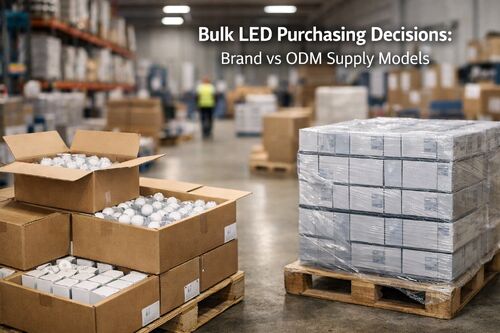
Bulk LED purchasing is rarely a simple price comparison. Many sourcing problems emerge months after the first shipment—when specifications change, replacements become difficult, or long-term costs rise unexpectedly.
The real question in bulk LED procurement is not whether Philips or ODM LED bulbs are “better,” but which supply model aligns with your purchasing volume, risk tolerance, and long-term supply strategy.
This article explains the structural differences between Philips-branded LED bulbs and ODM LED bulbs, analyzes their cost and risk profiles, and provides a practical framework to help B2B buyers choose the right option—or combine both—based on real application scenarios.
Understanding the Fundamental Difference: Brand-Controlled vs Buyer-Controlled Supply
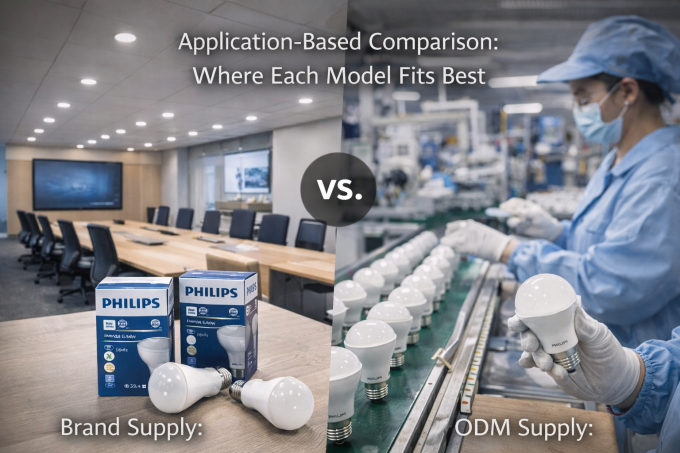
Philips and ODM LED bulbs are built on fundamentally different supply-chain philosophies.
Philips represents a brand-controlled product model, while ODM represents a buyer-controlled manufacturing model.
Who controls the product?
With Philips LED bulbs:
- Product specifications are fixed by the brand
-
Lifecycle changes are brand-driven
-
Buyers select from predefined SKUs
-
Product discontinuation is outside buyer control
With ODM LED bulbs:
- Buyers define performance, structure, and packaging
-
Factories manufacture to specification
-
Buyers control long-term SKU continuity
-
Changes require buyer approval
This difference in control is more important than brand reputation or unit price, especially for repeat or long-term bulk purchasing.
What “bulk purchasing” means in each model
For Philips, bulk purchasing typically means:
For ODM suppliers, bulk purchasing means:
The same term—bulk—leads to very different supply behaviors.
Where Philips LED Bulbs Perform Best in Bulk Procurement
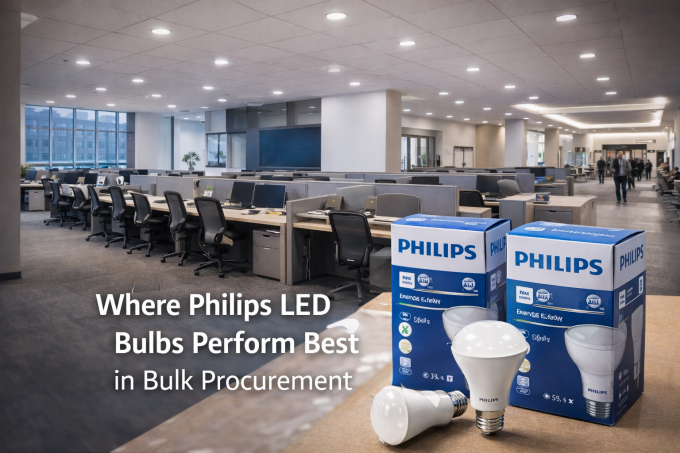
Philips remains a benchmark supplier for buyers who prioritize predictability and reduced decision complexity.
Philips LED bulbs perform best when stability, documented compliance, and reduced buyer responsibility are critical.
Strengths of the Philips model
Philips offers advantages in areas such as:
- Consistent product performance across regions
-
Well-maintained certification and documentation
-
Established compatibility with control systems
-
Structured warranty and after-sales processes
For buyers with limited technical resources, this model shifts much of the operational risk to the brand.
Typical use cases for Philips in bulk purchasing
Philips is often preferred when:
- Brand recognition is required for approval
-
Projects involve public or institutional procurement
-
Documentation scrutiny is high
-
Technical risk must be minimized
In these cases, higher unit cost is often accepted as a trade-off for reduced uncertainty.
Structural limitations to consider
However, Philips sourcing also has constraints:
- Limited customization options
-
Forced product updates or discontinuation
-
Less control over long-term SKU availability
-
Pricing flexibility constrained by brand structure
For buyers managing multi-year supply programs, these factors can become restrictive.
Where ODM LED Bulbs Deliver Greater Value
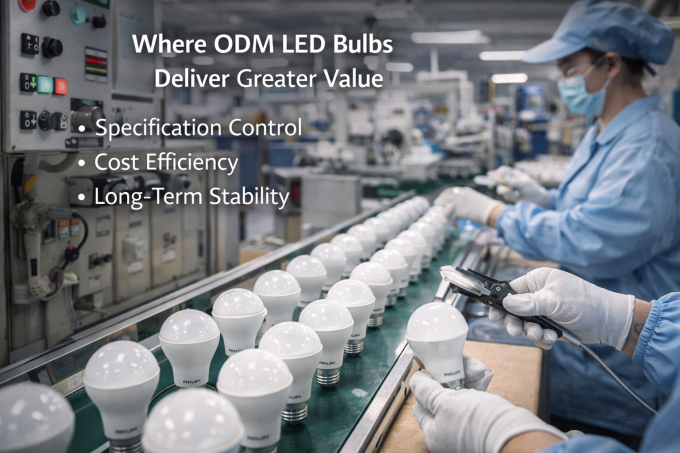
ODM LED bulbs operate under a fundamentally different logic.
ODM suppliers deliver value when buyers seek cost efficiency, specification control, and long-term supply continuity.
Cost efficiency through manufacturing focus
ODM pricing benefits from:
For high-volume purchases, cost differences can be significant—especially when specifications remain stable over time.
Customization as a structural advantage
ODM suppliers can manufacture to buyer-defined requirements, including:
- Lumen output and power
-
Color temperature and CRI targets
-
Beam angles and optical structure
-
Dimming behavior and driver configuration
-
Packaging and private labeling
This allows buyers to avoid paying for unnecessary features and tailor products to specific markets.
Long-term product lifecycle control
One often overlooked advantage of ODM sourcing is lifecycle stability.
Buyers can:
For wholesalers, residential developers, and repeat-order customers, this stability often outweighs initial cost savings.
Responsibilities that shift to the buyer
ODM sourcing requires buyers to actively manage:
ODM rewards prepared buyers with clear requirements and disciplined supplier management.
Application-Based Comparison: Where Each Model Fits Best
Different environments amplify different strengths.
Hotels and hospitality
Hotels prioritize guest comfort, reliability, and operational simplicity.
Many hospitality projects adopt a hybrid approach.
Commercial and retail spaces
Commercial environments emphasize efficiency and scalability.
ODM’s flexibility often aligns better with large commercial programs.
Residential developments
Residential bulk buyers typically focus on:
- Cost control
-
Long-term availability
-
Reduced maintenance
ODM LED bulbs generally perform better in these scenarios due to stable specifications and repeat production.
Large-scale and infrastructure projects
For large projects:
The deciding factor is usually who carries technical and operational responsibility.
Cost vs Risk: How Bulk Buyers Should Think About Trade-Offs

Bulk LED procurement decisions should evaluate total cost over time, not unit price alone.
Cost considerations
However, cost evaluation must include:
Risk distribution
| Risk Area |
Philips Model |
ODM Model |
| Design responsibility |
Brand |
Buyer |
| Product continuity |
Brand-controlled |
Buyer-controlled |
| Quality variability |
Lower |
Depends on specification |
| Change management |
Limited buyer influence |
Buyer-managed |
Experienced buyers often prefer ODM because risks are visible and controllable. Less experienced buyers may prefer Philips because risks are externalized.
A Practical Hybrid Procurement Strategy
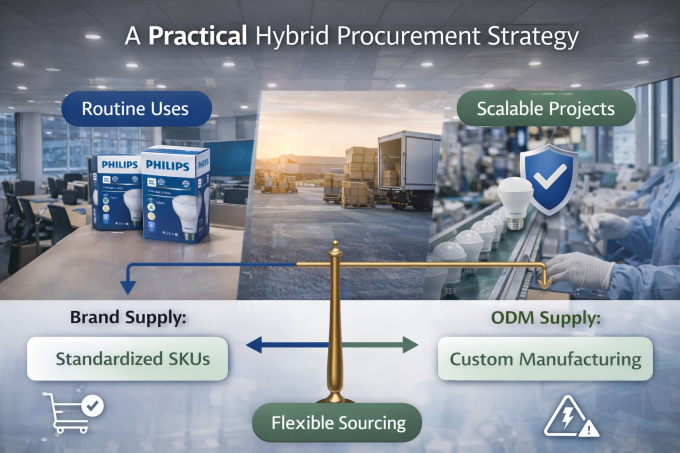
Many professional buyers do not choose one model exclusively.
A hybrid procurement strategy combines the strengths of Philips and ODM while managing risk by application.
How hybrid sourcing typically works
Common approaches include:
This allows buyers to balance cost efficiency with risk control.
Key rules for hybrid sourcing
Hybrid strategies work best when:
Random mixing without structure creates operational complexity.
A Buyer’s Checklist for Bulk LED Purchasing Decisions
Before committing to Philips, ODM, or a hybrid strategy, buyers should confirm:
- Are specifications frozen and documented?
-
Is change notification (PCN) required and enforced?
-
Are certifications valid for the target market?
-
Has dimming and control compatibility been tested?
-
Is long-term availability guaranteed?
-
Who handles failures and replacements?
These questions reveal whether a supply model truly fits your business.
Conclusion
Philips LED bulbs and ODM LED bulbs serve different bulk purchasing needs. Philips offers brand-backed stability and reduced decision complexity, while ODM provides cost efficiency, customization, and long-term supply control.
The better option is not universal—it depends on how you manage risk, scale, and product continuity.
Teco supports B2B buyers evaluating ODM LED bulbs as part of long-term, cost-controlled procurement strategies.
We specialize in:
- ODM GU10, MR16, and LED bulb programs
-
Stable specifications and repeat production
-
Compatibility testing and documentation support
-
Hybrid sourcing strategies alongside global brands
Our role is not to replace brands blindly, but to help buyers choose the supply structure that fits their business model.
Email: [email protected]
Website: www.tecolite.com
Tell us your purchasing volume, target market, and risk priorities.
We will help you determine whether Philips, ODM, or a hybrid approach is the right fit for your bulk LED procurement.


 Your message must be between 20-3,000 characters!