Many projects claim to implement human-centric lighting, yet occupants still report fatigue, night-time overstimulation, or visual discomfort. In most cases, the problem is not intention—it is design logic and inappropriate tool selection.
Human-centric lighting focuses on how light affects people biologically and psychologically. GU10 bulbs can support this approach when their role is clearly defined and their limits are respected.
Human-centric lighting is not a product category. It is a design mindset. GU10 bulbs are one tool within that framework. Used correctly, they improve comfort and sleep-related outcomes. Used incorrectly, they add complexity without delivering real benefits.
Core Design Principles of Human-Centric Lighting
Human-centric lighting begins with human biology, not luminaires or control systems.
At its core, human-centric lighting aligns light spectrum, intensity, timing, and predictability with human physiological and behavioral needs.
Light as a biological signal
Humans respond to light through more than vision. Light directly affects hormones, alertness, and emotional state.
Research shows that intrinsically photosensitive retinal ganglion cells (ipRGCs) respond strongly to short-wavelength blue light and transmit signals directly to the brain’s circadian center, bypassing visual perception entirely. A light can appear comfortable while still overstimulating the nervous system.
This is why visual comfort alone is not a reliable indicator of biological suitability.
Foundational human-centric principles
Across residential, hospitality, and wellness-focused environments, several principles consistently apply:
- Time awareness: Light requirements change throughout the day
-
Spectrum control: Blue-rich light during the day, low-blue or blue-free light at night
-
Intensity restraint: Brightness only where and when it is necessary
-
Visual comfort: Low glare and soft contrast
-
Predictability: No sudden or confusing changes in lighting behavior
Human-centric lighting prioritizes stress reduction before performance enhancement.
Vertical exposure matters more than floor brightness
Biological response depends on light reaching the eyes, not illuminance measured on horizontal surfaces.
Bright floors with dark walls have limited biological effect. Soft, vertical illumination at eye level is far more influential. This principle directly shapes how GU10 bulbs should be positioned and aimed.
Less stimulation often delivers better outcomes
Human-centric lighting is frequently misunderstood as adding features. In practice, it removes unnecessary stimulation:
GU10 bulbs naturally support this restraint-oriented approach due to their limited output and directional nature.
The Role of GU10 Bulbs in Human-Centric Lighting
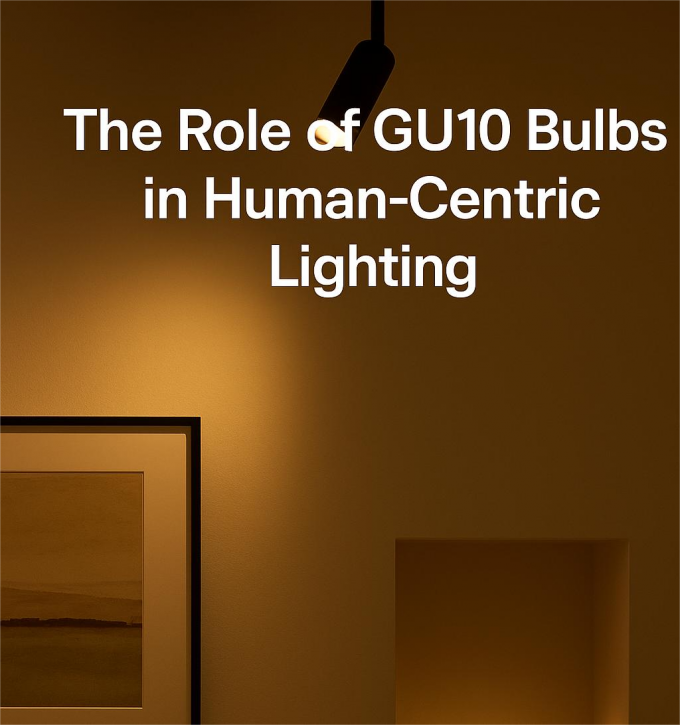
GU10 bulbs are rarely the primary drivers of human-centric lighting. They function best as controlled, supportive elements.
GU10 bulbs contribute to human-centric lighting by enabling localized, low-impact, spectrum-specific light where restraint is required.
Why GU10 aligns with human-centric logic
GU10 bulbs offer characteristics that fit human-centric design goals:
These traits allow designers to control where light is present—and just as importantly, where it is absent.
Human-centric lighting often requires reducing exposure, not increasing it.
Typical GU10 roles in human-centric projects
GU10 bulbs are most effective when used for:
These applications benefit from precision and low biological impact rather than high output.
Spectrum roles GU10 handles effectively
GU10 bulbs perform best when assigned limited, intentional spectral roles:
| Spectrum |
Human-Centric Function |
| 2700K warm white |
Evening comfort and relaxation |
| Amber |
Late-evening calm |
| Red |
Night-time orientation with minimal biological impact |
White GU10 bulbs above 3000K should be avoided late at night, even when dimmed. Blue content remains present and biologically active.
GU10 as a boundary-setting tool
Human-centric lighting depends on clear boundaries between activity and rest.
GU10 bulbs help define:
These boundaries are particularly important in bedrooms, hotel guest rooms, and wellness-oriented environments.
Psychological comfort still matters
Beyond hormones, lighting influences emotional perception.
Warm, localized GU10 lighting improves:
In hospitality and residential settings, these psychological effects are often as important as measurable biological outcomes.
Design Strategies Using GU10 Bulbs
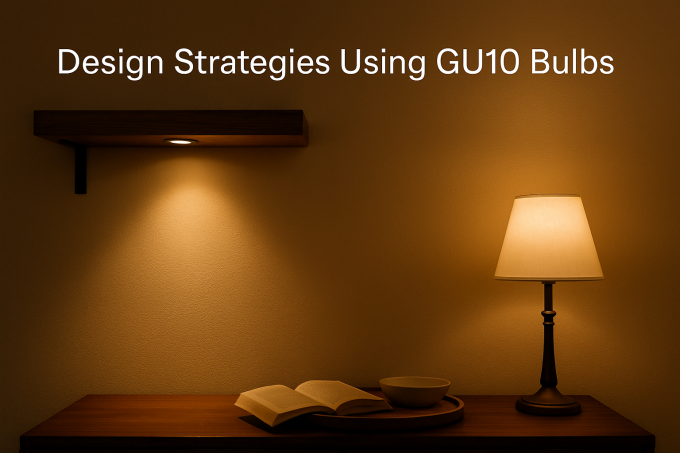
GU10 bulbs deliver results only when integrated into structured design strategies.
Effective human-centric lighting with GU10 relies on layered, time-aware, and placement-sensitive design.
Strategy 1: Layered lighting hierarchy
Human-centric spaces rely on multiple lighting layers rather than a single dominant source:
| Layer |
Purpose |
GU10 Suitability |
| Ambient |
General visibility |
Limited |
| Task |
Focused activity |
Moderate |
| Accent |
Comfort and mood |
Strong |
| Night |
Orientation only |
Very strong |
GU10 bulbs should dominate the lower-impact layers, not the ambient layer.
Strategy 2: Evening transition control
Evening lighting should gradually reduce cognitive stimulation.
Effective approaches include:
Dim-to-warm GU10 bulbs support this transition, but only as an intermediate step—not as true night lighting.
Strategy 3: Night-time protection
At night, the objective is simple: avoid waking the brain.
Recommended practice:
Red light has been shown to have negligible impact on melatonin suppression, making it suitable for night-time navigation in bedrooms, hotel bathrooms, and corridors.
Strategy 4: Directional and glare control
Human-centric lighting minimizes direct eye exposure.
GU10 fixtures should be:
Indirect reflection creates softer, more biologically tolerable exposure.
Strategy 5: Default-safe design
Human-centric lighting must function correctly even when users behave unpredictably.
Design systems so that:
This principle is critical in hotels, serviced apartments, and rental properties.
Strategy 6: Retrofit-friendly improvements
GU10 bulbs enable incremental upgrades.
Replacing night-time white GU10 lamps with red or amber versions often produces noticeable improvements in sleep comfort with minimal disruption.
Limitations Designers Must Accept
Human-centric lighting fails when designers expect GU10 bulbs to perform tasks they were never designed to handle.
GU10 bulbs have clear biological and technical limits that must be accepted.
Limited circadian stimulation capability
GU10 bulbs cannot provide strong circadian activation due to:
Circadian stimulation requires large-area, vertical illumination that GU10 cannot deliver alone.
Spectrum control constraints
Most GU10 bulbs use phosphor-converted white LEDs, resulting in:
Even tunable GU10 products often change visual appearance more than biological impact.
Dimming does not resolve biological issues
Dimming reduces brightness, not wavelength.
White GU10 light still contains blue energy when dimmed, and research shows melatonin suppression can occur at very low blue-light levels. For night-time use, spectrum selection is more important than dimming.
Flicker and driver quality risks
GU10 bulbs integrate compact drivers, and quality varies widely.
Low-quality drivers introduce:
Neurological comfort depends on consistency, not just brightness control.
Certification and standard limitations
GU10-based designs rarely meet:
This does not disqualify GU10—it defines its appropriate role.
The correct mindset
Successful human-centric design accepts that:
Honest tools produce reliable outcomes.
Conclusion
GU10 bulbs support human-centric lighting when used for localized, low-impact, and time-aware applications. Their value lies in comfort enhancement, night-time protection, and boundary-setting—not in full circadian stimulation or biological optimization.
Teco designs and manufactures GU10 LED spotlights for human-centric and wellness-aware lighting applications in hospitality and residential projects. We work B2B only, focusing on stable quality, clear technical positioning, and real-world performance.
Our China-based factory operates four production lines and supports:
- warm, amber, and red GU10 solutions
-
dim-to-warm GU10 development
-
stable low-level dimming
-
OEM and ODM customization
-
compliance for Europe, the Middle East, and Southeast Asia
If you are designing a human-centric lighting project and considering GU10 bulbs, tell us your space, users, and constraints.
We will help you determine where GU10 fits—and where it does not.


 Your message must be between 20-3,000 characters!