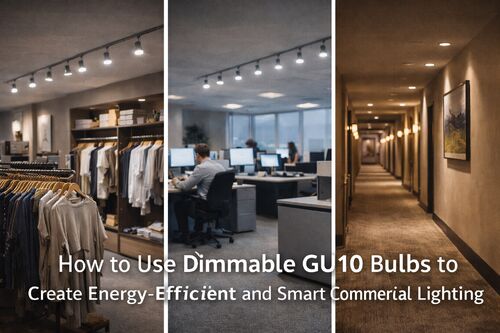
Many commercial lighting projects pursue energy savings by replacing fixtures, redesigning layouts, or installing complex building management systems. In reality, a significant portion of wasted energy comes from a simpler issue: lights operate at full output even when full brightness is unnecessary.
Dimmable GU10 bulbs offer one of the most practical paths to energy-efficient and smart commercial lighting—without replacing fixtures or over-engineering control systems.
This article explains why dimming is often the most effective energy-saving strategy in commercial environments, how dimmable GU10 bulbs enable smart lighting upgrades, where return on investment is highest, and how buyers should specify dimmable GU10 correctly for reliable, energy-efficient commercial projects.
Why Dimming Is the Most Effective Energy-Saving Strategy in Commercial Lighting
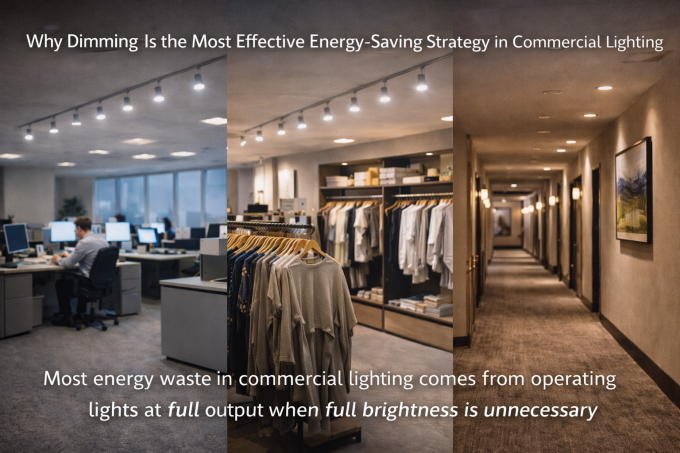
Energy efficiency in commercial lighting is often treated as a hardware problem. In practice, it is usually a usage problem.
The largest energy losses in commercial lighting come from over-lighting, not inefficient light sources.
Full output is rarely required
In real commercial spaces:
- corridors remain empty for long periods
-
retail traffic fluctuates throughout the day
-
offices are partially occupied
-
hospitality spaces operate on variable schedules
Yet lighting systems are commonly designed to run at 100% output continuously.
Why dimming outperforms simple on–off control
On–off switching creates binary behavior, not optimization.
Dimming allows:
This is why dimmable GU10 bulbs for commercial lighting consistently outperform simple switching strategies.
Energy savings depend on time, not just wattage
Even modest dimming levels matter.
Reducing output by 30% for 10 hours per day often saves more energy than replacing a fixture that operates inefficiently for only short periods.
Dimming works because it reduces average operating power over time, not just peak load.
Why GU10 spotlights benefit most from dimming
GU10 bulbs are widely used in:
These applications rarely require constant full brightness, making GU10 an ideal format for dimming-based energy strategies.
How Dimmable GU10 Bulbs Reduce Energy Without Fixture Replacement
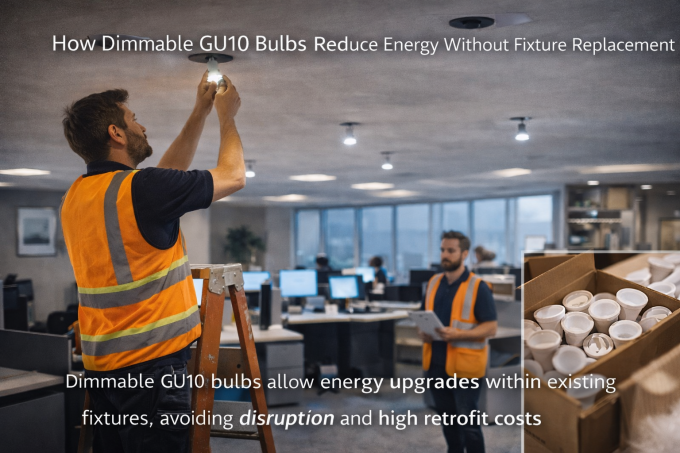
One of the biggest barriers to energy-efficient upgrades is disruption.
Dimmable GU10 bulbs allow energy reduction without replacing fixtures, rewiring ceilings, or redesigning layouts.
The retrofit advantage
Most commercial buildings already use GU10 fixtures.
Replacing fixtures introduces:
- labor cost
-
downtime
-
coordination risk
Replacing lamps with dimmable GU10 bulbs upgrades performance within existing infrastructure—forming the basis of GU10 smart lighting retrofit strategies.
Power reduction and thermal benefit
Dimming does not reduce power perfectly linearly, but lower output still reduces:
Lower operating temperature extends lamp life and reduces replacement frequency, contributing to long-term energy efficiency.
Incremental implementation
Commercial projects rarely upgrade everything at once.
Dimmable GU10 bulbs support:
This flexibility often delivers higher real-world savings than theoretical maximum efficiency.
What “Smart” Means in Smart Commercial GU10 Lighting
In this context, smart does not mean complex.
Smart commercial lighting with GU10 bulbs refers to basic automation—timers, sensors, and controlled dimming—not necessarily full building management systems.
Why automation matters
Manual dimming depends on:
- staff discipline
-
consistent behavior
-
correct daily operation
In commercial environments, this reliability rarely holds at scale.
Automation ensures dimming actually happens.
Practical smart control methods
Effective setups often include:
These systems reduce energy without increasing operational complexity.
GU10’s advantage in smart control
GU10 circuits are usually:
- localized
-
application-specific
-
easy to segment
This enables targeted smart control rather than whole-building complexity.
Where Dimmable GU10 Delivers the Highest ROI
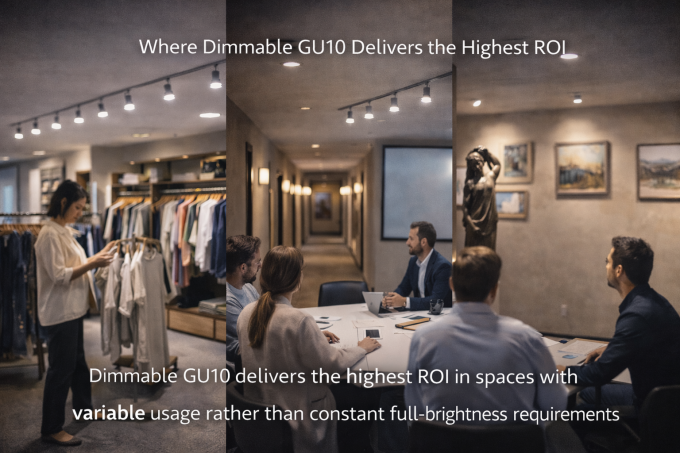
Not all spaces benefit equally from dimming.
The highest ROI appears where occupancy and usage fluctuate.
High-ROI applications
- Retail: variable traffic, accent lighting, long operating hours
-
Hospitality: corridors, lounges, restaurants, public zones
-
Offices: meeting rooms, breakout areas, circulation spaces
-
Museums & galleries: accent lighting, preservation-sensitive zones
In these environments, dimming reduces waste without affecting functionality.
Lower-ROI applications
Dimmable GU10 is less effective in:
In these cases, efficient non-dimmable lighting or limited night-time reduction may be more appropriate.
ROI is not only energy
Return on investment also includes:
- reduced maintenance
-
longer lamp life
-
improved user comfort
These benefits often outweigh pure kWh savings.
A Simple Energy Saving Estimation Method
For early-stage evaluation, buyers can estimate savings using a practical approximation:
Annual Energy Saving (kWh)
= (W_full − W_dim_avg) × operating hours × number of lamps ÷ 1000
Notes:
- Actual power reduction is not perfectly linear
-
Low-end dimming behavior depends on driver design
-
For large projects, request measured power curves from suppliers
This approach supports realistic budgeting and ROI comparison.
Common Mistakes in Smart Commercial GU10 Projects
Most failures come from execution, not concept.
Typical errors
- assuming all dimmable GU10 bulbs perform similarly
-
ignoring dimmer and load compatibility
-
over-complex automation
-
no defined dimming strategy
-
poor commissioning
-
excessive dimming that causes discomfort
Discomfort leads to manual overrides, which eliminate energy savings.
How Buyers Should Specify Dimmable GU10 for Commercial Projects
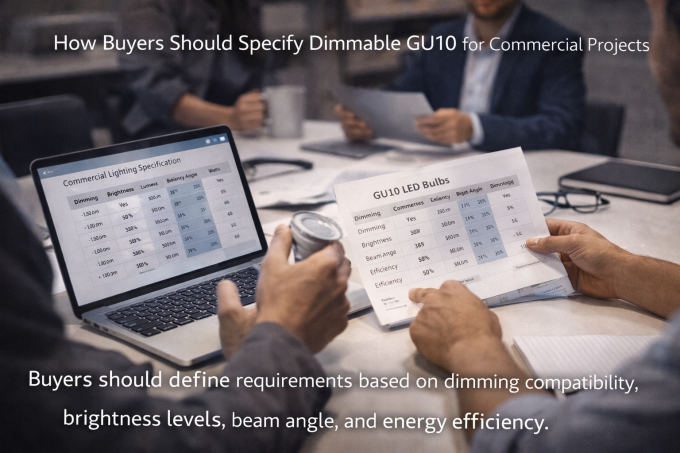
Specification determines outcome.
Five parameters that must be fixed in specifications
- Supported dimming type (leading-edge / trailing-edge / TRIAC)
-
Minimum stable dimming level (with test conditions)
-
Flicker acceptance criteria or measurement method
-
Recommended load range per dimmer
-
Change management: written approval for driver or BOM changes
These items should appear in datasheets, contracts, or purchase orders.
Prioritize stability over features
Reliable dimming with low flicker and silent operation matters more than advanced features that are rarely used.
Think beyond the first order
Energy efficiency includes:
Short-term savings disappear if products change silently.
Conclusion
Dimmable GU10 bulbs enable energy-efficient and smart commercial lighting by reducing over-lighting, supporting simple automation, and upgrading existing fixtures without disruption—when specified, controlled, and commissioned correctly.
Teco supports B2B buyers developing dimmable GU10 bulbs for commercial lighting that focus on real energy savings, not marketing claims.
We help with:
- energy-efficient GU10 lighting programs
-
smart commercial GU10 retrofit strategies
-
dimmer compatibility and stability guidance
-
long-term, repeatable GU10 specifications for bulk orders
Email: [email protected]
Website: www.tecolite.com
Share your application type, control method, and project scale.
We will help you design a GU10 dimming solution that saves energy without creating new operational problems.


 Your message must be between 20-3,000 characters!