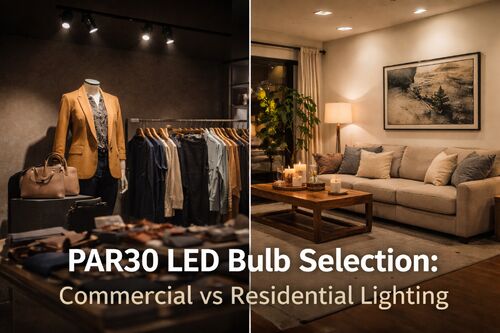
Many buyers assume that a PAR30 LED bulb is a universal product. Same size, same socket, same wattage—so it should work everywhere. In real projects, this assumption leads to glare complaints, poor atmosphere, wasted energy, and repeated replacements.
Choosing the right PAR30 LED bulb depends less on the bulb itself and more on whether the application is commercial or residential.
This guide explains how commercial and residential lighting needs differ, how those differences affect beam angle, color temperature, CRI, and operating patterns, and why professional buyers should never use one PAR30 specification to cover both environments.
Understanding the Fundamental Differences Between Commercial and Residential Lighting Needs?
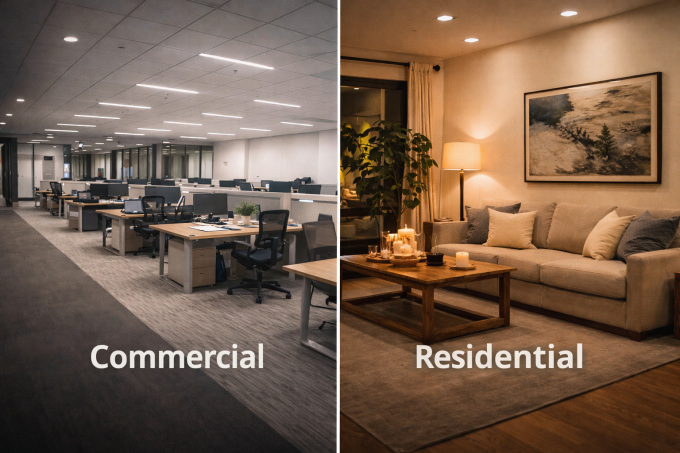
Commercial and residential lighting serve different purposes, even when the same PAR30 LED bulb is used.
Commercial vs residential PAR30 lighting differs primarily in objectives, operating time, and tolerance for variation.
What commercial lighting is designed to achieve
Commercial lighting focuses on:
- visibility and clarity
-
consistency across spaces
-
support for business activity
-
reduced complaints at scale
In commercial environments, lighting must work for many users with different preferences.
What residential lighting is designed to achieve
Residential lighting focuses on:
In homes, lighting serves individuals, not crowds.
Why this difference matters for PAR30 selection
A PAR30 LED bulb that works well in a shop may feel harsh in a living room.
A PAR30 LED bulb that feels cozy at home may feel dim or yellow in a commercial space.
Using the same specification for both creates friction.
Risk tolerance is not the same
Commercial buyers want:
- fewer complaints
-
predictable performance
-
standardized outcomes
Residential users accept variation if comfort is high.
This difference shapes every technical decision.
The key takeaway
PAR30 LED bulb selection must start with application context, not product availability.
How Beam Angle Selection for PAR30 Differs in Commercial and Residential Spaces?
Beam angle is one of the most misunderstood factors in PAR30 selection.
PAR30 beam angle selection must reflect how light is used, not just how bright it looks on paper.
Beam angle needs in commercial spaces
Commercial environments often require:
- clear product highlighting
-
defined visual zones
-
controlled spill light
Common commercial beam angles include:
A focused beam increases visual efficiency and perceived brightness.
Beam angle needs in residential spaces
Residential spaces prioritize:
Wider beam angles are often preferred to avoid harsh contrast.
Comparing beam angle intent
| Application |
Typical Beam Angle Goal |
| Retail display |
Focused, controlled |
| Office common areas |
Balanced, medium |
| Living room |
Soft, wide |
| Dining area |
Medium, comfortable |
This difference explains why one PAR30 LED bulb cannot serve all uses equally.
The glare factor
In homes, glare tolerance is low.
A narrow PAR30 beam aimed incorrectly can feel uncomfortable.
In commercial spaces, higher contrast is often acceptable.
Practical buyer guidance
For PAR30 LED bulb for commercial lighting, prioritize:
- beam control
-
higher center intensity
For PAR30 LED bulb for residential lighting, prioritize:
- wider beam
-
softer transitions
Beam angle choice directly affects user satisfaction.
Choosing the Right Color Temperature for PAR30 in Different Environments?
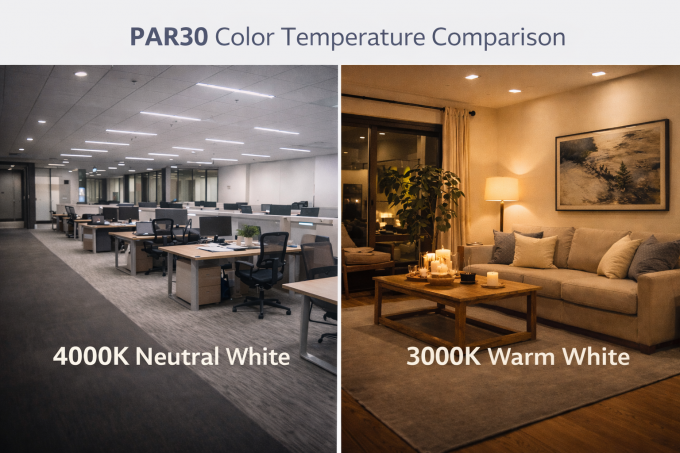
Color temperature drives perception more than most buyers expect.
PAR30 color temperature application should reflect human expectation in each environment, not a single “standard” value.
Color temperature in commercial settings
Commercial spaces often favor:
- neutral white (around 4000K)
-
daylight-like clarity
-
consistent appearance
These temperatures support:
- alertness
-
product visibility
-
modern visual identity
This is why many buyers default to neutral or daylight PAR30 in commercial projects.
Color temperature in residential settings
Residential environments typically favor:
- warm white (2700K–3000K)
-
relaxed atmosphere
-
emotional comfort
These temperatures support rest and social interaction.
Why mixing standards causes problems
Installing a commercial-grade color temperature in homes often leads to:
Installing warm residential PAR30 in commercial spaces often leads to:
Cultural and regional influence
Color temperature preference also varies by region.
Commercial buyers usually choose safer, more neutral options to reduce cultural risk.
Buyer takeaway
Color temperature is not personal taste for buyers.
It is risk management.
Separate PAR30 color temperature strategies reduce returns and complaints.
CRI and Light Quality Requirements: Commercial vs Residential PAR30?
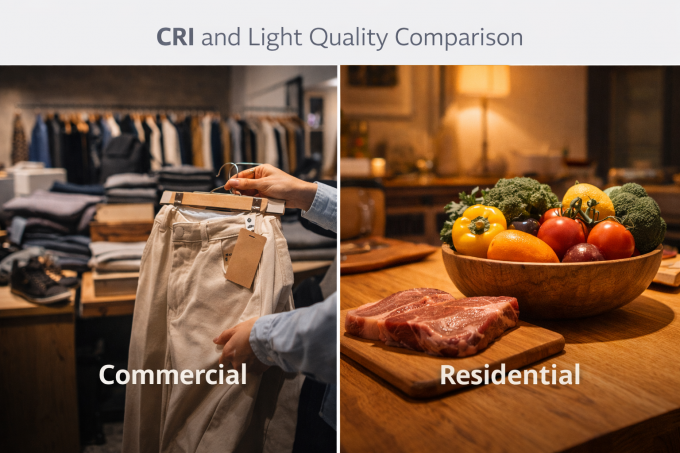
Light quality expectations differ between markets.
CRI requirements for PAR30 LED bulb selection change based on whether accuracy or comfort is the priority.
CRI expectations in commercial lighting
Commercial environments require:
For many applications, standard CRI levels are acceptable if consistency is high.
Retail or display-focused areas may require higher CRI, but uniformity often matters more than maximum values.
CRI expectations in residential lighting
Residential users are more sensitive to:
- skin tone appearance
-
food presentation
-
interior material colors
Higher CRI is often appreciated because it enhances comfort and realism.
The consistency factor
In commercial settings, inconsistency between batches causes more problems than slightly lower CRI.
In residential settings, users often accept variation if light feels pleasant.
Light quality vs cost trade-off
Higher CRI often means:
- higher cost
-
lower efficacy
Commercial buyers must balance:
- visual quality
-
energy targets
-
budget constraints
Residential buyers often prioritize comfort over efficiency.
Practical guidance
For commercial vs residential PAR30 lighting:
Matching CRI strategy to application avoids over-specification.
Energy Efficiency and Operating Hours: How Usage Patterns Affect PAR30 Selection?
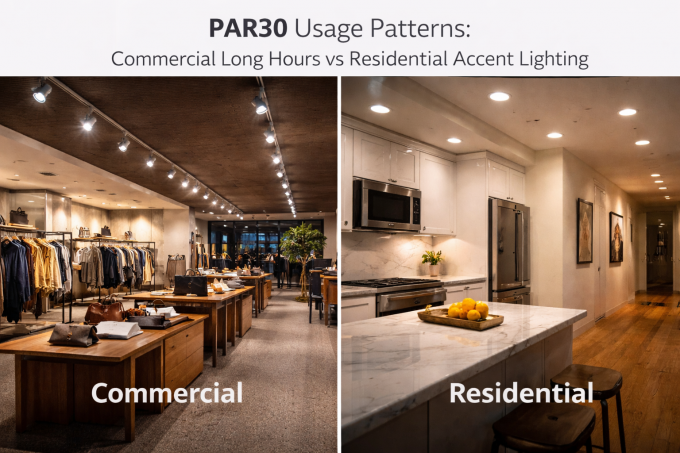
Operating hours change how energy efficiency should be evaluated.
PAR30 LED bulb efficiency must be judged against usage patterns, not just wattage.
Commercial operating reality
Commercial PAR30 LED bulbs often run:
- 8–14 hours per day
-
6–7 days per week
This makes:
more important than minimal upfront cost.
Residential operating reality
Residential PAR30 usage is often:
- shorter daily duration
-
more intermittent
-
behavior-dependent
Efficiency still matters, but lifetime stress is lower.
Why this affects specification
A PAR30 LED bulb that performs well at home may fail prematurely in a commercial setting.
Commercial environments require:
Energy efficiency beyond watts
Efficiency also includes:
In commercial projects, these factors outweigh small wattage differences.
Buyer lesson
For PAR30 LED bulb for commercial lighting, durability and stability drive true efficiency.
For PAR30 LED bulb for residential lighting, comfort and flexibility often matter more.
Best Practice: Creating Separate PAR30 Specifications for Commercial and Residential Projects?
The most common mistake buyers make is trying to simplify too much.
Using one PAR30 LED bulb specification for both commercial and residential projects creates unnecessary risk.
Why one-size-fits-all fails
Commercial and residential environments differ in:
- expectations
-
operating patterns
-
tolerance for variation
One compromise specification rarely satisfies both.
Best practice approach
Professional buyers create:
Even if the housing looks identical, internal choices differ.
What should differ between specs
| Parameter |
Commercial PAR30 |
Residential PAR30 |
| Beam angle |
Controlled |
Wider |
| Color temperature |
Neutral / Daylight |
Warm |
| CRI focus |
Consistency |
Comfort |
| Driver margin |
High |
Moderate |
| Lifetime stress |
High |
Lower |
Inventory management concern
Some buyers worry this increases SKU count.
In practice, it reduces:
- complaints
-
returns
-
project rework
Which lowers total cost.
Long-term benefit
Separate specifications allow:
This approach reflects mature procurement, not complexity.
Final buyer mindset
PAR30 LED bulbs are not commodities.
They are application tools.
Choosing correctly once is cheaper than fixing mistakes later.
Conclusion
Choosing the right PAR30 LED bulb requires recognizing that commercial and residential lighting have different goals, usage patterns, and tolerance levels, and the best results come from creating separate, application-specific PAR30 specifications.
Teco supports B2B buyers and project professionals selecting PAR30 LED bulb solutions tailored for both commercial and residential environments.
We help with:
- PAR30 LED bulb for commercial lighting programs
-
PAR30 LED bulb for residential lighting optimization
-
PAR30 beam angle selection and color temperature planning
-
long-term, stable PAR30 supply for differentiated markets
Our focus is on helping buyers reduce complaints, control operating cost, and build lighting product lines that actually fit their applications.
Email: [email protected]
Website: www.tecolite.com
Tell me your project type and usage scenario.
I will help you define the right PAR30 specification before problems appear.


 Your message must be between 20-3,000 characters!