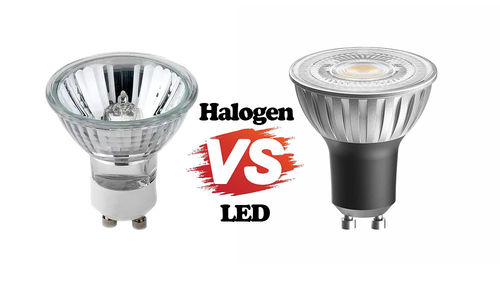
Choosing between GU10 LED and halogen bulbs is a common dilemma for homeowners, business owners, and lighting professionals. Both technologies have their strengths, but they differ significantly in energy efficiency, brightness, lifespan, and practical applications. This comprehensive guide will help you understand the key differences and make an informed decision for your lighting needs.
What Are GU10 Bulbs?
GU10 bulbs are a popular spotlight type featuring a twist-and-lock base with two pins spaced 10mm apart. They are widely used in:
Both LED and halogen GU10 bulbs offer focused lighting, making them ideal for accent, task, or ambient illumination.
**
**
Energy Efficiency Comparison
LED: The Clear Winner in Efficiency
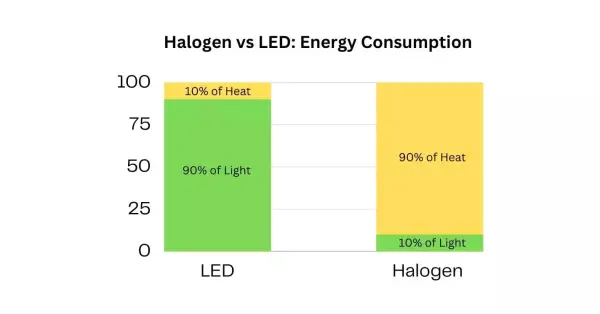
- LEDs convert 80-90% of energy into light rather than heat.
-
Typical GU10 LED bulbs produce 75-200 lumens per watt.
-
A 5W GU10 LED matches the brightness of a 50W halogen bulb.
-
Annual running cost for a 5W LED (8 hours/day): approximately £2.
Halogen: High Energy Consumption
-
Halogen bulbs convert only 20% of energy into light; the rest becomes heat.
-
Typical GU10 halogen bulbs produce 16-25 lumens per watt.
-
A 50W halogen is needed to match a 5W LED’s output.
-
Annual running cost for a 50W halogen (8 hours/day): approximately £11.
**
**
Brightness and Light Quality
Brightness Output
Despite lower wattage, modern GU10 LEDs can easily match or exceed the brightness of halogen bulbs.
| Bulb Type |
Wattage |
Lumens |
Efficiency (lm/W) |
Halogen Equivalent |
| LED |
4.5W |
345 |
77 |
50W |
| LED |
6.2W |
575 |
93 |
80W |
| Halogen |
35W |
300 |
8.6 |
– |
| Halogen |
50W |
400 |
8 |
– |
Light Quality Factors
- Color Rendering Index (CRI): Halogen bulbs have a CRI near 100 (excellent color accuracy). Quality LEDs achieve CRI between 80 and 98.
-
Color Temperature: LEDs cover a wide range (2700K-5000K+), while halogens are typically warm (2700K-3000K).
-
Beam Angle: LEDs offer a variety of beam angles (36°-60°), while halogens are usually around 36°.
-
Instant Brightness: LEDs reach full brightness instantly; halogens have minimal warm-up time.
Lifespan and Maintenance
Dramatic Difference in Longevity
-
GU10 LED: 15,000–50,000 hours (15–50 years at 3 hours/day)
-
GU10 Halogen: 1,000–2,000 hours (1–2 years at 3 hours/day)
This means fewer replacements and lower maintenance costs with LEDs, especially in hard-to-reach fixtures.
| Comparison |
GU10 Halogen Bulb |
GU10 LED Bulb |
| Average Lifespan |
800–2,000 hours |
25,000–40,000 hours |
| Replacement Rate |
High |
Low |
| Heat Output |
High |
Low |
| Maintenance Cost |
High |
Low |
| Energy Saving Effect |
Low |
High (saves about 75%–80%) |
Cost Analysis: Upfront and Long-Term
Initial Investment
5-Year Total Cost (Per Bulb, Including Purchase and Energy)
| Bulb Type |
Initial Cost |
Replacements |
Energy Cost |
5-Year Total |
| GU10 LED |
£8 |
£0 |
£10 |
£18 |
| GU10 Halogen |
£3 |
£9 |
£55 |
£67 |
While LEDs cost more upfront, their efficiency and longevity result in significant savings within the first year.
Environmental Impact
Sustainability Considerations
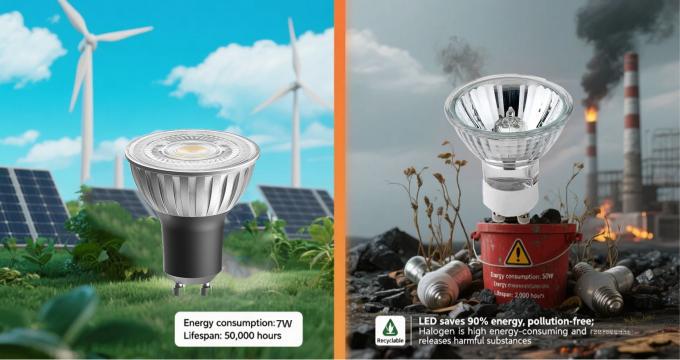
- Energy Consumption: LEDs use 80–90% less electricity, reducing carbon footprint.
-
Bulb Disposal: LEDs last longer, resulting in less waste, though they contain electronic components.
-
Heat Production: Halogen bulbs emit more heat, potentially increasing cooling costs.
-
Manufacturing Impact: LEDs have a higher initial manufacturing impact but a lower lifetime impact due to longevity.
**
**
Practical Applications
Where Each Technology Excels
GU10 LED
- Living Areas: Efficient lighting for daily use.
-
Offices: Flicker-free, consistent illumination.
-
Retail: Long-lasting, low-maintenance.
-
Outdoors: Weather-resistant options.
-
Smart Homes: Compatible with smart lighting systems.
GU10 Halogen
-
Art Displays: Superior color rendering for artwork.
-
Temporary Installations: When initial cost is the main concern.
-
Warm Ambiance: Ideal for restaurants or cozy spaces.
-
Photography Studios: Consistent color temperature.
Installation and Compatibility
-
Fixture Compatibility: Most GU10 fixtures accept both LED and halogen bulbs.
-
Dimmer Switches: Dimmable LEDs require compatible dimmers.
-
Heat Management: Halogen fixtures must tolerate higher temperatures.
-
Size Variations: Some LEDs may be slightly longer than halogens.
-
Voltage: Both operate on standard household voltage.
**
**
Brand Comparison
| Brand |
LED Price Range |
Notable Features |
Warranty |
| Philips |
£6–£10 |
High CRI, wide beam options |
5–7 years |
| Osram |
£5–£8 |
Energy efficient, good dimming |
3–5 years |
| Ikea |
£4–£7 |
Affordable, reliable |
2–3 years |
| GE Lighting |
£7–£12 |
Long lifespan, premium quality |
5–10 years |
| Teco |
£3–£6 |
High CRI, Affordable, good dimming |
3–5 years |
Frequently Asked Questions
Q: Can I replace halogen GU10 bulbs with LED directly?
A: Yes, most GU10 LEDs are designed as direct replacements and fit existing fixtures.
Q: Why do my LED GU10 bulbs flicker when dimmed?
A: Flickering usually occurs with incompatible dimmer switches. Use trailing-edge dimmers for best results.
Q: Are GU10 LEDs worth the higher price?
A: Yes. LEDs pay for themselves within 1–2 years through energy savings and reduced replacements.
Q: How do I know if my fixture is compatible with GU10 LEDs?
A: Most modern fixtures are compatible. Check the maximum wattage and ensure proper ventilation.
Q: What color temperature should I choose for my home?
A: Warm white (2700K–3000K) for living areas; cool white (4000K–5000K) for workspaces.
Conclusion
When comparing GU10 LED and halogen bulbs, the differences in energy efficiency, brightness, lifespan, and environmental impact are clear. For most modern applications, GU10 LEDs offer superior performance, significant cost savings, and greater versatility. However, halogen bulbs may still be preferred in specific scenarios where color rendering and initial cost are paramount.


 Your message must be between 20-3,000 characters!