.gtr-container-led-article-7f3d {
font-family: Verdana, Helvetica, “Times New Roman”, Arial, sans-serif;
color: #333;
line-height: 1.6;
padding: 15px;
max-width: 100%;
box-sizing: border-box;
overflow-x: hidden;
}
.gtr-container-led-article-7f3d * {
box-sizing: border-box;
}
.gtr-container-led-article-7f3d p {
margin-bottom: 1em;
text-align: left !important;
font-size: 14px;
}
.gtr-container-led-article-7f3d a {
color: #007bff;
text-decoration: none;
}
.gtr-container-led-article-7f3d a:hover {
text-decoration: underline;
}
.gtr-container-led-article-7f3d em {
font-style: italic;
font-size: 13px;
color: #666;
display: block;
margin-top: -0.5em;
margin-bottom: 0.5em;
}
.gtr-container-led-article-7f3d .gtr-title-h1 {
font-size: 18px;
font-weight: bold;
margin-bottom: 1.2em;
line-height: 1.3;
text-align: left;
}
.gtr-container-led-article-7f3d .gtr-title-h2 {
font-size: 17px;
font-weight: bold;
margin-top: 1.8em;
margin-bottom: 1em;
line-height: 1.4;
text-align: left;
}
.gtr-container-led-article-7f3d .gtr-title-h3 {
font-size: 16px;
font-weight: bold;
margin-top: 1.5em;
margin-bottom: 0.8em;
line-height: 1.5;
text-align: left;
}
.gtr-container-led-article-7f3d ul,
.gtr-container-led-article-7f3d ol {
list-style: none !important;
padding-left: 20px;
margin-bottom: 1em;
}
.gtr-container-led-article-7f3d ul li {
position: relative;
padding-left: 20px;
margin-bottom: 0.5em;
font-size: 14px;
list-style: none !important;
}
.gtr-container-led-article-7f3d ul li::before {
content: “⢔ !important;
position: absolute !important;
left: 0 !important;
color: #007bff;
font-size: 1.2em;
line-height: 1;
}
.gtr-container-led-article-7f3d ol {
counter-reset: list-item;
}
.gtr-container-led-article-7f3d ol li {
position: relative;
padding-left: 25px;
margin-bottom: 0.5em;
font-size: 14px;
list-style: none !important;
}
.gtr-container-led-article-7f3d ol li::before {
content: counter(list-item) “.” !important;
position: absolute !important;
left: 0 !important;
color: #007bff;
text-align: right;
width: 18px;
line-height: 1.6;
}
.gtr-container-led-article-7f3d table {
width: 100%;
border-collapse: collapse !important;
border-spacing: 0 !important;
margin-bottom: 1.5em;
font-size: 14px;
border: 1px solid #ccc !important;
}
.gtr-container-led-article-7f3d th,
.gtr-container-led-article-7f3d td {
padding: 10px 12px !important;
text-align: left !important;
vertical-align: top !important;
border: 1px solid #ccc !important;
word-break: normal;
overflow-wrap: normal;
}
.gtr-container-led-article-7f3d th {
font-weight: bold !important;
background-color: #f0f0f0;
}
.gtr-container-led-article-7f3d tbody tr:nth-child(even) {
background-color: #f9f9f9;
}
.gtr-container-led-article-7f3d .gtr-table-wrapper {
overflow-x: auto;
margin-bottom: 1.5em;
}
.gtr-container-led-article-7f3d .gtr-section-separator {
border-bottom: 1px solid #eee;
margin: 2.5em 0;
}
@media (min-width: 768px) {
.gtr-container-led-article-7f3d {
padding: 25px 40px;
max-width: 960px;
margin: 0 auto;
}
.gtr-container-led-article-7f3d .gtr-title-h1 {
font-size: 24px;
}
.gtr-container-led-article-7f3d .gtr-title-h2 {
font-size: 20px;
}
.gtr-container-led-article-7f3d .gtr-title-h3 {
font-size: 18px;
}
.gtr-container-led-article-7f3d .gtr-table-wrapper {
overflow-x: visible;
}
}
Global Supply Chain Shifts in LED Manufacturing: How Production and Trade Are Being Reshaped
Global LED supply chains are entering a period of structural change. For more than a decade, LED manufacturing followed a relatively predictable pattern: China dominated component production and final assembly, while markets such as North America, Europe, the Middle East, and Southeast Asia served as consumption centers.
Today, geopolitical uncertainties, rising labor costs, shifting trade policies, and post-pandemic supply chain rebalancing are reshaping where LED products are designed, manufactured, and shipped. For wholesalers, importers, contractors, and OEM/ODM buyers, understanding these shifts is essential for making stable sourcing decisions and securing long-term supply reliability.
This article examines the key forces driving global change, how regional roles are evolving, and what procurement leaders can do to build more resilient LED supply networks.
1. What Is Driving the Global Shift in LED Manufacturing?
The last five years introduced unprecedented volatility in global supply chains. LED manufacturing—deeply dependent on cross-border flows of chips, phosphors, PCBs, drivers, and packaging—has been significantly affected.
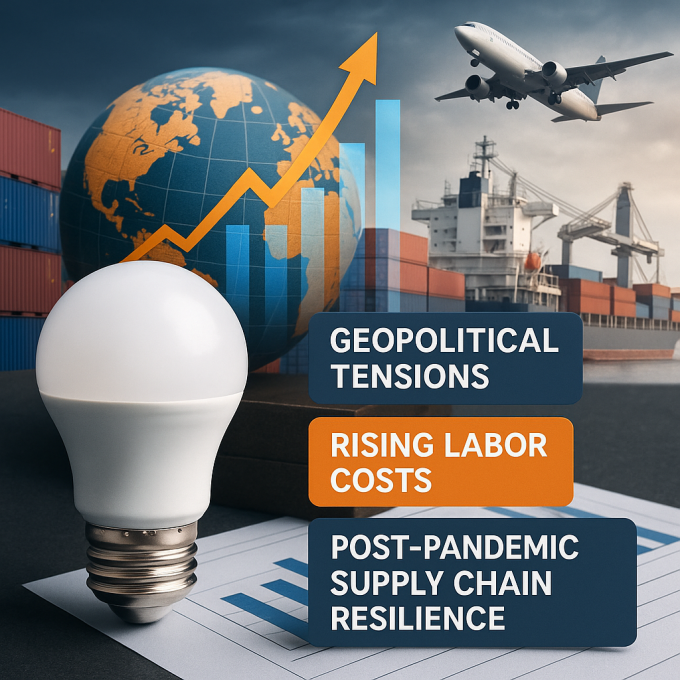
1.1 Geopolitical Tensions and Trade Policies
Tariff policies and export regulations have reshaped cost structures.
- The U.S.–China tariff rounds beginning in 2018 placed additional duties on a wide list of LED products and electronic components.
Source: U.S. International Trade Commission
https://www.usitc.gov/
Export controls on semiconductor-related technologies, announced in 2022–2023, increased uncertainty for chip-level supply.
Source: U.S. Department of Commerce
https://www.commerce.gov/
These measures have encouraged manufacturers to distribute production across multiple regions to reduce geopolitical exposure.
1.2 Rising Labor Costs in Traditional LED Hubs
Labor costs in China, Malaysia, and Thailand have steadily increased over the past decade.
- China’s manufacturing wages grew by more than 80% between 2012 and 2022.
Source: International Labour Organization
https://www.ilo.org/
Vietnam’s wages rose approximately 7–8% annually from 2015 to 2022.
Source: Asian Development Bank
https://www.adb.org/
For labor-intensive LED assembly (e.g., bulb assembly, driver soldering, manual testing), these increases push companies to evaluate alternative hubs.
1.3 Post-Pandemic Supply Chain Resilience
COVID-19 highlighted the risks of geographic concentration.
- Global container shipping prices surged 300–400% in 2021.
Source: UNCTAD Maritime Transport Report
https://unctad.org/
Average lead times for electronic components extended from 6–8 weeks to 12–20+ weeks during peak disruption.
Source: OECD Supply Chain Indicator
https://www.oecd.org/
This prompted LED brands, electrical distributors, and contractors to diversify sourcing to avoid future bottlenecks.
1.4 Demand Shifts Toward Energy-efficient Technology
Energy-efficiency policies worldwide (EU Ecodesign, DOE standards, Middle East ESMA regulations) have accelerated demand for high-performance LED products, increasing the need for more sophisticated supply chain structures.
2. China’s Evolving Role in Global LED Production
China remains the center of global LED manufacturing, but its role is transitioning.
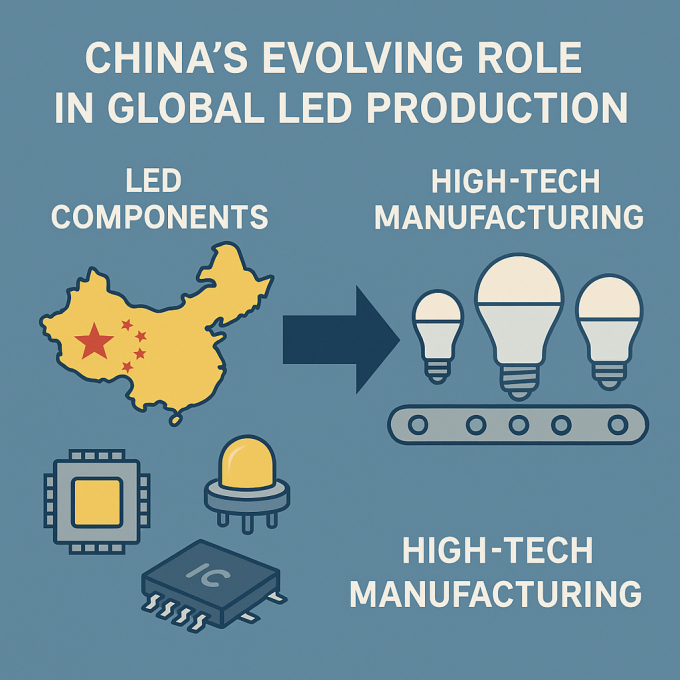
2.1 Still the Global Backbone for LED Components
China accounts for the majority of upstream LED component production:
| Segment |
China’s Share |
Source |
| LED chips |
~70% |
WSTS (World Semiconductor Trade Statistics) |
| LED packages |
~75% |
Statista LED Market Report |
| Driver IC assembly |
60–70% |
IC Insights |
Links:
https://www.statista.com/
https://www.icinsights.com/
This dominance ensures that China will remain essential for high-value components such as COB modules, mid-power LEDs, and ICs.
2.2 Shift From Low-cost Assembly to High-tech Manufacturing
Policy initiatives such as Made in China 2025 encourage producers to move toward:
As a result, some lower-margin assembly operations are migrating to Southeast Asia, leaving China focused on efficiency and technological leadership.
2.3 Impact for Overseas Buyers
For importers in Europe or the Middle East, China remains the primary source for:
However, buyers increasingly pair Chinese components with final assembly in other regions to reduce tariff and logistics risks.
3. Southeast Asia and India: The Emerging Alternative Hubs
Southeast Asia and India are now key beneficiaries of supply chain diversification.
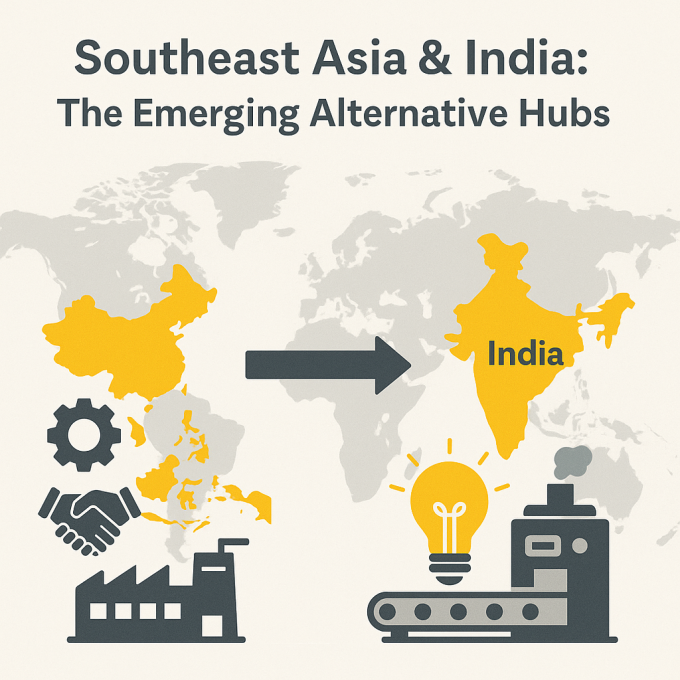
3.1 Why Southeast Asia Is Growing
Countries like Vietnam, Malaysia, and Thailand are becoming LED assembly hubs due to:
- competitive wages
-
free trade agreements (ASEAN, RCEP)
-
proximity to Chinese component suppliers
-
government incentives for electronics manufacturing
Vietnam’s electronics exports grew at a CAGR of 16% from 2010–2023, reflecting strong industrialization.
Source: World Bank
https://data.worldbank.org/
In LED applications, Southeast Asia is now widely used for:
3.2 India’s Expanding Manufacturing Ecosystem
India’s “Production Linked Incentive (PLI)” scheme supports domestic electronics manufacturing.
India is strong in:
However, India still relies heavily on imported LED chips and driver components.
3.3 How These Regions Compare
| Factor |
China |
Southeast Asia |
India |
| Component ecosystem |
Very strong |
Moderate |
Limited |
| Labor cost |
Medium-high |
Low-medium |
Low |
| Export reliability |
High |
High |
Moderate |
| Best for |
High-tech LEDs |
Mid-range lighting |
High-volume basic lighting |
4. Growing Trend Toward Nearshoring and Regional Production
To reduce risks, many lighting companies now localize part of their production.
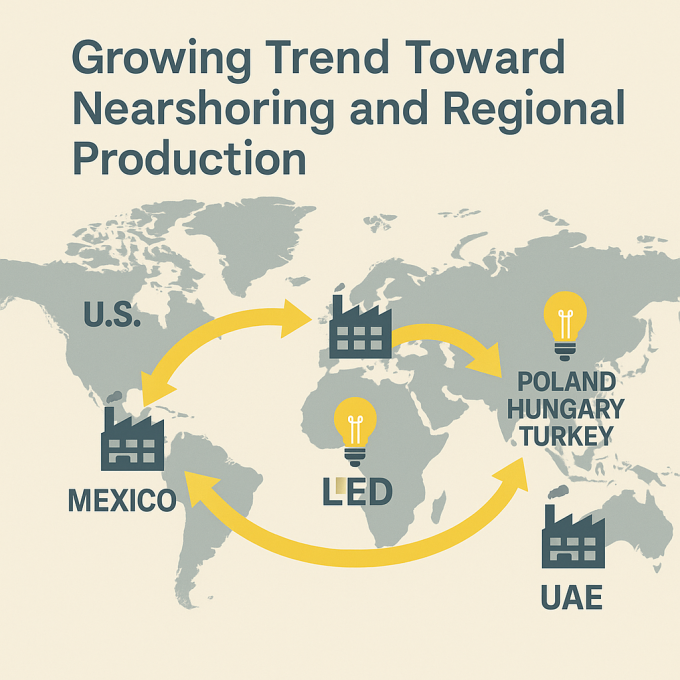
4.1 Examples of Nearshoring
- U.S. buyers shifting final assembly to Mexico or the U.S.
-
European brands producing bulk assembly in Poland, Hungary, or Turkey
-
Middle Eastern suppliers sourcing partially from the UAE and Turkey to shorten lead times
Nearshoring has become attractive because:
- shipping times decrease from 25–40 days to 5–10 days
-
tariff exposure is reduced
-
after-sales support improves
-
MOQs become more flexible
4.2 Nearshoring Does Not Replace China
Nearshoring often focuses on:
- packaging
-
driver casing assembly
-
local certification
-
last-mile customization
while still relying on Chinese upstream components.
5. Supply Chain Bottlenecks Affecting LED Components
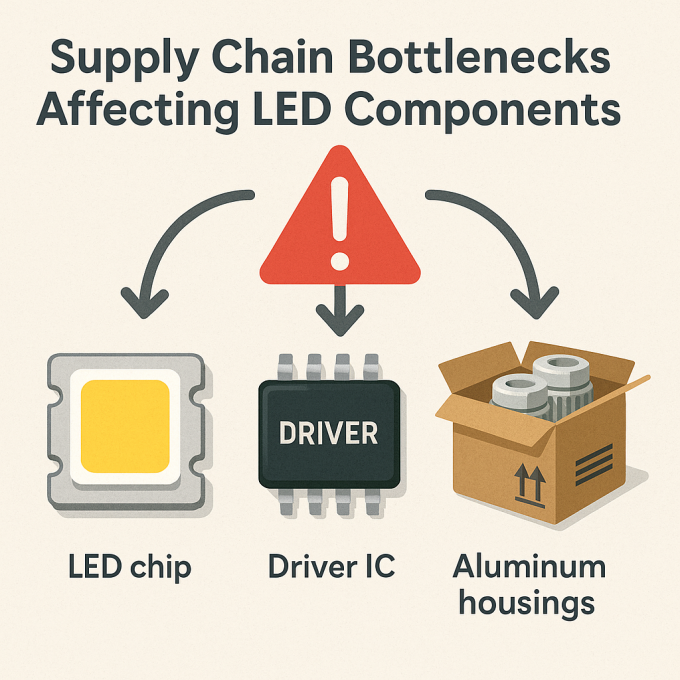
5.1 Driver IC Shortages
Driver ICs remain a global bottleneck because semiconductors are shared across automotive, consumer electronics, and LED applications.
During peak shortages, lead times for driver ICs extended to:
5.2 Logistics Disruptions
Global freight remains volatile:
- Container rates rose significantly during 2021–2022, then partially normalized in 2023–2024.
Source: Drewry Shipping Index
https://www.drewry.co.uk/
Such fluctuations affect LED shipping costs and lead-time predictability.
5.3 Raw Material Volatility
Materials such as aluminum, copper, and rare earth phosphors experienced price volatility due to mining and geopolitical constraints.
This affects:
- heat-sink costs
-
PCB production
-
LED phosphor composition
6. How These Shifts Are Reshaping Global LED Trade Flows
6.1 Redistribution of Export Routes
WTO trade data indicates:
A corresponding increase in Southeast Asian re-exports, especially from Vietnam, Malaysia, and Thailand.
6.2 Increased Complexity in Compliance
Different regions enforce:
- RoHS (EU)
-
ERP and Ecodesign (EU)
-
UL/ETL (U.S.)
-
SASO/ESMA (Middle East)
This increases documentation and certification requirements for importers.
6.3 Stable but More Distributed Supply
Rather than relying on a single hub, supply is now balanced across:
- China (components & advanced LEDs)
-
Southeast Asia (assembly)
-
India (high-volume basics)
-
Regional hubs (final assembly/customization)
7. Strategies for Businesses to Mitigate LED Supply Risks
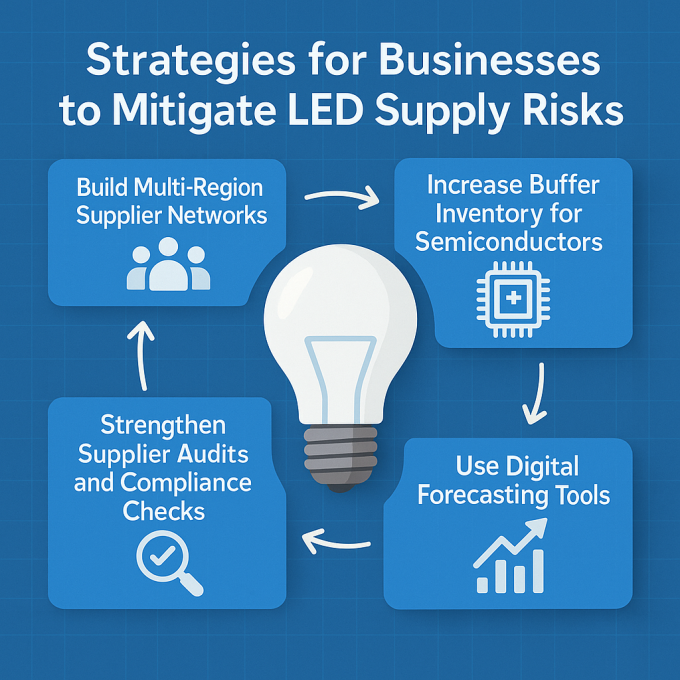
To navigate the new environment, organizations must adopt more robust procurement strategies.
7.1 Build Multi-Region Supplier Networks
Diversify by combining:
7.2 Increase Buffer Inventory for Semiconductors
Keep 4–8 weeks of driver ICs for stable production during global fluctuations.
7.3 Strengthen Supplier Audits and Compliance Checks
Regular audits help validate:
- production capacity
-
certification validity
-
environmental compliance
-
supply continuity plans
7.4 Use Digital Forecasting Tools
ERP and AI-based forecasting can help anticipate:
Conclusion
The global LED supply chain is undergoing a broad reconfiguration shaped by geopolitical shifts, rising costs, regional incentives, and the need for resilience. China remains the backbone of LED components, but Southeast Asia, India, and nearshore markets now play growing roles in assembly and final production.
For wholesalers, contractors, and procurement teams, the new landscape presents both challenges and opportunities. Organizations that diversify sourcing, deepen supplier partnerships, and apply data-driven forecasting will secure more stable, cost-effective, and resilient LED supply chains for the years ahead.


 Your message must be between 20-3,000 characters!