.gtr-container-ledcomp-7f3d9a {
font-family: Verdana, Helvetica, “Times New Roman”, Arial, sans-serif;
color: #333;
line-height: 1.6;
padding: 15px;
box-sizing: border-box;
max-width: 100%;
overflow-x: hidden;
}
.gtr-container-ledcomp-7f3d9a p {
margin-bottom: 1em;
text-align: left !important;
font-size: 14px;
}
.gtr-container-ledcomp-7f3d9a .gtr-title {
font-size: 18px;
font-weight: bold;
margin-bottom: 1.5em;
color: #0056b3;
text-align: left;
}
.gtr-container-ledcomp-7f3d9a .gtr-section-title {
font-size: 18px;
font-weight: bold;
margin-top: 2em;
margin-bottom: 1em;
color: #0056b3;
text-align: left;
}
.gtr-container-ledcomp-7f3d9a .gtr-divider {
border-top: 1px solid #eee;
margin: 2em 0;
}
.gtr-container-ledcomp-7f3d9a blockquote {
margin: 0 0 1em 20px;
padding-left: 15px;
border-left: 4px solid #007bff;
color: #555;
font-style: italic;
font-size: 14px;
}
.gtr-container-ledcomp-7f3d9a ul,
.gtr-container-ledcomp-7f3d9a ol {
margin: 0 0 1em 0;
padding: 0;
list-style: none !important;
}
.gtr-container-ledcomp-7f3d9a li {
list-style: none !important;
position: relative;
padding-left: 25px;
margin-bottom: 8px;
font-size: 14px;
text-align: left;
}
.gtr-container-ledcomp-7f3d9a ul li::before {
content: "â¢" !important;
position: absolute !important;
left: 0 !important;
color: #007bff;
font-weight: bold;
font-size: 16px;
line-height: 1;
}
.gtr-container-ledcomp-7f3d9a ol {
counter-reset: list-item;
}
.gtr-container-ledcomp-7f3d9a ol li {
counter-increment: none;
list-style: none !important;
}
.gtr-container-ledcomp-7f3d9a ol li::before {
    content: counter(list-item) "." !important;
    position: absolute !important;
    left: 0 !important;
    color: #007bff;
    font-weight: bold;
    width: 18px;
    text-align: right;
    font-size: 14px;
    line-height: 1.6;
}

.gtr-container-ledcomp-7f3d9a a {
    color: #007bff;
    text-decoration: none;
}

.gtr-container-ledcomp-7f3d9a a:hover {
    text-decoration: underline;
}

.gtr-container-ledcomp-7f3d9a .gtr-table-wrapper {
    overflow-x: auto;
    margin-bottom: 1em;
}

.gtr-container-ledcomp-7f3d9a table {
    width: 100%;
    border-collapse: collapse !important;
    border-spacing: 0 !important;
    margin-bottom: 1em;
    font-size: 14px;
    border: 1px solid #ccc !important;
}

.gtr-container-ledcomp-7f3d9a th,
.gtr-container-ledcomp-7f3d9a td {
    padding: 10px !important;
    text-align: left !important;
    vertical-align: top !important;
    border: 1px solid #ccc !important;
    word-break: normal;
    overflow-wrap: normal;
}

.gtr-container-ledcomp-7f3d9a th {
    font-weight: bold !important;
    color: #333;
}

.gtr-container-ledcomp-7f3d9a tbody tr:nth-child(even) {
    background-color: #f9f9f9;
}

@media (min-width: 768px) {
    .gtr-container-ledcomp-7f3d9a {
        padding: 25px 50px;
        max-width: 960px;
        margin: 0 auto;
    }

    .gtr-container-ledcomp-7f3d9a .gtr-title {
        font-size: 24px;
    }

    .gtr-container-ledcomp-7f3d9a .gtr-section-title {
        font-size: 20px;
    }
}
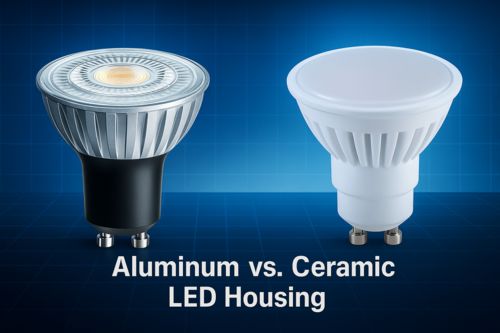
Exploring Aluminum vs. Ceramic Housings for Long-Life LED Bulbs
Introduction
In the commercial and industrial lighting space, the housing or enclosure of an LED bulb far exceeds mere aesthetics—it’s a key enabler of performance, reliability, lifespan and total cost of ownership. Two of the dominant materials for LED bulb housings are aluminum and ceramic. While each has its merits, the right choice depends on application-specs, thermal management demands, environmental exposure and cost constraints.
For lighting OEMs, specifiers and facility managers selecting LED bulbs for long-life performance (10 + years, high duty-cycles) it is crucial to understand how housing material influences heat dissipation, mechanical robustness, maintenance intervals and end-user satisfaction. This article dives deep into the comparison between aluminum and ceramic housings, highlighting strengths, trade-offs and criteria to guide your next lighting rollout.
Why Housing Material Matters for LED Lifespan
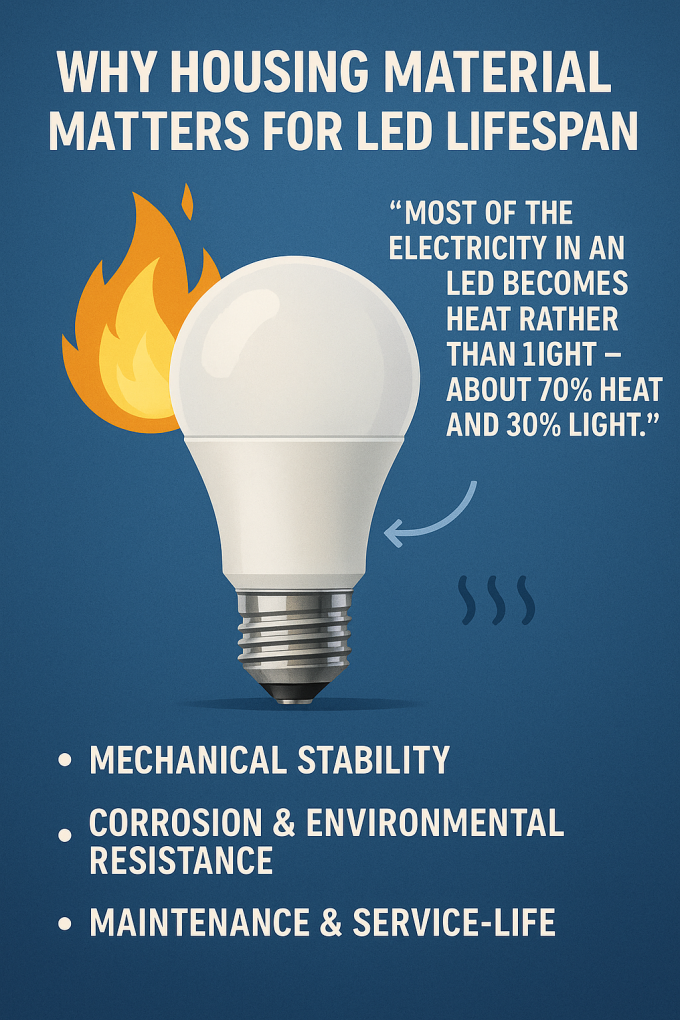
LED technology is significantly more efficient than traditional lighting, yet a substantial portion of energy still converts into heat inside the device. As one summary puts it:
“High power light-emitting diodes … most of the electricity in an LED becomes heat rather than light – about 70% heat and 30% light.” (ç»´åºç¾ç§)
Excess heat raises the junction and phosphor temperatures, accelerating lumen depreciation, color shift and overall failure. Housing material plays a vital role in conducting and dissipating that heat out of the LED module and into the ambient. (å¤éç¯é¥°å±è§ä¼)
Additionally, housing material affects:
- Mechanical stability (vibration, thermal expansion)
-
Corrosion and environmental resistance (e.g., outdoor or harsh conditions)
-
Weight, cost and design flexibility
-
Maintenance and service-life of the LED installation
Thus, choosing the optimal material is not just a manufacturing detail—it shapes the lifetime economics of your lighting system.
Key Properties: Aluminum vs. Ceramic
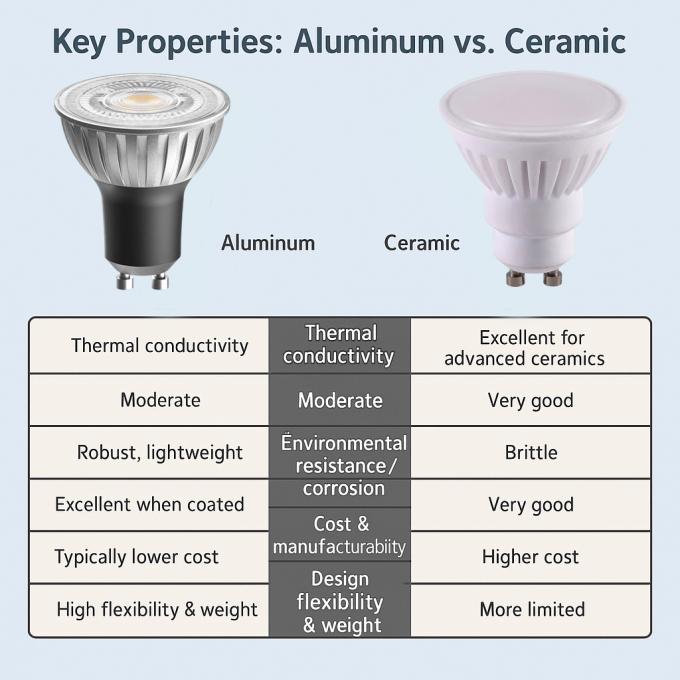
Here’s a summary comparison of core material attributes relevant to LED housings.
| Property |
Aluminum Housing |
Ceramic Housing |
| Thermal conductivity |
Very high (≈ 200-240 W/m·K for typical alloys) (å®æµ©æ±½è½¦é
件) |
Excellent for advanced ceramics; typical alumina or AlN ceramics can reach > 20-200 W/m·K in substrate form (Benwei Light) |
| Thermal expansion match to LED module |
Moderate; mismatches possible; supports heat sink fins and large surface area |
Very good match to ceramic chip substrates; low expansion helps high-power modules (Rice Lighting) |
| Mechanical strength & durability |
Robust, lightweight, well-understood fabrication (die cast, extrusion) (Neway Custom Parts Manufacturer) |
More limited in complex large shapes; heavier or thicker parts may be needed |
| Environmental resistance / corrosion |
Excellent when anodized or coated; good outdoor suitability (Neway Custom Parts Manufacturer) |
Higher cost; more challenging to mold or cast large complex forms |
| Cost & manufacturability |
Typically lower cost; mature manufacturing |
More limited in complex large shapes; heavier or thicker parts may be needed |
| Design flexibility & weight |
High flexibility in shapes, fins, profiles; lightweight |
More limited in complex large shapes; heavier or thicker parts may be needed |
Thermal Management: The Critical Factor
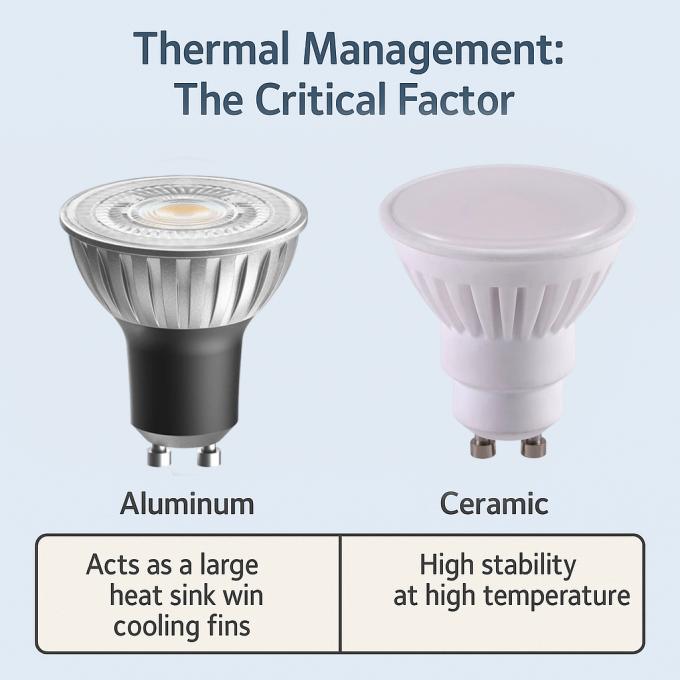
A key driver for housing material choice is how well it manages heat. Let’s examine how aluminum vs ceramic perform in real-world terms.
Aluminum:
- With its high thermal conductivity, aluminum housings often act as large heat sinks, with fins or ribs to increase surface area and convective cooling. (å®æµ©æ±½è½¦é
件)
-
Die-cast aluminum housings for outdoor LED luminaires frequently include features like integrated heat-sink fins, pre-anodized surfaces for corrosion resistance, and optimized wall thickness. (Neway Custom Parts Manufacturer)
-
One article states: “As explained … research data shows … the service life of LED lighting depends so much on the environmental temperature of LED lighting. Higher working temperature means a shorter lifespan.” (ç±åºå°å
ç
§æ)
Ceramic:
- Ceramic materials (e.g., alumina AlâOâ, aluminum nitride AlN) offer excellent stability at high temperature and can minimize thermal impedance between the junction and ambient. For instance: replacement of plastic mould to ceramic mould for LED packages decreased thermal resistance from 76.1 °C/W to 45.3 °C/W. (arXiv)
-
Ceramic’s lower coefficient of thermal expansion helps avoid mechanical stress at high power densities. (Rice Lighting)
-
However, ceramics are less often used for large form-factor housings because of brittleness and higher manufacturing cost.
What it means for lifespan
Studies suggest that for every 10 °C reduction in LED junction temperature, one can double the lifetime of the LED module. (Rice Lighting) Since the housing contributes significantly to junction cooling, material choice is fundamental.
Application Scenarios: Where Each Material Shines
To help guide decision-making, here are typical use-cases for each material.
When to choose Aluminum Housing
- Medium to high-power LED bulbs (e.g., >10 W) used in general lighting, commercial downlights, outdoor floodlights
-
Environments where assembly cost, weight, design flexibility (fins, extrusions) matter
-
Situations where fixture must act as heat sink itself (integration into building systems)
-
Budget-sensitive roll-outs with strong manufacture maturity
When to choose Ceramic Housing
- High-power LEDs in challenging thermal or harsh environments: e.g., industrial warehouse high bay, street lights, automotive headlamps
-
Applications demanding ultra-long lifespan (≥50,000 h) and minimal maintenance
-
Environments with high ambient temperature, humidity, corrosive chemicals or thermal cycling
-
Niche, premium lighting where cost and weight are less constrained
Trade-offs & Considerations
While both materials are excellent, some trade-offs must be weighed.
Cost vs performance
Ceramic can cost significantly more in both materials and tooling. If the extra lifetime or durability doesn’t translate into measurable payoff, aluminum may be a more economical choice.
Manufacturability & complexity
Aluminum is easier to die-cast, extrude, machine and finish. Ceramic requires more advanced moulding or sintering, and care in mounting to avoid cracking or delamination. (arXiv)
Mechanical robustness
Aluminum is more forgiving to impacts, vibrations and installation handling. Ceramic, while stable thermally, is brittle and may fracture if mishandled.
Weight & design flexibility
Aluminum allows more complex shapes, integrated heatsinks, fins and lighter weight. Ceramic may require bulkier design to provide equivalent structural strength.
Electrical considerations
Ceramic is non-conductive, which can simplify insulation design and reduce risk of shorting. Aluminum is conductive, so designers need to ensure proper isolation. For example, in some LED lamp-holder articles, ceramic holders offer max operating temp >300 °C, while thermoplastics only ~150 °C. (Benwei Light)
Real Data & Case Examples
- A housing materials analysis noted: “Research data shows … LED lighting’s luminous efficiency will reduce from 20% to 75% with the increase of the lighting temperature from 25 °C to 100 °C.” (ç±åºå°å
ç
§æ)
-
An article on aluminum housings: “Aluminum, with its high thermal conductivity and lightweight nature … provides an excellent medium for dissipating the heat generated by LED components.” (å®æµ©æ±½è½¦é
件)
-
While specific case studies for ceramic housings at large scale are less frequently publicised, the thermal and mechanical analysis for ceramic packaged LEDs indicate substantially reduced thermal resistance (from 76.1 °C/W to 45.3 °C/W) when shifting from plastic to ceramic mould. (arXiv)
These quantitative findings support the material-choice logic: housing that reduces junction/ambient thermal rise leads to longer life, better performance, fewer replacements and lower maintenance costs.
A Buying Checklist for LED Bulb Housings
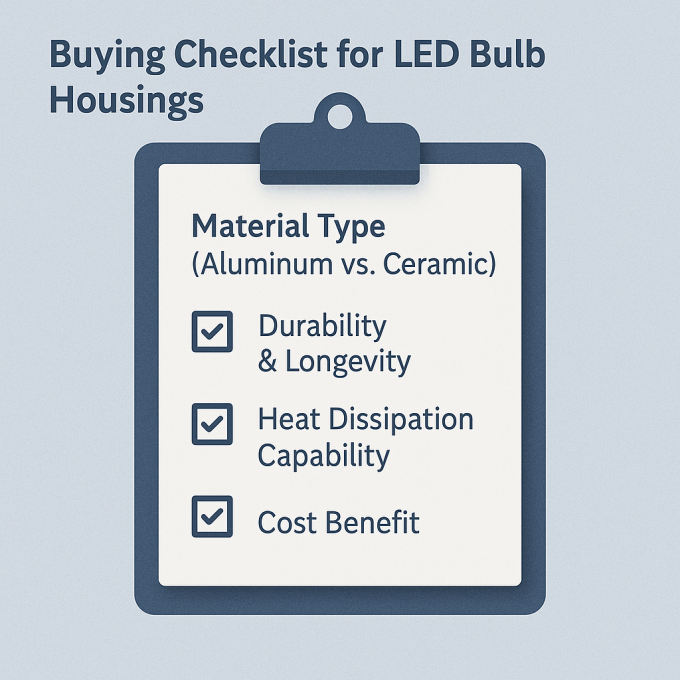
When evaluating LED bulbs for long-life applications (commercial offices, public infrastructure, industrial spaces), ask:
- What is the material of the housing/enclosure? – Aluminum alloy or ceramic?
-
How is heat drawn from LED junction to ambient? – Check thermal path, mounting, fins, surface area.
-
What is the operating ambient range? – If >40 °C ambient, ceramic may offer extra headroom.
-
Is the driver housing integrated? – Often aluminum helps with driver cooling too.
-
What is the expected lifespan (L70 or L80)? – Ensure housing supports that rating.
-
What environmental conditions apply? – Outdoor, humid, corrosive, dust-laden?
-
What is total cost of ownership? – Consider installation, maintenance, downtime, warranty.
-
What certifications exist? – Look for LM-80, LM-79, TM-21, and relevant fixture ratings.
Future Trends & Material Innovations
- Hybrid housings: Combining aluminum body with ceramic inserts or coatings to optimize thermal paths while controlling cost.
-
Advanced ceramics: Materials like aluminum nitride (AlN) with thermal conductivity > 160 W/m·K are emerging for premium outdoor lighting. (Semiconductorinsight)
-
Topology innovation: 3D-printed complex heat-sink geometries in aluminum, or ceramic micro-fin structures for compact high-power applications.
-
Sustainability: Recyclability of aluminum is excellent, and ceramic housings offer high stability and lifespan – both contribute to lower life-cycle footprint.
Summary & Recommendation
In summary:
- For most long-life LED bulb applications, aluminum housings provide a well-balanced mix of thermal performance, cost-effectiveness, manufacturability and reliability.
-
For demanding, high-power, harsh-environment or extreme-life-expectancy cases, ceramic housings offer thermal stability, mechanical robustness and longevity—but at higher cost and design complexity.
-
The right decision depends on your application environment, duty-cycle, ambient conditions and cost/maintenance strategy.
By choosing the correct housing material, you are not simply selecting a component—you’re specifying the thermal backbone that determines how many years your LED installation will perform with minimal maintenance.
If you’re developing or sourcing LED bulbs and are evaluating housing materials for long-life performance, our team at Tecolite (visit tecolite.com) can help you benchmark housing options, assess thermal modelling, and design cost-optimized durable LED solutions tailored to your facility or project. Contact us today to explore how we can support your next lighting deployment.


 Your message must be between 20-3,000 characters!