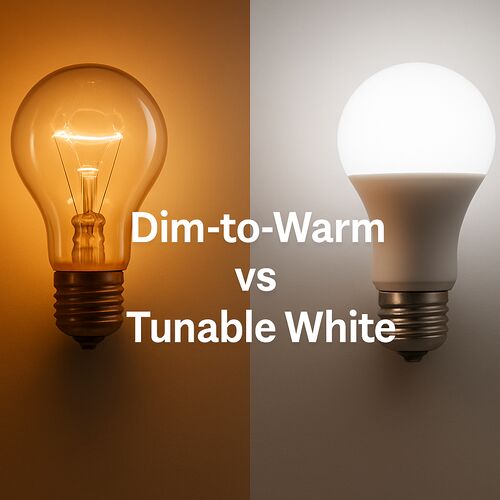
Lighting has evolved from a fixed-output utility into a controllable system that influences visual comfort, mood, circadian function, and brand experience.
Two technologies dominate the conversation: Dim-to-Warm and Tunable White.
They sound similar—both change color temperature—but they solve very different problems and deliver very different user experiences.
This article explains how each system works, what applications they are suited for, what engineering trade-offs they carry, and how specifiers should make decisions based on human perception, economics, and operational priorities.
1. Why Color Temperature Control Matters Today
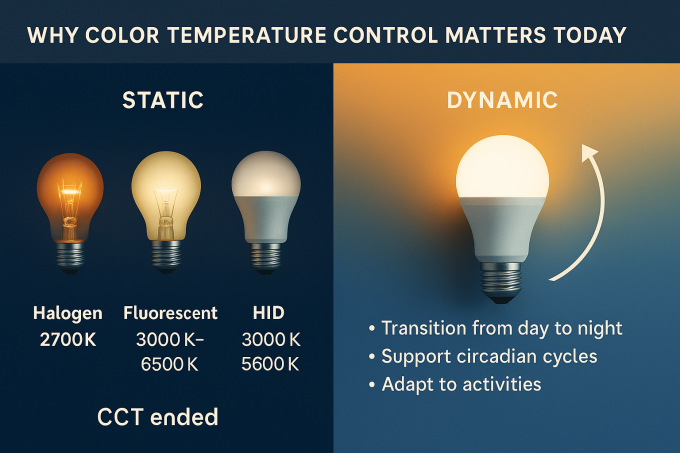
Historically, light sources had a fixed CCT:
- Halogen: 2700–3000K
-
Fluorescent: 3000–6500K
-
HID: 3000–5600K
LED disrupted this by enabling digital control of spectral output.
The shift wasn’t just aesthetic. It reflected three real industry demands:
Today, hospitality, residential, retail, and workplaces expect lighting to:
Static CCT cannot do this.
Dynamic CCT can.
But dynamic CCT is not one technology.
There are two fundamentally different approaches.
2. What Is Dim-to-Warm (Warm-Dimming)?
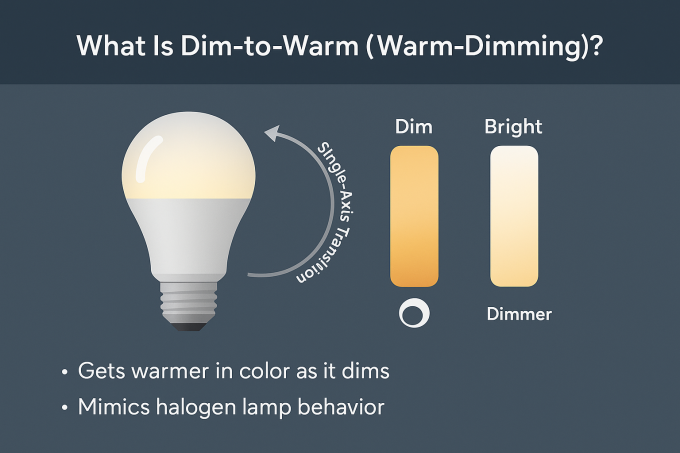
Dim-to-Warm mimics the behavior of halogen lamps:
as you dim the light, the color temperature gets warmer.
Typical range:
- Bright: 2700–3000K
-
Dim: 1800–2200K
Some premium systems go as low as 1600K.
This is a single-axis transition that follows a predefined curve.
Users do not control CCT directly—only brightness.
Color temperature changes automatically.
2.1 How Dim-to-Warm Works
A dim-to-warm LED uses two phosphor or diode channels:
- Cool/neutral channel
-
Warm/amber channel
As the driver reduces output, it shifts the balance toward the warm channel.
The user sees:
- Bright = neutral
-
Dim = warm and cozy
It creates a natural, intuitive dimming experience without control complexity.
2.2 What Dim-to-Warm Feels Like
The experience is closer to analog incandescent lighting:
- Softer
-
Calmer
-
Lower contrast
-
Low blue content
Humans perceive dim-to-warm as comfortable and emotional, not “technical”.
This is why it fits living spaces, restaurants, hotels, and hospitality.
2.3 Technical Advantages
| Benefit |
Value |
| Intuitive control |
No CCT settings, just dimming |
| Emotional experience |
Similar to firelight/halogen |
| Reliable driver behavior |
Fewer channel conflicts |
| Low blue light at low output |
Better evening comfort |
| Lower cost than tunable white |
Simpler architecture |
2.4 Limitations
| Limitation |
Impact |
| Single preset curve |
No customization |
| Limited CCT range |
Not suitable for high-CCT daylight scenes |
| Cannot support circadian protocols |
No automated CCT control |
| No “cool” output |
Not suitable for workspaces |
3. What Is Tunable White?
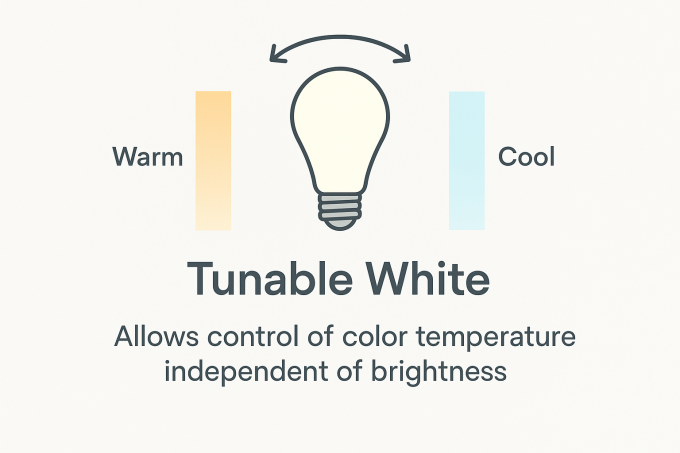
Tunable White (TW) allows independent control of color temperature regardless of brightness.
Typical range:
Users can adjust:
Tunable white requires:
This makes it a more powerful but more complex system.
3.1 What Tunable White Is Designed For
Tunable white enables lighting to adapt to:
- Circadian schedules
-
Task requirements
-
Aesthetic scenes
-
Architectural events
-
Brand experience
It is a dynamic visual tool, not just a mood tool.
Example use cases
- Day: 4000K for productivity
-
Evening: 3000K for relaxation
-
Presentation: 5000K for clarity
-
Dining: 2700K for ambience
Dim-to-warm cannot do this.
3.2 Technical Advantages
| Benefit |
Value |
| Wide CCT range |
Supports human-centric lighting |
| Independent control |
Flexible programming |
| Dynamic scenes |
Retail, office, museum |
| True circadian lighting |
Morning cool, evening warm |
| Architectural adaptability |
Design differentiation |
3.3 Limitations
| Limitation |
Impact |
| Higher cost |
Multi-channel + controls |
| More complex commissioning |
System design required |
| Risk of visual mismatch |
Poor mixing or calibration |
| User confusion |
Too many controls without UX design |
| Control compatibility issues |
Many dimmers incompatible |
4. Why People Confuse the Two
To people unfamiliar with lighting, both technologies look like:
“LEDs that change color temperature”
But the mechanisms and outcomes are fundamentally different.
| Feature |
Dim-to-Warm |
Tunable White |
| CCT control |
Automatic |
Manual / programmable |
| Dim effect |
Warmer |
Same or warmer |
| Range |
Limited |
Wide |
| Complexity |
Low |
High |
| Purpose |
Comfort |
Function + experience |
| Biology |
Partially supportive |
Fully supportive |
Dim-to-warm is a behavior.
Tunable white is a system.
5. Which One Looks More “Natural”?
Dim-to-warm almost always looks more natural because:
Tunable white looks technical, unless well-designed.
In high-end hospitality, designers often want lights to feel invisible:
Light should not call attention to itself.
Dim-to-warm achieves this elegantly.
6. Biological Impact: Which One Supports Circadian Health?
6.1 Dim-to-Warm
Supports evening biology, but not 24-hour health.
6.2 Tunable White
Supports research-backed circadian strategies, including:
- Office productivity
-
Sleep environments
-
Healthcare recovery
Summary
| Feature |
Dim-to-Warm |
Tunable White |
| Evening relaxation |
Excellent |
Good |
| Daytime stimulation |
Weak |
Excellent |
| Circadian alignment |
Partial |
Full |
| Human health strategy |
Limited |
Strong |
7. Energy and Driver Behavior
7.1 Dim-to-Warm
-
Typically uses triac or phase-cut dimmers
-
Stable performance with legacy hardware
-
Minimal flicker if engineered well
7.2 Tunable White
-
Requires digital or 0–10V / DALI DT8 controls
-
Higher risk of flicker or misconfiguration
-
Higher commissioning cost
Operationally, dim-to-warm is simpler and more deployable.
8. Economic Considerations
8.1 Capex (Upfront Cost)
| System |
Cost |
| Dim-to-Warm |
Low–Medium |
| Tunable White |
Medium–High |
8.2 Opex (Operational Cost)
| System |
Complexity |
| Dim-to-Warm |
Low |
| Tunable White |
Medium–High |
9. Best Applications for Each
9.1 Best for Dim-to-Warm
- Restaurants
-
Bars
-
Hotels
-
Lounge spaces
-
Residential
-
Cinemas
-
Spas
-
Retail dressing rooms
Design philosophy:
“Comfort, mood, and visual softness matter most.”
9.2 Best for Tunable White
- Offices
-
Schools
-
Hospitals
-
Museums
-
Galleries
-
Conference rooms
-
Retail chains
-
Experience centers
Design philosophy:
“Lighting must adapt to activity, time, or branding.”
10. Common Mistakes in Specification
10.1 Mistake 1 — Using Tunable White for Simple Projects
Results:
- Overcost
-
Underutilized features
-
Confused users
10.2 Mistake 2 — Using Dim-to-Warm in Workspaces
Results:
- Sleepiness
-
Low visibility
-
Poor task performance
10.3 Mistake 3 — Ignoring Beam and Optics
People obsess over CCT and forget optics.
Optics shape experience more than color.
11. How to Choose the Right Technology
11.1 Choose Dim-to-Warm if:
11.2 Choose Tunable White if:
-
Lighting must adapt
-
You need circadian support
-
You want programmable scenes
-
You design for commercial spaces
-
You want performance outcomes
12. Future Trends
-
Dual-engine spectrally optimized LEDs
-
Circadian standards (WELL, UL, DIN)
-
Low-blue workplace lighting
-
Adaptive hospitality environments
The industry is moving toward biologically meaningful control, not just visual preference.
Conclusion
Dim-to-warm and tunable white are both powerful technologies—but they are designed for different outcomes.
- Dim-to-warm delivers emotional, warm, halogen-like ambiance, ideal for hospitality and residential environments that prioritize comfort.
-
Tunable white delivers dynamic, programmable, performance-focused lighting, ideal for commercial spaces that need adaptability, productivity, and wellness support.
They are not substitutes.
They are tools for different problems.
The correct choice depends on purpose, people, and place, not just CCT ranges on a datasheet.
If you’re planning a project and need dim-to-warm or tunable white solutions with reliable drivers, high CRI, and OEM/ODM capability, Teco can help.
We support:
Contact: [email protected]
Website: tecolite.com
Share your application requirements or spec sheet—
we’ll help you select technology that fits human behavior, not just hardware specs.


 Your message must be between 20-3,000 characters!